
Forecasting Crude Oil: The Geopolitical Sentiment Signal
Forecasting Weekly Crude Oil Using Twitter Sentiment of U.S. Foreign Policy and Oil Companies Data
The paper introduces a novel machine learning framework for forecasting the weekly direction of WTI crude oil prices by leveraging Twitter sentiment. Specifically, it utilizes sentiment analysis and word frequency (e.g., "oil" and OPEC members) from the accounts of US foreign policy think tanks and major oil companies to achieve a Senti-SVM hybrid model that reaches a state-of-the-art 76.29% classification accuracy.
TL;DR
Predicting the price of oil has traditionally been a game of supply and demand numbers. However, a new study from the University of Cambridge and the University of Oulu suggests that the "vibe" of US foreign policy think tanks and oil companies on Twitter is a much more potent predictor. By analyzing sentiment and keyword frequency, researchers developed a model that predicts weekly price directions with 76.29% accuracy, identifying a critical 7-week lag between sentiment shifts and market impact.
Background: Beyond the Spreadsheet
Crude oil is the lifeblood of the global economy, yet its price is notoriously volatile. For decades, economists have looked at inventory levels (OECD data), production rates, and historical price points. While these quantitative metrics work for short-term "noise," they often miss the tectonic shifts caused by human factors: sanctions, legislative changes, and corporate posturing.
The authors of this paper argue that in the digital age, social media isn't just noise; it’s a repository of professional sentiment that precedes market movement.
Methodology: Mapping Sentiment to Market Reality
The research team built a sophisticated pipeline to transform raw tweets into actionable financial signals.
1. Data Source Selection
The authors didn't just look at "all" of Twitter. They hypothesized that only credible accounts matter. They filtered:
- US Foreign Policy (USFP): 76 top strategy think tanks (e.g., Brookings, CFR).
- Oil Companies (OC): 52 of the world's largest oil firms and associations (e.g., ExxonMobil, OPEC).
- Control Variable: Justin Bieber’s sentiment was used as a "sanity check" to ensure the model wasn't just finding patterns in random noise.
2. The 7-Week Discovery
By using the Granger Causality Test, a statistical method for determining if one time series can predict another, the researchers found a unique window. Sentiment changes in US foreign policy tweets don't hit the oil market instantly; they take roughly 7 weeks to manifest in WTI (West Texas Intermediate) prices.
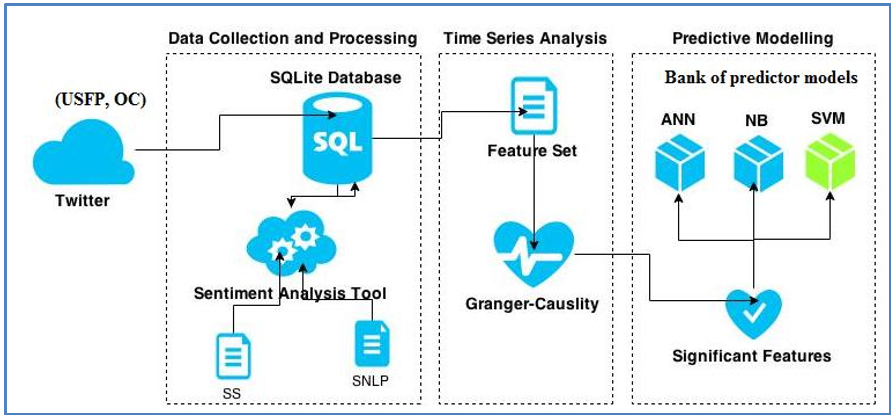 Figure 1: The architecture of the forecasting pipeline, from tweet extraction to majority voting.
3. Machine Learning Architecture
The model extracts features such as sentiment scores (via Stanford NLP and SentiStrength) and the frequency of keywords like "OPEC" and "Oil." These are fed into three main classifiers:
- Support Vector Machine (SVM)
- Naive Bayes
- Artificial Neural Networks (ANN)
The final decision is made via Majority Voting, where the model takes the consensus of these three systems.
Experiments and SOTA Results
The results were striking. While traditional models like the ARIMA or simple linear regression often hover around 50-65% accuracy for directional price shifts, this sentiment-driven model reached much higher levels.
| Model/Study | Accuracy (%) |
|---|---|
| Linear Regression (Chen, 2014) | 65.00% |
| ANFIS (Ghaffari & Zare, 2009) | 68.18% |
| Our Model (Majority Voting) | 76.29% |
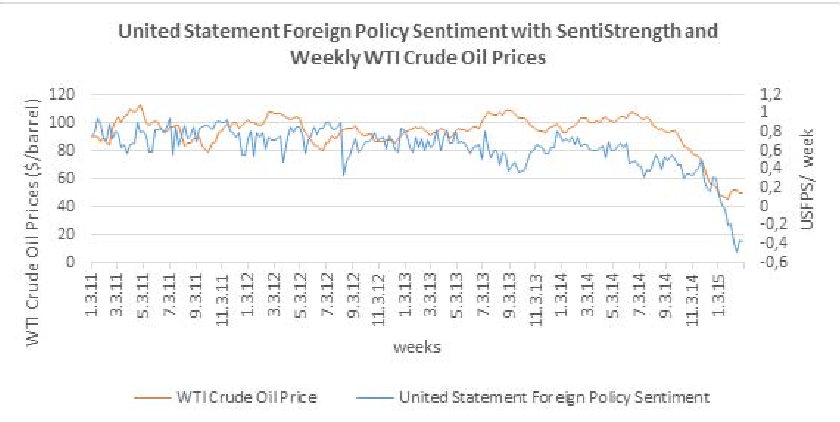 Figure 2: The visual correlation between US foreign policy sentiment and WTI Crude Oil prices, showing a clear tandem drop in late 2014.
The study also confirmed that SVM is the champion among individual classifiers, strike a superior balance between Precision and Recall. Interestingly, when "oil" is mentioned more frequently in a negative USFP context, it often precedes a price drop, allowing the model to anticipate the market long before the physical supply changes.
Critical Insight & Future Outlook
The core takeaway is that geopolitics has a measurable lead time. The 7-week lag identified by the authors aligns with the actual time it takes for threats of sanctions or policy changes to affect physical shipping and supply chains.
Limitations:
- Account Reliability: The model depends on the activity of a curated list of accounts. If these entities stop tweeting or change their communication style, the model needs retraining.
- Sentiment Nuance: While Stanford NLP is powerful, the subtleties of geopolitical "sarcasm" or complex diplomatic language can still result in errors.
Future Work: Integrating this data with other grades of oil (like Brent) and expanding the feature set to include real-time news headlines could further refine the accuracy. For traders and nations, this proves that the "Geopolitical Twitter-verse" is more than just social media—it's a critical financial indicator.