
Forensic NLP: Identifying Criminal Sentiment on Facebook with Naïve-Bayes
The Forensic Algorithm on Facebook Using Natural Language Processing
This paper introduces a forensic analysis framework for Facebook data using Natural Language Processing (NLP) to identify criminal behavior and negative sentiment. By employing a Naïve-Bayes classifier combined with keyword weight definitions, the system distinguishes between positive and negative social media posts to assist law enforcement in investigating computer-related crimes.
TL;DR
In the era of digital communication, social media has become a primary staging ground for both positive expression and criminal intent. This paper presents a specialized NLP forensic algorithm designed for Facebook. By leveraging a Naïve-Bayes classifier and a curated set of forensic keywords, the researchers successfully achieved a 90.89% accuracy in distinguishing between positive social contributions and potentially illegal negative sentiments.
Context & Motivation
Digital forensics is no longer limited to hard drive recovery; it now focuses on the "latent intent" found in social media feeds. The authors identify a critical gap: while social media usage in countries like Thailand is skyrocketing, the tools for police and legal investigators to systematically flag "computer crimes" (negative/illegal posts) are insufficient.
The core insight is that forensic analysis should not just be reactive. By creating a weighted keyword system that aligns with legal definitions of social harm, investigators can proactively identify risks to community peacefulness.
Methodology: The Forensic Pipeline
The authors propose a structured 6-step workflow to transform raw social media data into actionable legal evidence:
- API Data Extraction: Using Facebook APIs to collect user details and "Opinion Text" (posts/comments).
- Keyword Seeding: Defining 100 specific forensic keywords (50 positive, 50 negative).
- Weight Assignment: Assigning indices to these keywords to create an "Attribute" profile for every user.
- String Matching: Mapping real-world posts against the forensic dictionary.
- Naïve-Bayes Classification: The heart of the system. It calculates the posterior probability of a user belonging to the "Negative" (potentially criminal) or "Positive" class based on their word usage.
Architecture Overview
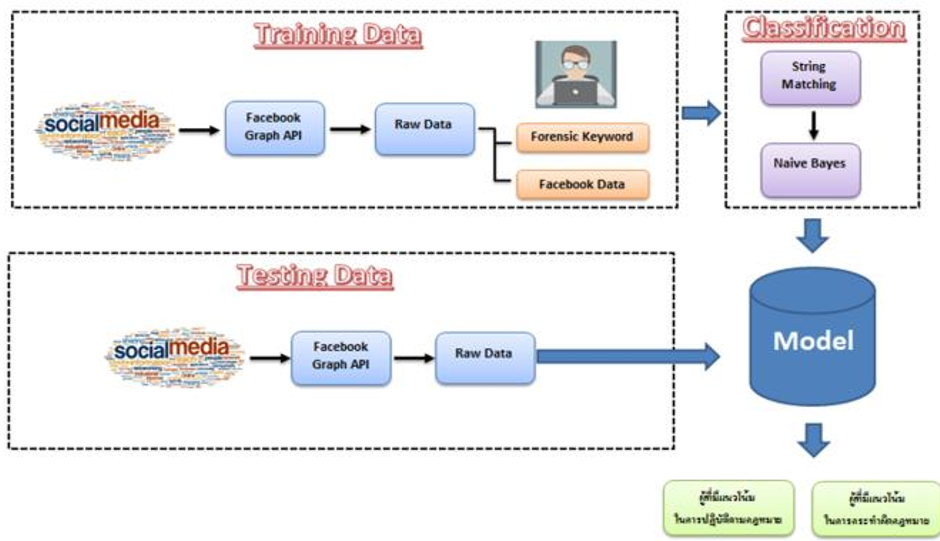 The process flow from data preparation to final forensic classification.
The Mathematical Edge: Why Naïve-Bayes?
Text data is notoriously sparse. Often, a specific "criminal" keyword might not appear in the training set for a specific class. To prevent the probability from dropping to zero and ruining the calculation, the authors utilized Laplace Smoothing. This ensures that the model remains robust even when faced with novel or rare forensic keywords.
Experimental Battleground: SOTA Comparison
The researchers didn't just test their model in a vacuum; they benchmarked it against four other common machine learning architectures using the same Facebook dataset.
| Model | Accuracy | Classification Error |
|---|---|---|
| Naïve Bayes | 90.89% | 9.11% |
| AutoMLP | 85.00% | 15.00% |
| SVM | 82.00% | 18.00% |
| KNN | 40.00% | 60.00% |
Analysis of Results
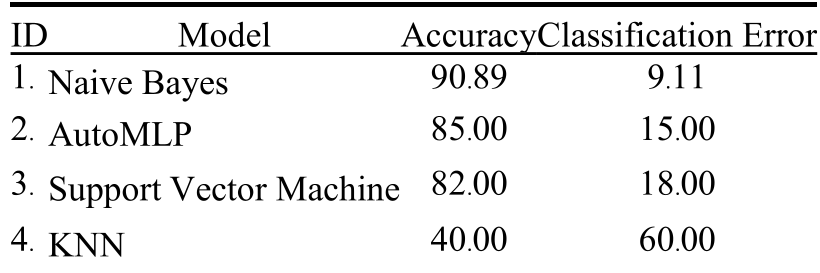 The comparison clearly shows Naïve Bayes outperforming complex models like SVM in this specific NLP task.
The significant failure of KNN (40%) suggests that the "distance" between positive and negative posts is not easily captured by simple spatial clustering, whereas the probabilistic nature of Naïve-Bayes captures the categorical weight of specific "illegal" keywords much more effectively.
Critical Insights & Future Outlook
Takeaway: This research highlights that for specialized domains like law enforcement, a domain-specific dictionary is often more valuable than the raw complexity of the algorithm. By curating keywords like "kill," "bomb," and "marijuana" vs. "kindness" and "thanks," the model gains a strong inductive bias that generic models lack.
Limitations:
- Dataset Size: The study was conducted on a relatively small sample of 100 accounts. Scaling this to millions would require more efficient indexing.
- Language Nuance: Sarcasm and slang (common in social media) still pose a significant challenge for keyword-based Naïve Bayes models.
Future Work: The next frontier for this forensic algorithm is the expansion into Multimodal Forensics—integrating the analysis of images and metadata alongside text to build a holistic profile of digital criminal behavior.