
Mind the Gap: Why We Forget Our Social Networks and Why It Matters
Forgetting in the recall-based elicitation of personal and social networks
This paper provides a comprehensive review of forgetting in recall-based elicitation of personal and social networks. It synthesizes literature comparing free recall against recognition and objective records, establishing that forgetting is a pervasive phenomenon across various social relations.
TL;DR
When we ask people who they know, they forget—a lot. This paper by Devon D. Brewer reveals that forgetting is a fundamental, non-trivial barrier in social network research. Across dozens of studies, respondents consistently failed to recall a significant portion of their ties, including close friends and frequent contacts. This "memory gap" isn't just a psychological curiosity; it fundamentally distorts our understanding of how information, support, and diseases move through society.
The "Sampling" Problem in Your Head
In academic research, we often treat an interview as a "census" of a person's life. If you ask a subject to name their friends, you assume the list they provide is the territory. However, as researcher Muriel Hammer noted in 1984—and Brewer reaffirms here—the persons recalled are merely a sample of the potential set.
The motivation for this meta-analysis was the realization that if this sample is biased (e.g., if we only remember people of a certain status or closeness), then our maps of social networks (graphs) are fundamentally broken.
Methodology: Measuring the Unremembered
To quantify the "invisible" parts of social networks, Brewer looks at three types of evidence:
- Recall vs. Recognition: Asking someone to list friends (Recall) vs. showing them a list of names and asking who they know (Recognition).
- Recall vs. Objective Records: Comparing a person's remembered interactions against hard data like email logs or attendance sheets.
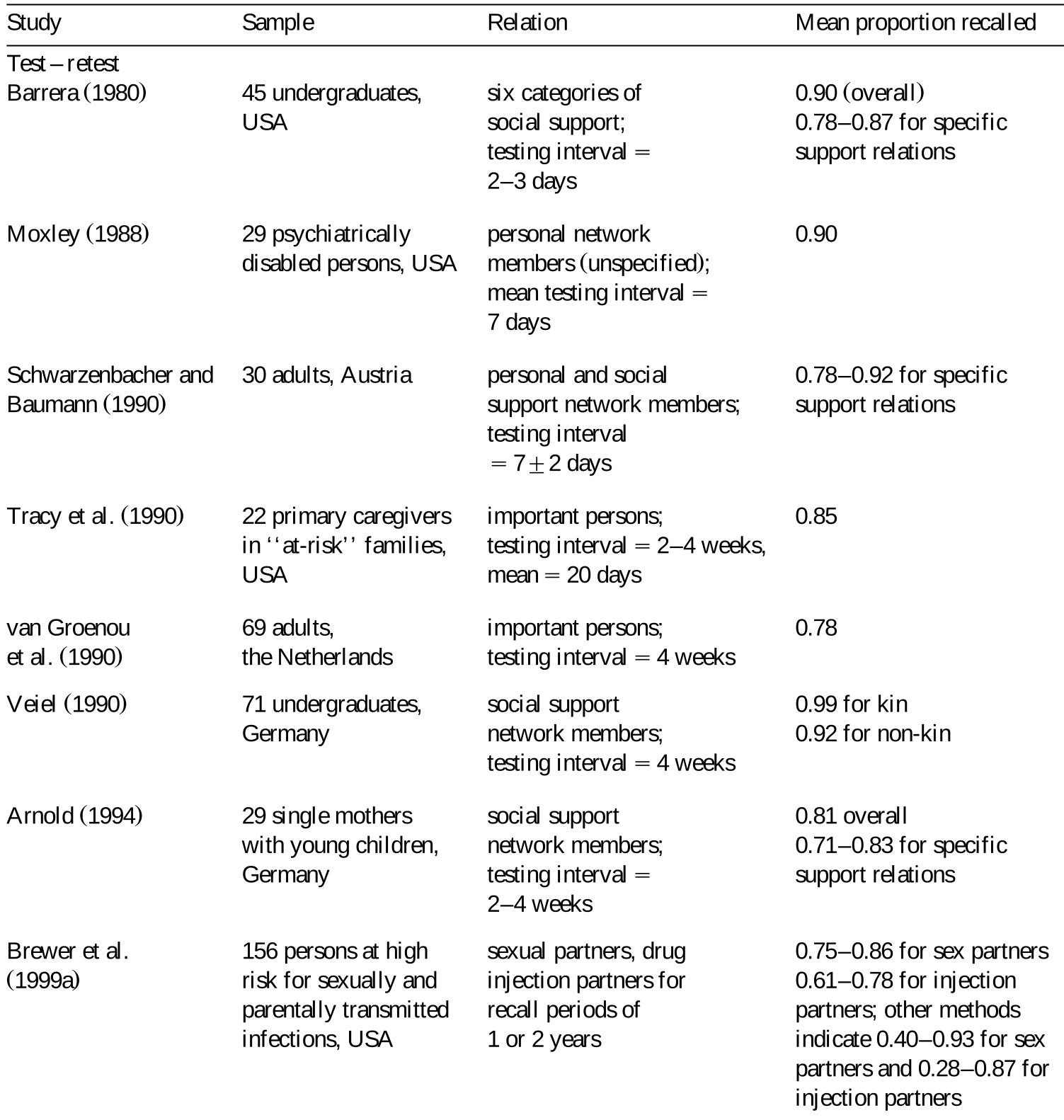
- Test-Retest: Seeing how much the list changes when you ask the same person the same question two weeks later.
Key Evidence: The Recall Deficit
The following table from the paper highlights just how stark the difference is between what we know and what we can recall on the spot:
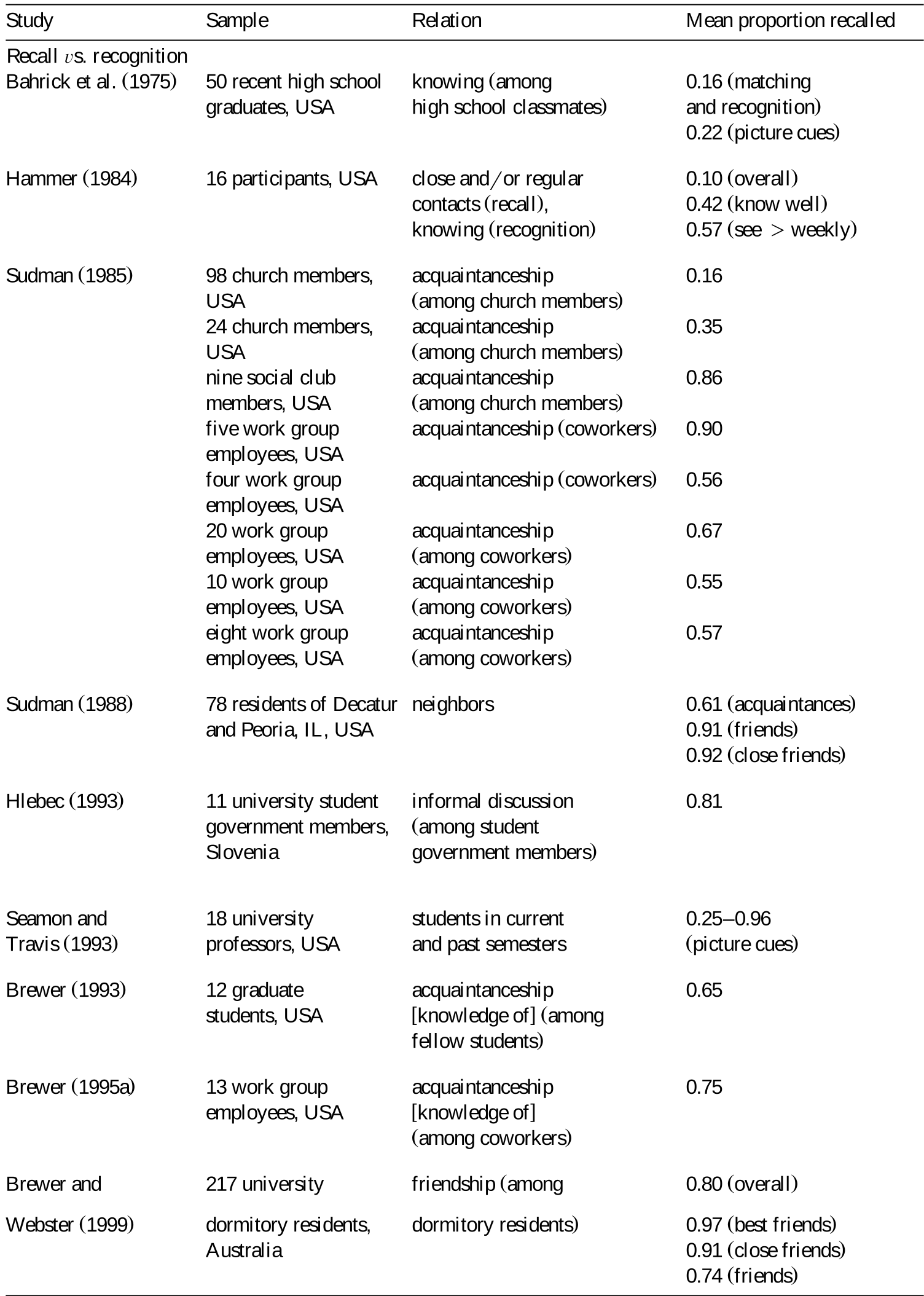
As seen in the data, Bahrick et al. (1975) found that high school graduates could only freely recall about 16% of the classmates they were able to recognize through photos.
Core Insights: What Do We Forget?
The paper clears up several misconceptions about social memory:
- The Proportionality Myth: There are no good demographic predictors (age, sex, etc.) for who forgets more. However, people who have larger networks tend to recall more people, but they also forget more people in absolute terms.
- Tie Strength: While common sense suggests we only forget "weak ties" (acquaintances), the evidence is surprisingly mixed. Brewer notes that people still forget a significant proportion of their close contacts and "best friends."
- Structural Distortion: This is the most critical find for data scientists. Forgetting isn't "random noise." It changes the measured density and centrality of a network. If you only look at recalled data, you might miss the "bridge" nodes that connect different social cliques, because those peripheral ties are often the first to be forgotten.
How to Fight Forgetting
If we can't trust simple recall, how do we get better data? Brewer evaluates several interventions:
- Multiple Elicitation Questions: Asking about different contexts (e.g., "Who do you talk to at work?" followed by "Who do you get coffee with?") helps broaden the search in the brain.
- Non-specific Prompting: Simply asking "Is there anyone else?" multiple times can increase recall by 5-15%.
- Recognition Lists: The "gold standard." Using a pre-defined list of all possible members (e.g., a company roster or a student directory) dramatically improves data completeness.
Conclusion and Future Outlook
Brewer’s work is a sobering reminder for anyone working with human-generated data. In fields like epidemiology (contact tracing) or organizational sociology, forgetting can lead to missing the "patient zero" or the key influencer in a company.
The Takeaway: If your research depends on "who knows whom," never rely on a single free-recall question. Supplement with recognition tasks or repeated, multi-contextual prompts. The future of the field likely lies in "hybrid" models—combining human recall with digital interaction logs to fill the gaps left by our selective memories.