
Collective Intelligence Formalized: Measuring the "IQS" of Social Structures
A formal definition of the phenomenon of collective intelligence and its IQ measure ଝ
This paper establishes a formal mathematical definition for Collective Intelligence (CI) using a molecular, quasi-chaotic computational model. By representing social structures as Random PROLOG Processors (RPP), the author introduces "IQS"— a probability-based IQ measure that quantifies a group's ability to solve N-element problems compared to individuals.
TL;DR
Is a crowd truly smarter than a person? This seminal paper moves beyond philosophical debate to provide a formal mathematical definition of Collective Intelligence (CI). By modeling societies as "molecular computers" using the Random PROLOG Processor (RPP), the author introduces IQS—a quotient measured not by a score, but by the probability of a group solving a complex problem over time.
Motivation: Why We Lack a Theory of the "Group Mind"
For decades, the scientific community has been hesitant to formalize Collective Intelligence. The primary barrier was the "deterministic" bias of computing: we assumed that for a system to be "intelligent," information must have a fixed address and follow a rigid path. Pioneers like Allen Newell even argued that the low communication bandwidth between humans makes modeling a "group mind" unscientific.
Tadeusz Szuba challenges this by looking at nature. Bacterial colonies and ant hills solve incredibly complex problems without a central "CPU" or high-bandwidth communication. The author's insight is that intelligence is an emergent property of chaotic, parallel interactions, which can be captured using non-Turing computational models.
Methodology: The Random PROLOG Processor (RPP)
The paper utilizes PROLOG—a declarative logic language—as the base, but strips away its deterministic execution. In the RPP model:
- Information Molecules: Facts, rules, and goals are treated as molecules moving in a "Computational Space" (CS).
- Rendezvous Logic: When two molecules (e.g., a "Matchbox" fact and a "How to make fire" rule) meet by chance in space, an inference (unification) occurs.
- Membranes: Boundaries (like city walls or office departments) are modeled as membranes that filter or contain these molecules, affecting the probability of they meeting.
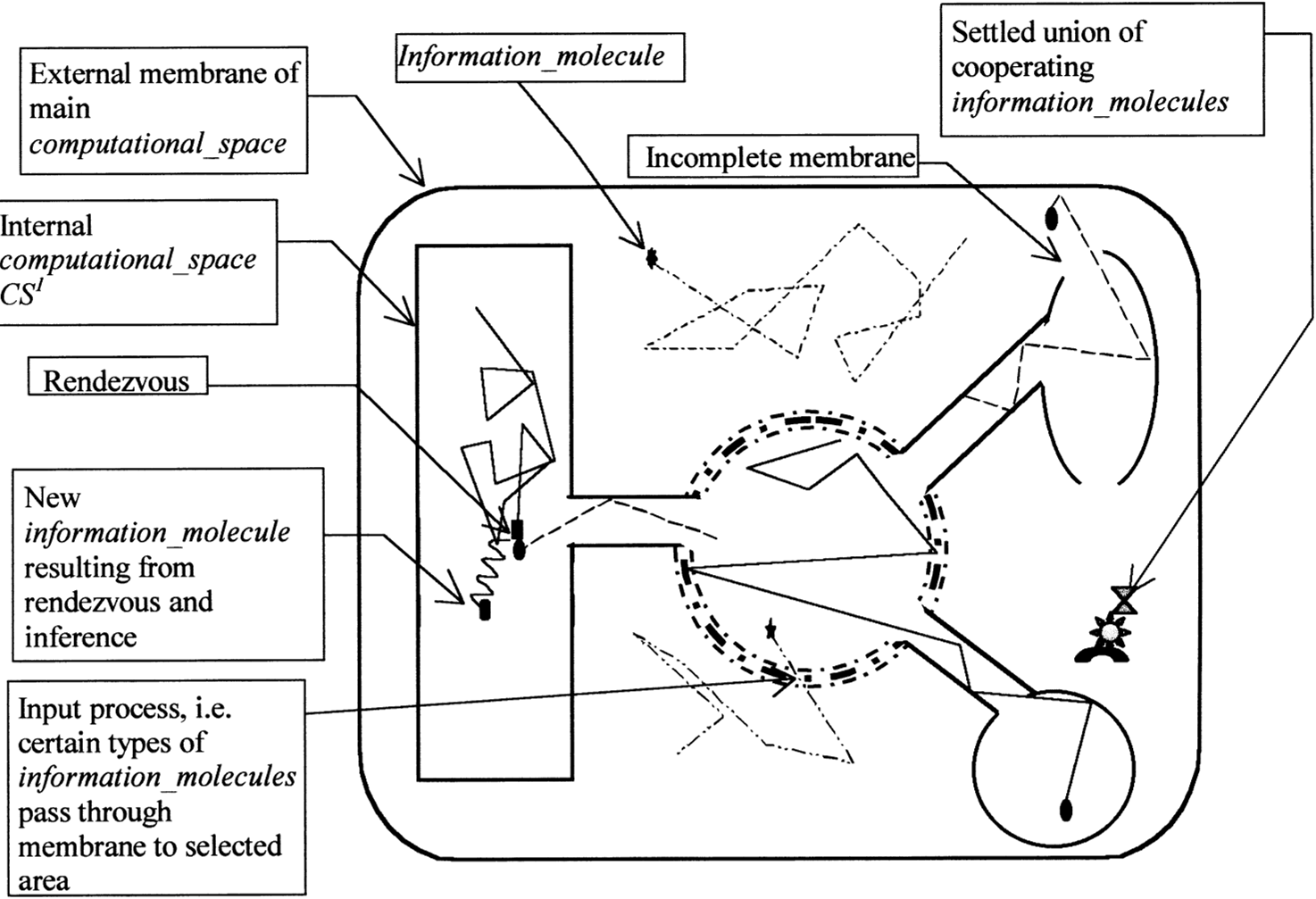 Figure 1: A conceptual snapshot of the Random PROLOG Processor, showing how facts and rules interact within structured membranes.
The Formal Definition of CI
The author defines CI emergence very simply: If a group can solve a problem that is either more complex than what the best individual can solve alone, or a new problem entirely, Collective Intelligence has emerged.
Measuring "IQS": The Quotient of Probability
Unlike a human IQ test that results in a single number, the IQS is a function: Where is the probability that an N-element inference chain (a problem requiring logical steps) is completed within time .
 Figure 2: Example of a parallel inference chain within the RPP, displaying how scattered facts eventually unify into a goal.
Critical Insights: The Power of Structure
The most profound takeaway is that organization dictates intelligence.
- Synergy via Proximity: The paper explains why medieval "Shoemaker Streets" worked. By reducing physical distance, the probability of "information molecules" (skills, trade secrets) meeting increased, raising the IQS of the street beyond the sum of individual shoemakers.
- Inconsistency Tolerance: Because the system is chaotic and parallel, it doesn't crash if one individual is "wrong." Inconsistent facts eventually "self-destruct" or are filtered out by more successful inference chains.
- Human Growth: It provides a formal justification for "Group Dynamics"—people join groups because their "individual account" of solved problems grows when they leverage the collective's background inferences.
Conclusion and Future Outlook
Szuba’s work bridges the gap between sociology and computer science. By defining CI in a way that includes bacteria, humans, and robots, it opens the door for Collective Artificial Intelligence.
Limitations: The model assumes a certain level of randomness that might not fully capture highly structured, top-down hierarchies. However, as our world becomes more decentralized via the Internet, the RPP model's "quasi-chaotic" approach becomes increasingly relevant for analyzing the intelligence of online communities and global networks.
Takeaway for the Future: To increase the "IQ" of an organization, don't just hire smarter people—optimize the "membranes" and "displacement" of information to ensure the right "molecules" meet at the right time.