
The Super-Agent Perspective: Formally Mapping Collective Behavior to Individual Cognition
Formal Interpretation and Analysis of Collective Intelligence as Individual Intelligence
The paper presents a formal framework for interpreting collective intelligence in multi-agent systems (MAS) as the intelligence of a single individual "super-agent." By utilizing the Temporal Trace Language (TTL) and ontological mapping, the authors demonstrate how social interactions can be mathematically mapped to cognitive mental processes.
TL;DR
Can a bustling ant colony be considered a single "mind"? This paper moves beyond metaphor, providing a formal mathematical framework using Ontological Interpretation Mapping to translate the distributed actions of a multi-agent system into the internal mental states of a single "super-agent." The research proves that social interactions (socialperspective) can be formally viewed as cognitive processes (cognitive perspective).
Background: The Extended Mind
In traditional AI, an agent's mind is "in the head." However, the Extended Mind hypothesis suggests that external objects (like a notepad or a pheromone trail) can function as part of the cognitive process. Bosse and Treur take this further: if a group of agents uses the environment to coordinate, can we map the entire group onto a single agent whose "mind" is simply distributed across space?
Problem: The Complexity of "The Social"
Explaining why an ant colony finds food is often cumbersome. You have to track thousands of individual stimulus-response actions, pheromone drops, and local observations.
- The Pain Point: Multi-agent descriptions are often too "low-level" to capture the "Why" of a system's goal-seeking behavior.
- The Insight: By defining a formal mapping, we can treat the colony as a Superant. This Superant doesn't "observe" pheromones; it simply has "beliefs" about which paths are relevant.
Methodology: The Interpretation Mapping
The authors utilize two primary tools:
- TTL (Temporal Trace Language): To model how states evolve over time.
- (Interpretation Mapping): A function that maps atoms from the Multi-Agent ontology to the Single-Agent ontology.
Architecture Shift
As shown in the figures below, the mapping embeds the complex multi-step social process into a streamlined cognitive process.
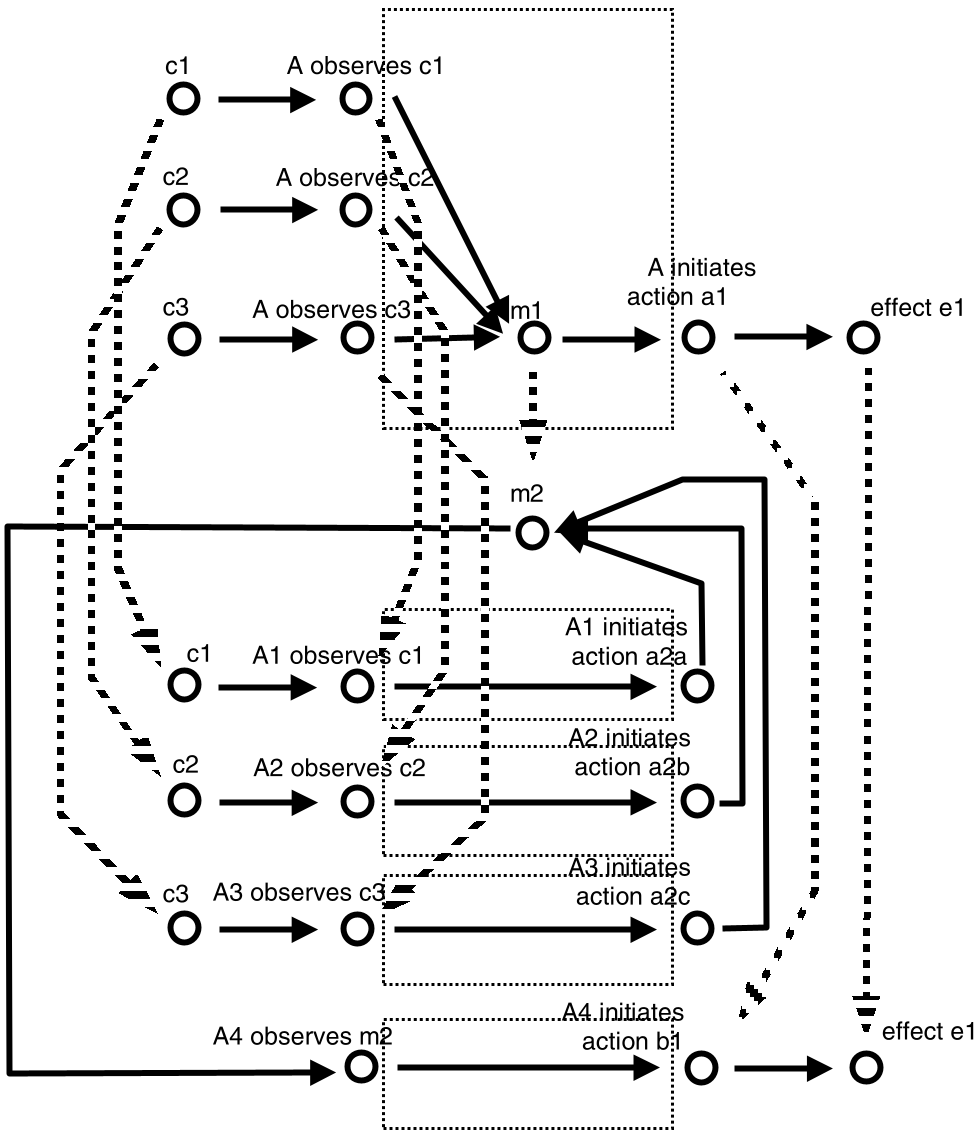 Figure 1: The structural isomorphism between internal mental states (m1) and shared external states (m2).
In the case study of the Ant Colony:
- Individual Ants are mapped to different Paws of the Superant.
- Pheromone Levels in the world are mapped to Beliefs in the Superant's mind.
- Dropping Pheromones is re-conceptualized not as an action, but as an Internal Memory Update.
Experiments: Simulation and Validation
The authors constructed two simulation models using "leads to" rules (e.g., if observation X, then action Y).
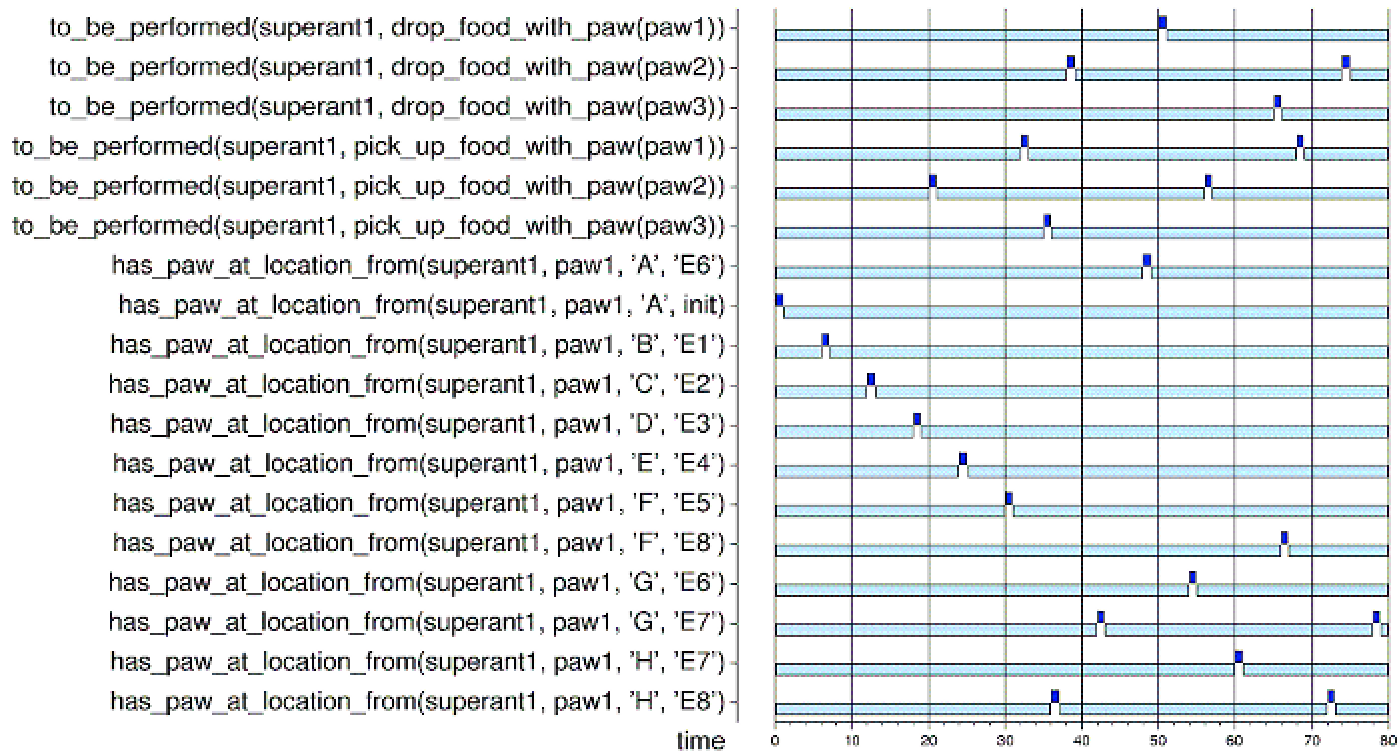 Figure 2: Traces from the Single-Agent simulation (Superant S) showing the activation of "beliefs" and "paw movements."
Key Findings:
- Equivalence: The global properties (e.g., "Food is discovered") were preserved across both models.
- Simplification: The Single-Agent model eliminated the need for explicit "observation" steps for pheromones, as they were treated as internal beliefs.
- Abstraction: Complex interactions between agents were reduced to the state transitions of 1 agent.
Critical Analysis & Conclusion
Why does this matter?
This research extends Dennett’s Intentional Stance. Predicting a system's behavior by "tracing every neurotransmitter" (or every ant) is computationally intractable. By adopting a "cognitive stance" toward a collective, we gain a more elegant and predictive model.
Takeaway
For AI researchers, this suggests that Swarm Intelligence isn't just a collection of simple rules; it can be formally analyzed as a coherent distributed cognition.
Limitations
The mapping in this paper is unidirectional. While we can map a colony to an individual, mapping a complex individual (like a human) to a colony of sub-agents is much harder because many internal thoughts don't have an obvious "social" counterpart. Future work aims to explore the bidirectional "society of mind" perspective.
Final Thought: If an ant colony is a super-agent, what does that make a corporation, a city, or a neural network? This paper provides the formal language to start answering those questions.