
Beyond Content: Navigating the Technical Hurdles of OER Adaptation with OpenScout
Formal Metadata and Shared Experiences for Discovering Tools to Adapt Open Educational Resources
This paper introduces the OpenScout Tool Library, a collaborative ecosystem designed to help educators find and utilize software for adapting Open Educational Resources (OER). The platform integrates formal metadata with social narratives (scenarios) to bridge the gap between static content and the technical tools required for localization and repurposing.
TL;DR
While Open Educational Resources (OER) are increasingly available, the technical "friction" of actually using and modifying them remains a major barrier. This paper presents the OpenScout Tool Library, a social and technical platform that doesn't just host content, but connects users with the specific tools and "stories of use" required to transform, translate, and repackage educational materials for real-world scenarios.
The "Friction" in Open Education
The OER movement is built on the philosophy that knowledge is a public good. However, the reality is often frustrating for educators: you find a perfect resource, but it's in the wrong format, the wrong language, or contains localized examples that don't apply to your students.
Current repositories are great at finding a PDF, but they offer little help when you need to know how to edit that PDF or which collaborative tool works best for a distributed team. This "technical barrier" often discourages infrequent users from engaging with OER altogether.
Methodology: People, Tools, and Scenarios
The OpenScout Tool Library moves beyond a simple software directory. It builds an ecosystem based on three pillars:
- People: Grouped into content developers, educators, collaborators, and social learners.
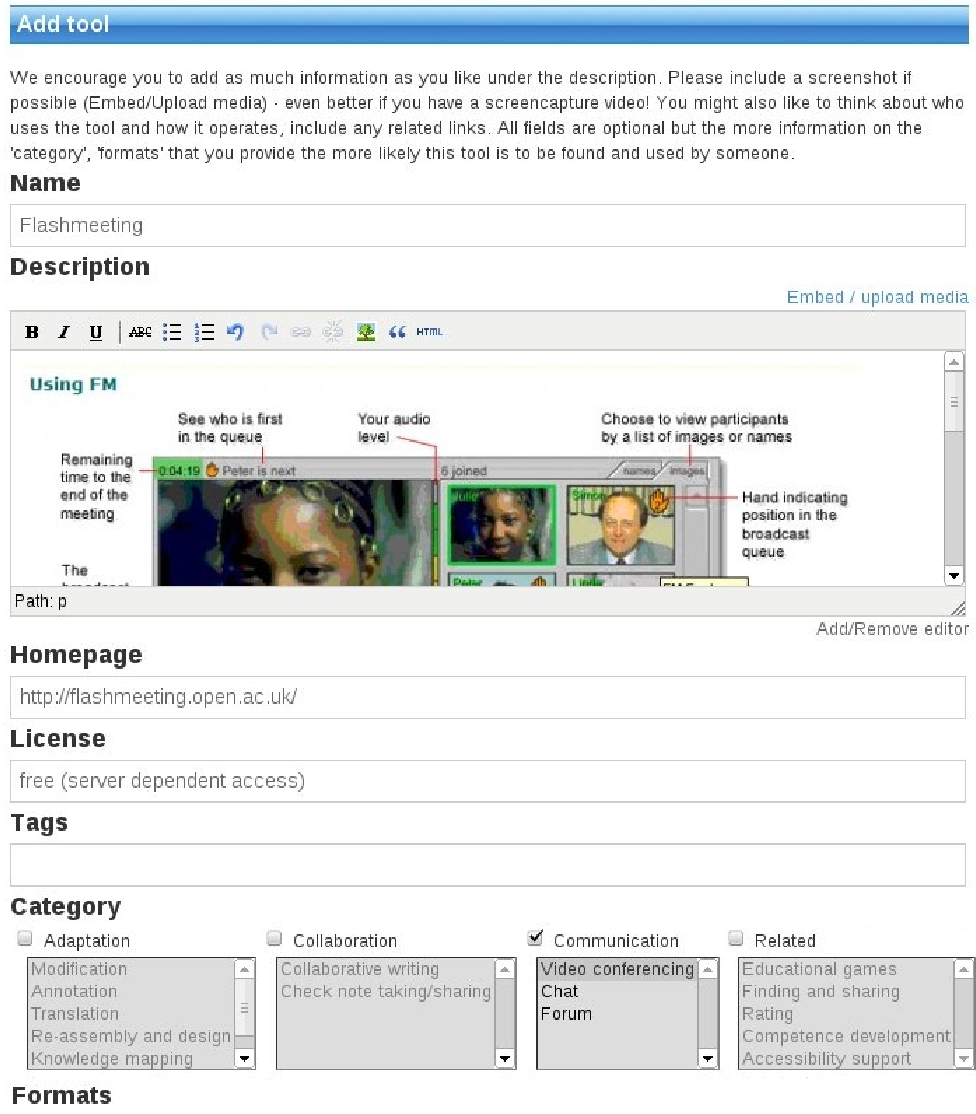
- Tools: Software and services categorized by their functional role (Adaptation, Collaboration, Communication).
- Scenarios: The "glue" of the system. These are narratives where users describe exactly how they used specific tools to solve a problem (e.g., "Using Google Docs and FlashMeeting to create a shared presentation").
The Architecture of Collaboration
The system uses the Elgg open-source framework to provide a social networking layer, allowing users to rate, recommend, and comment on tools based on their actual performance in the field.
Bridging Formal Metadata and Social Intuition
One of the paper's most significant contributions is its approach to metadata. It attempts to bridge:
- IEEE LOM (Learning Object Metadata): Formal technical fields like Format, Location, and Rights.
- DOAP (Description Of A Project): An RDF schema for describing software projects.
- Social Metadata: Peer ratings and "Scenarios" that provide contextual proof of a tool's utility.
By mapping these together, the Library can suggest tools based on the specific license or format of an OER. For instance, if an OER is licensed under Creative Commons Attribution-ShareAlike, the Tool Library can automatically filter for tools that permit modification and support that content's specific MIME type.
Measuring Success: The Tool Integration Lifecycle
How do we know if a tool is actually useful to the community? The authors proposed a Tool Integration Metric (0-5).
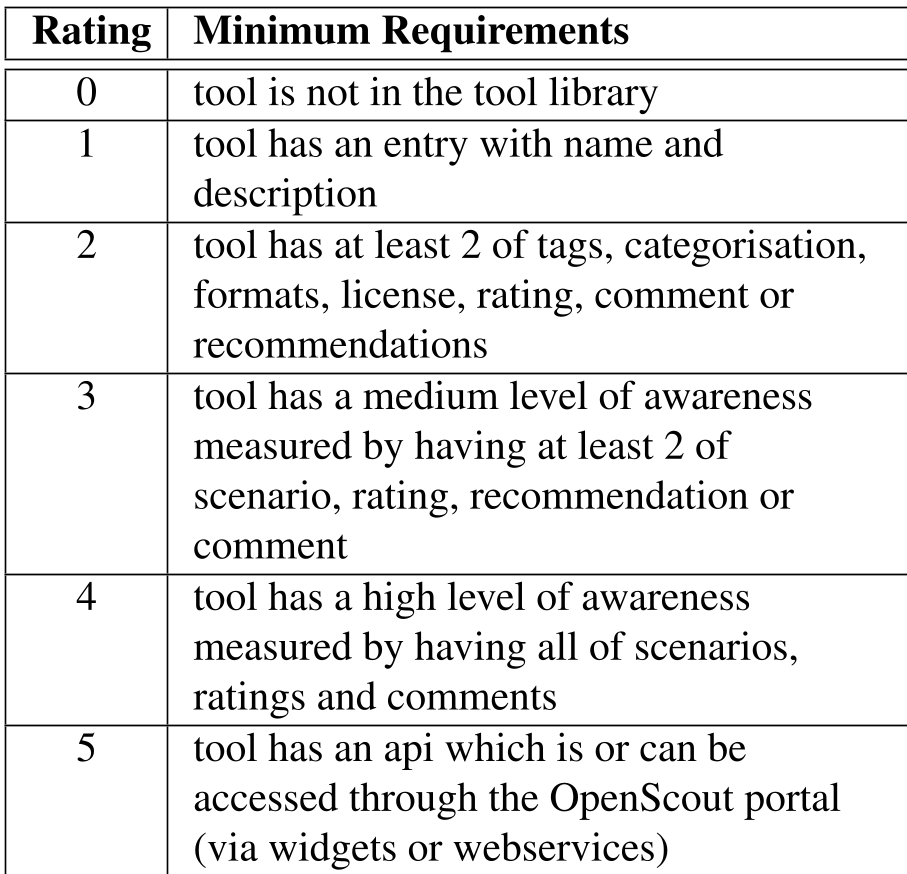
This metric tracks a tool from being "not in the library" (Level 0) to having high social awareness (Level 4—rich with scenarios and ratings) and finally to technical integration (Level 5—where the tool's API is directly accessible via the OpenScout portal).
Critical Insight & Conclusion
The OpenScout project recognizes that abundance is not enough. Having 6,000 hours of study material (like the OpenLearn project) is useless if a teacher cannot adapt it to their local classroom.
The Takeaway: The future of OER lies in the "Socialization of Metadata." By turning technical workflows into shared "stories," we lower the barrier for the next generation of educators.
Limitations: The success of this model depends heavily on user participation. Without a critical mass of contributors sharing "Scenarios," the library risks becoming a static directory. Future work must focus on automating metadata extraction to keep the entry barrier low for busy teachers.