
Logic of the Echo Chamber: A Formal Model for Group Polarization
Toward a Formal Model for Group Polarization in Social Networks
This paper introduces a formal mathematical framework to model group polarization in social networks by integrating agents' belief strengths with an influence graph. It adapts the Esteban-Ray measure for economic polarization to social belief dynamics and investigates how irrational behaviors like confirmation bias and the backfire effect drive ideological segregation.
TL;DR
Researchers have developed a formal mathematical model that explains why social media often feels like a powder keg. By incorporating psychological biases—Confirmation Bias and the Backfire Effect—into an influence graph, this work demonstrates that "more communication" isn't always the cure for a divided society. In fact, under certain conditions, a perfectly connected network polarizes faster than a disconnected one.
The Rationality Myth in Social Dynamics
For years, academic models of social influence assumed a "rational" update path: if you talk to someone with a different opinion, your opinions should move closer together (the Classic Update). If the world worked this way, the internet would have led us to a global consensus decades ago.
The reality is "Group Polarization." We don't just process information; we filter it. The authors identify a major shortcoming in prior work: most models either ignore cognitive biases or assume that every agent interacts the same way. This paper bridges the gap between Social Psychology and Formal Mathematics.
Methodology: Coding the Human Bias
The model consists of two parts: Static Elements (who believes what right now) and Dynamic Elements (how those beliefs change over time).
1. The Polarization Metric (Esteban-Ray)
To measure how "split" a society is, the authors utilize the Esteban-Ray (ER) measure. It’s not just about the distance between opinions; it’s about identification (how many people share a pole) and alienation (how far those poles are from each other).
2. The Backfire Effect Function
This is the model's "secret sauce." Instead of moving toward an influencer, an agent moves away if:
- The Belief Gap is too wide (you're too different for me to listen).
- The Influence is high (you are a source I normally respect, but you're saying something I hate).
The authors use a logistic function to model this "step-change" in belief strength:
 Note: The formula captures how beliefs become "sharper" at the extremes when the backfire effect is triggered.
Visualizing Discord: Simulation Insights
Through various "Interaction Graphs" (Cliques, Faintly-Connected, Unrelenting Influencers), the simulations produced several "Aha!" moments:
The Non-Monotonic Nature of Hate
Polarization doesn't just go up. In "Faintly Connected" groups, polarization often peaks early as people align with their immediate peers (forming two distinct camps) but can eventually trend toward zero as the two camps slowly influence each other over a long timeframe.
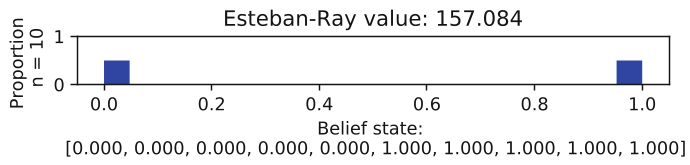 Figure: Various initial belief states from Uniform to Extremely Polarized.
The Danger of the "Clique"
Perhaps the most counter-intuitive finding is that total connectivity can be harmful. In a "clique" network where everyone hears everyone, the backfire effect is triggered constantly. In contrast, a "disconnected" network might stay stable because the conflicting groups simply never talk, preventing the "backfire" from radicalizing them further.
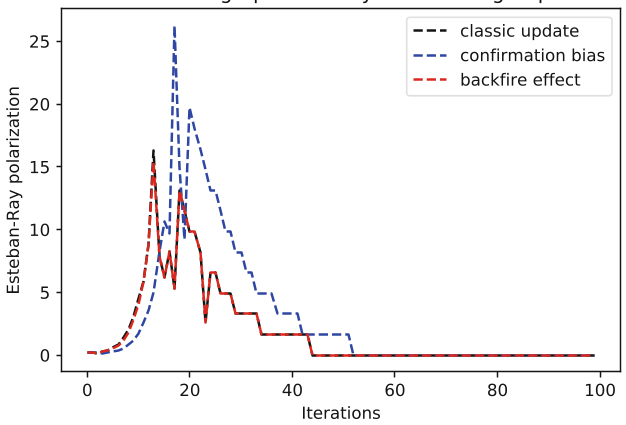 The graph shows that under Backfire effects, a clique (red line) can lead to higher long-term polarization than a disconnected graph.
Conjectures and The Path Forward
The paper concludes with several rigorous mathematical conjectures:
- Classic Update → Consensus: In any connected graph, if people are rational, they will eventually agree (Polarization = 0).
- Bias → Persistence: Confirmation bias and backfire effects are the only reasons polarization sustains itself in a connected world.
Future Outlook: "Smart" Feeds
The authors suggest a radical strategy for social network design: instead of "bursting" filter bubbles by showing people extreme opposing views (which triggers backfire), algorithms should show users "slightly different" views. By building small bridges of consensus, we might lead the whole population toward agreement without ever triggering the defensive mechanisms of the backfire effect.
Critical Analysis
While the model is elegant, it remains one-dimensional (believing in proposition p). In reality, political identity is a web of interconnected beliefs (taxes, climate, religion). However, as a baseline for a Formal Logic of Social Networks, this work provides the necessary mathematical scaffolding to move beyond hand-wavy sociological observations and into the realm of provable theorems.