
Formalizing the Courtroom: A Case Study in AI-Driven Legal Adjudication
Formalising ordinary legal disputes: a case study
This paper presents a formal reconstruction of a real Dutch civil case using "Prakken's formal model of adjudication dialogues." It evaluates the suitability of AI & Law dialogue games for mapping complex legal procedures and evidence phases into structured, logic-based interactions.
TL;DR
This landmark study by Henry Prakken takes AI & Law out of the ivory tower of abstract logic and into the grit of a Dutch civil dispute over a camping tent. By formalizing every speech act, witness testimony, and judicial ruling into a "Dialogue Game," the research tests whether machines can truly capture the nuances of legal procedural law and the shifting burdens of proof.
Background Positioning
In the landscape of computational law, this paper is a seminal "Reality Check." While most researchers focus on the logic of the law, Prakken focuses on the process of the dispute. It builds upon Prakken’s 2008 model of Adjudication Dialogues to bridge the gap between static legal rules and the dynamic "ping-pong" of a courtroom trial.
Problem & Motivation: The "Mundane" Challenge
Why model a simple dispute about a tent? Most AI models fail not on complex constitutional law, but on the "routine" aspects of legal discourse:
- The Evidentiary Gap: Prior models (like Leenes 1998) ignored the evidence phase, focusing only on the statutes.
- Implicit Knowledge: Lawyers rarely state the obvious; they leave "common-sense" premises unsaid.
- Procedural Complexity: Legal "truth" isn't just about facts; it's about who has the burden of proving them at a specific moment.
Methodology: The Adjudication Game
Prakken uses a game-theoretic approach where legal arguments are "moves" in a structured protocol.
1. The Logic (Topic Language)
The system uses Extended Logic Programming. Rules are either Strict (→) or Defeasible (⇒). For example, possession of a good usually implies ownership unless an exception (like being a loan) is proven.
2. Argumentation Schemes
To handle witnesses, the paper uses a "Witness Testimony Scheme":
- Premise: Witness W says .
- Inference: Therefore, is presumably true.
- Critical Questions: Is the witness sincere? Did their memory fail? These act as "undercutters" in the logic.
3. Dialogue Protocol
The dialogue is split into:
- Pleadings Phase: Plaintiff (p) and Defendant (d) exchange claims.
- Decision Phase: The Judge (i) takes over, evaluating the "Dialogical Status" (In or Out) of every claim.
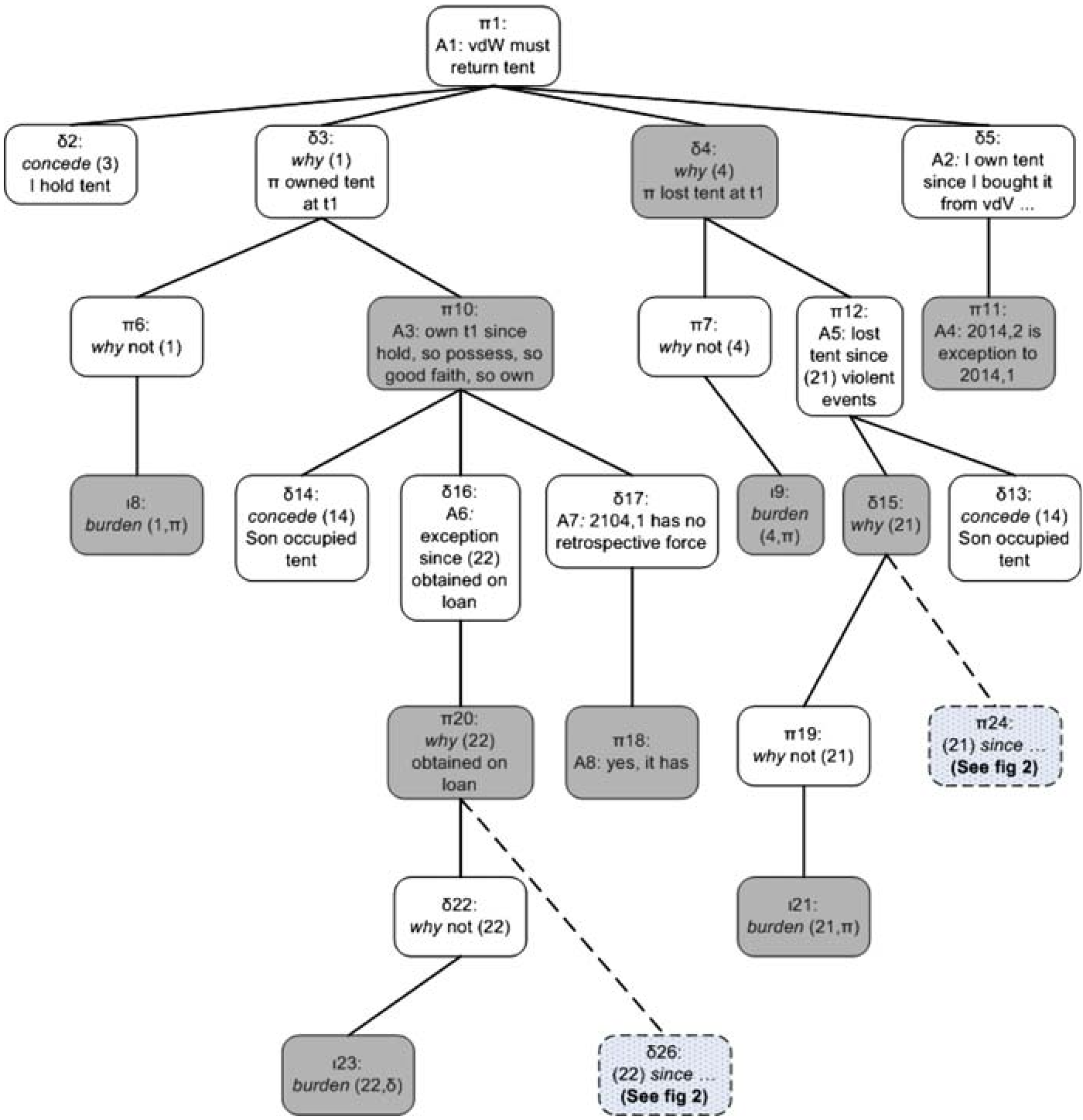 Figure 1: The structural-dialogical relations showing how claims () are attacked by denials () and judicial burdens ().
Experiments & Results: A Rationality Audit
The author meticulously reconstructed the "Tent Case." The Plaintiff claimed the tent was stolen; the Defendant claimed it was a loan.
The "Rationality Gap"
The most striking result of the formalization was the discrepancy between the model and reality.
- The Model says: The Plaintiff's claim is "In" (Winning) because the Judge failed to address several specific attacks on witness credibility.
- The Reality says: The Defendant won.
This illustrates that real-world judges often use "shorthand" reasoning that may be logically incomplete. The formalization serves as a "Rationality Auditor," highlighting where a verdict lacks a complete dialectical foundation.
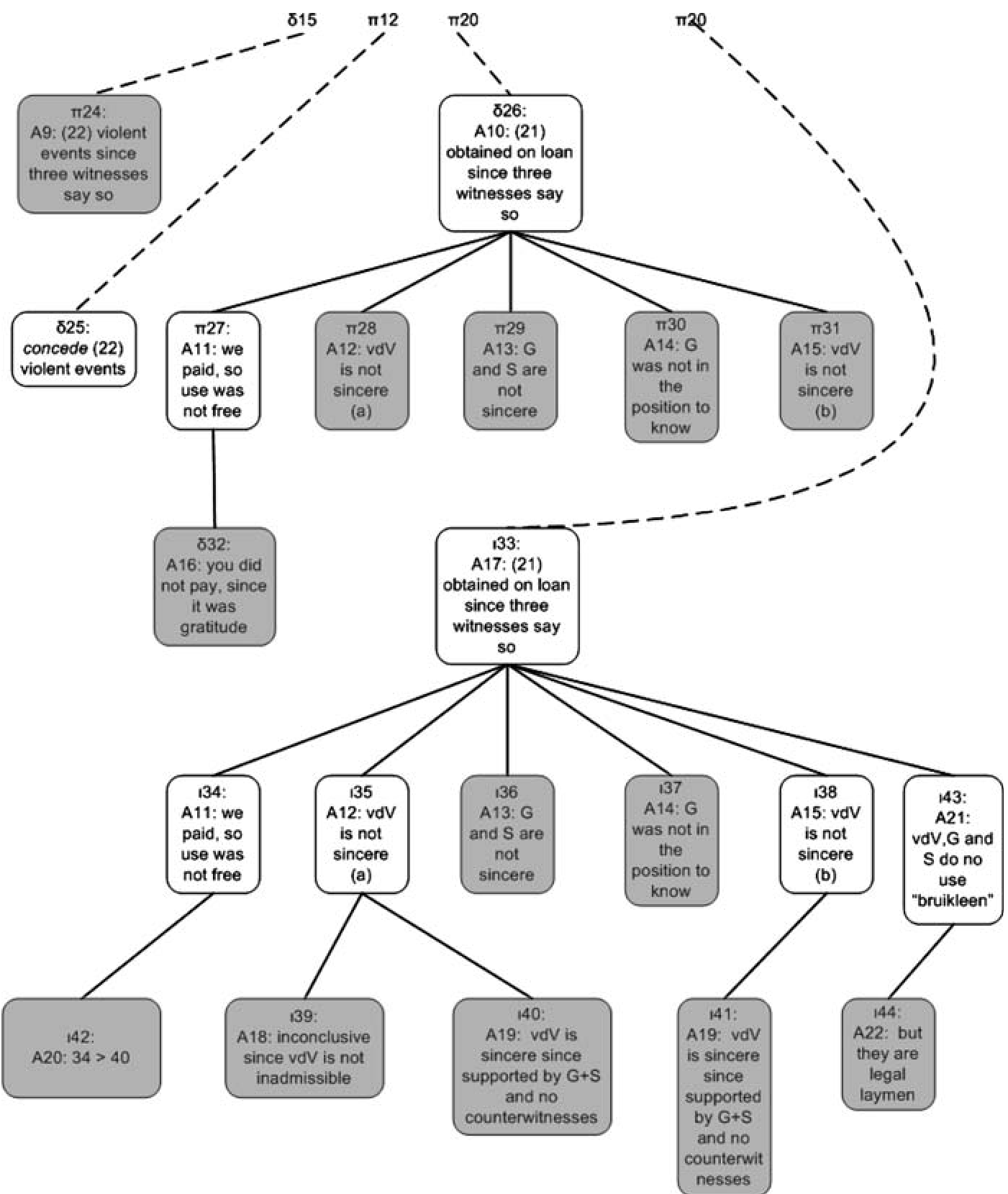 Figure 2: The complex tree of evidence. Grey nodes are 'In' (accepted), white nodes are 'Out' (defeated).
Critical Analysis & Conclusion
Takeaway
The paper proves that while we can formalize legal disputes, these systems shouldn't necessarily replace judges. Instead, they should function as Legal Argument Management Systems, helping lawyers and judges organize "case-related documents" into a logically sound structure.
Limitations
- Subjectivity: Formalizing natural language involves subjective "rational reconstruction."
- Rigidity: The model requires repeating moves (concessions) that happen only once in real life, making the "Dialogue Tree" somewhat artificial.
Future Outlook
As we move toward "AI-assisted law," Prakken’s work suggests that "Dialogue Games" will be the bedrock of tools that ensure legal decisions are not just authoritative, but rationally complete.