
Beyond the Equation: Why Algorithmic Fairness Needs Ethical Philosophy
Formalising Trade-Offs Beyond Algorithmic Fairness: Lessons from Ethical Philosophy and Welfare Economics
This paper critially examines the limitations of reductionist mathematical fairness metrics in machine learning. It introduces "Key Ethics Indicators" (KEIs), a holistic framework that integrates ethical philosophy and welfare economics to quantify trade-offs between fairness, welfare, and autonomy in algorithmic decision-making.
TL;DR
Modern AI fairness is stuck in a "metrics trap," where engineers optimize for mathematical parity that fails "in the wild." This paper argues that fairness cannot be automated into a simple pass/fail test. Instead, it proposes Key Ethics Indicators (KEIs)—a framework inspired by welfare economics and philosophy—to help decision-makers navigate the painful but necessary trade-offs between accuracy, social justice, and individual autonomy.
Background: The Reductionist Trap
In the quest to make AI "fair," the computer science community has produced dozens of metrics: Demographic Parity, Equal Odds, Predictive Equality, etc. However, these metrics are often mathematically incompatible. As the authors point out, a fairness toolkit might tell a bank their loan algorithm is "fair" by one metric but "discriminatory" by another. This disconnect creates a "false confidence" in flawed systems that ignore the messy, subjective reality of human justice.
The Core Insight: Fairness is Not Just About Equality
The authors argue that technical teams have outsourced "fairness" to math, but fairness is actually a branch of Ethical Philosophy. They identify two critical gaps in current ML thinking:
- Acceptability of Inequalities: Not all disparities are unfair. For example, income differences (Inequality) might be a legitimate factor in credit limits, whereas race (Discrimination) is not. Current metrics struggle to distinguish between "effort-based" results and "circumstance-based" biases.
- The Welfare Connection: Focusing only on distribution (who gets a loan) ignores Beneficence (is the loan actually good for the borrower?) and Autonomy (does the borrower understand the decision?).
Methodology: The KEI Framework
Instead of a single "Fairness Score," the authors propose Key Ethics Indicators (KEIs). This approach mimics corporate KPIs but measures moral alignment.
The 6-Step KEI Process:
- Define Success: Identify benefits (e.g., financial inclusion) and harms (e.g., predatory debt).
- Identify Inequalities: Map out which factors (skills, socioeconomic status) are influencing the model.
- Identify Biases: Trace bias to its source—historical, representation, or measurement.
- Design Mitigation: Use technical (in-processing) or non-technical (marketing changes) fixes.
- Calculate Trade-offs: Build multiple models and measure how they perform across different ethical dimensions.
- Justify Selection: Choose the model that best reflects the organization’s values and document the "Why."
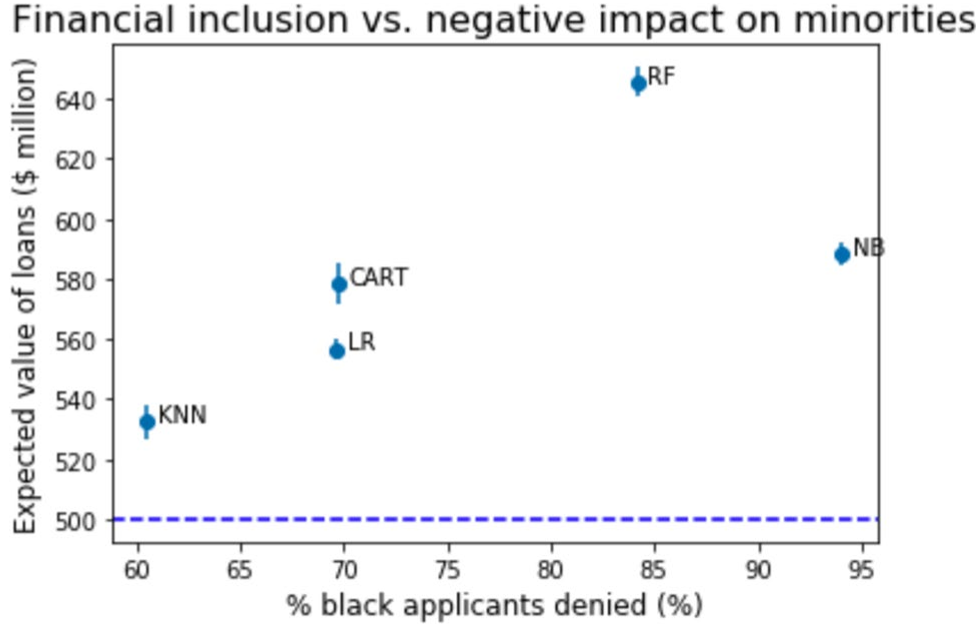 Figure 1: Visualizing the trade-off between financial inclusion and minority loan access across different algorithms.
Experimental Analysis: The Credit Risk Use Case
The paper applies KEIs to a mortgage lending scenario. The traditional approach might just ensure "False Negative Rates" are equal across races. The KEI approach, however, reveals a stark choice:
- CART Model: Higher overall accuracy (more "Financial Inclusion"), but a 3.8% higher denial rate for Black applicants.
- Logistic Regression: Lower accuracy, but higher approval for minorities.
By quantifying this, the decision-maker can no longer hide behind an "automated toolkit." They must make a value judgment: Is the $15.6 million in additional loans worth the increased disparity?
Critical Analysis & Future Outlook
The strength of this work lies in its refusal to offer a "magic bullet." It forces practitioners to accept that algorithmic ethics is a design choice, not a technical constraint.
Limitations: The KEI framework requires significant cross-departmental collaboration (legal, business, and tech), which may be difficult in fast-paced "move fast and break things" environments. Furthermore, defining "success" remains subjective and prone to organizational bias.
Takeaway: As AI regulations (like the EU AI Act) loom closer, the KEI approach provides a roadmap for Reviewability. It moves the conversation from "Is this model fair?" to "Is this model's impact justified?"
Summary Table of Philosophical Alignments
The authors provide a brilliant mapping of ML metrics to centuries of thought:
| Fairness Metric | Underlying Philosophy | Intuition |
|---|---|---|
| Max Accuracy | Desert | People get what they "deserve" based on data. |
| Demographic Parity | Strict Egalitarianism | Outcomes must be equal regardless of input. |
| Equal Opportunity | Rawlsian EOP | Focus on equalizing the "benefit" of a correct prediction. |
| Individual Fairness | Responsibility Egalitarianism | Similar people should get similar results. |
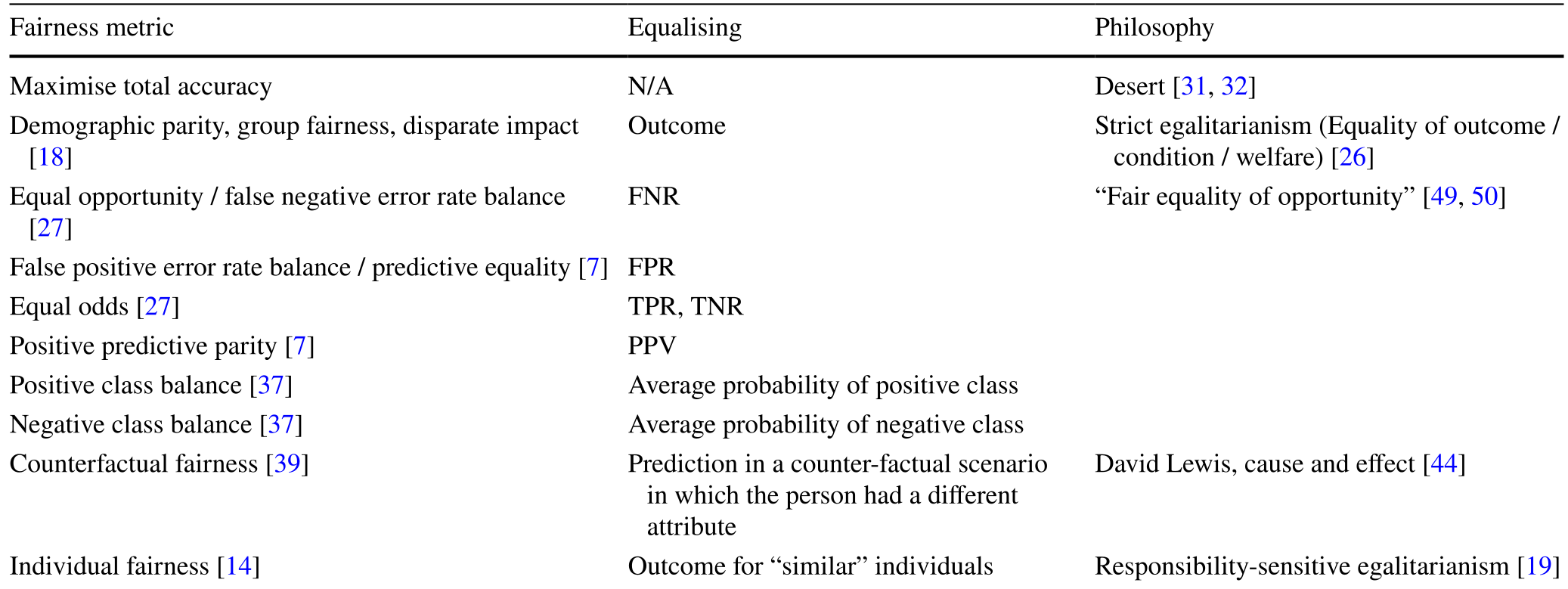 Table 1: The mapping of mathematical metrics to ethical schools of thought.