
This paper presents the first formalization of constructive Quantum Field Theory (QFT) in the Lean 4 theorem prover. Using the Glimm-Jaffe framework, the authors rigorously construct the free massive bosonic field in 4D Euclidean space and prove it satisfies the five core Osterwalder-Schrader/Glimm-Jaffe axioms.
TL;DR
Researchers have achieved a landmark in mathematical physics by formalizing the construction of the 4D Gaussian Free Field (GFF) in the Lean 4 interactive theorem prover. By proving the Glimm-Jaffe (OS) axioms, the team has moved QFT from the realm of "heuristic path integrals" to machine-certified mathematical truth. This work demonstrates that AI-assisted formalization—using agents like Claude and Gemini—can now handle the grueling functional analysis required for research-level physics.
The Gap: Why Rigor in QFT is a "Hard Problem"
For decades, a joke has circulated in the halls of academia: "Mathematicians prove what physicists have known for years." In QFT, physicists often manipulate the path integral as if it were a standard Lebesgue measure. However, in 4D, this measure doesn't technically exist on the space of continuous functions; it only exists as a random distribution.
Constructive QFT was born in the 1970s (led by Glimm, Jaffe, and others) to fix this. They established the Osterwalder-Schrader (OS) Axioms, which define the conditions under which a Euclidean field theory can be "Wick-rotated" back into a physical Minkowski QFT. Until now, these proofs lived only in dense textbooks, subject to human error and difficult for students to verify.
Methodology: Building the Gaussian Free Field
The authors chose the Glimm-Jaffe framework because it translates QFT into measure theory and probability—fields already well-supported by Lean’s Mathlib.
1. The Configuration Space
Instead of functions, the field configurations are treated as Schwartz distributions (). The authors define a Gel’fand triple (or rigged Hilbert space), providing the necessary structure to define a probability measure on an infinite-dimensional space.
2. Proof Strategy (The AI-Human Loop)
The team used a "backward-chaining" approach:
- State the final Axiom (e.g., Reflection Positivity).
- Use AI agents to propose "helper lemmas" that would make the proof work.
- Formalize those lemmas until they reach the "bottom" (Mathlib's existing definitions).
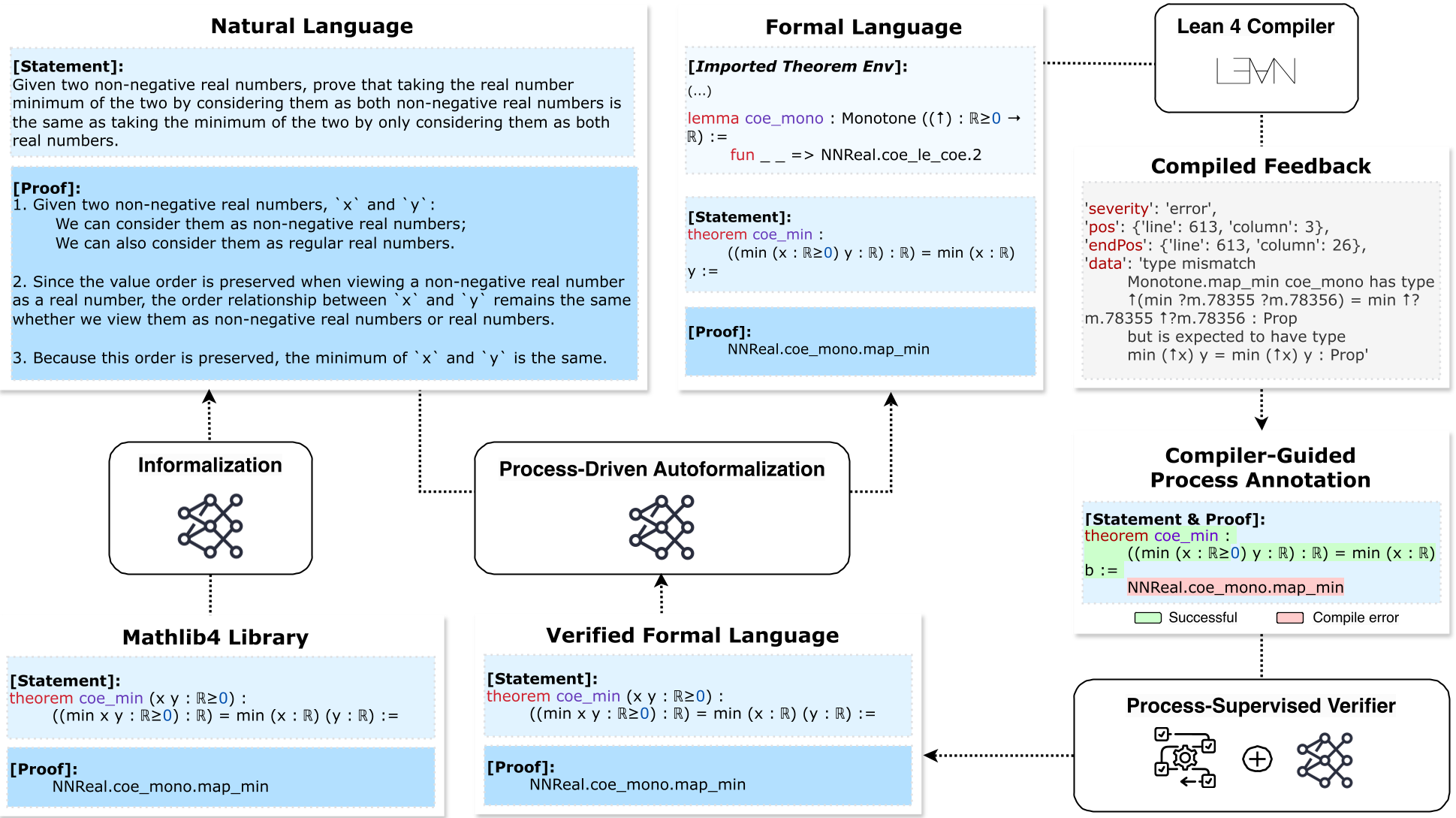 Figure 1: Illustration of process-driven autoformalization, where Lean provides feedback to the AI on the correctness of generated proof steps.
Breaking Down the Axioms
The core of the paper is the formal proof of five axioms:
- Analyticity (OS0): Proved using Hartog's Theorem and Fernique’s Theorem to bound the generating functional's derivatives.
- Regularity (OS1): Establishing an exponential bound on the generating functional using the norm.
- Euclidean Invariance (OS2): Showing the measure is invariant under rotation and translation.
- Reflection Positivity (OS3): The "Holy Grail" of Euclidean QFT. The authors proved this by reducing it to the positivity of the free covariance kernel via the Schur-Hadamard theorem.
- Ergodicity (OS4): Proved via a "Polynomial Clustering" bound, ensuring the uniqueness of the vacuum.
 Figure 2: The Ergodicity limit (3.13) as formalized in the paper.
Deep Insights: The AI "Aha!" Moment
One of the paper's most fascinating sections describes how the team used Claude Code and Gemini. They discovered that while AI is great at "filling in the blanks," it can be misled by "stale intuitions"—for example, treating conditionally convergent integrals as absolutely convergent (a common physics shortcut).
The researchers had to introduce a cross-model validation protocol: having Claude propose a proof while Gemini reviews it for "physical "sense," and Lean 4 provides the ultimate "Yes/No" on logical validity.
Conclusion and Future Work
This project isn't just about the 4D Free Field. It lays the groundwork for:
- Interacting Theories: Formalizing or the Wess-Zumino model.
- Yang-Mills: Addressing the "Mass Gap" Millennium Prize problem in a machine-verifiable environment.
- PhysLean: A growing library for digitalizing the laws of physics.
Final Takeaway: The era where physics was too "messy" for formal logic is ending. With AI-assisted ITP, we are entering an age where the most fundamental oracles of nature can be checked by the very machines we use to simulate them.
For more technical details, the full codebase is available at mrdouglasny/OSforGFF on GitHub.