
Formalizing Creative Minds: An Ontology Approach to Computational Thinking
Formalizing Problem Solving in Computational Thinking : an Ontology approach
This paper introduces a symbolic ontology-based approach to formalize complex human problem-solving in the context of Computational Thinking. By modeling the #CreaCube task and learner behaviors through Semantic Web technologies (OWL), the authors bridge the gap between cognitive neuroscience and learning sciences to better understand 21st-century transversal skills.
TL;DR
Researchers have developed a breakthrough framework that uses Semantic Web ontologies (OWL) to map the messy process of human creativity. By formalizing the #CreaCube task—where children build robots from modular cubes—the team has created a way to "read" a learner's strategy, distinguishing between structured goal-seeking and spontaneous, stimulus-driven discovery.
The Problem: The "Black Box" of Creative Learning
In modern education, "Computational Thinking" is a buzzword often reduced to simple coding. However, its true value lies in ill-defined problem solving—the ability to face a vague challenge and creatively navigate toward a solution.
Prior work in learning analytics has struggled with two things:
- The Performance Bias: Focusing on whether the student finished the task, rather than how they thought through it.
- Data Scarcity: Unlike Large Language Models, educational studies often involve small groups (dozens, not millions), making traditional statistical "Big Data" approaches ineffective.
The Insight: Bridging Neuroscience and Education
The authors propose a "Computational Learning Science" approach. They argue that if we can build a symbolic map (an ontology) of both the Task (the physical robot parts) and the Learner's Brain (their goals and reactions), we can use logic to fill in the blanks of the learning process.
They categorize behavior into two neurocognitive modes:
- Top-Down (Goal-Driven): The learner has a plan (e.g., "I need wheels") and searches for parts to fulfill it.
- Bottom-Up (Stimulus-Driven): The learner sees a shiny red button and presses it just to see what happens, which then sparks a new idea.
Methodology: Mapping the Problem Space
The researchers used Protégé to build a hierarchy of concepts.
1. The Material Environment
The ontology defines every "affordance" of the robotic cubelets. For example, a "wheel" isn't just an object; it has a functional affordance (it allows movement) and preconditions (it must be touching the ground).
2. The Cognitive Process
This is the heart of the paper. The model tracks Knowledge Construction. It maps how a stimulus (seeing a light turn on) becomes a "contextual knowledge" point, which then influences the next sub-goal.
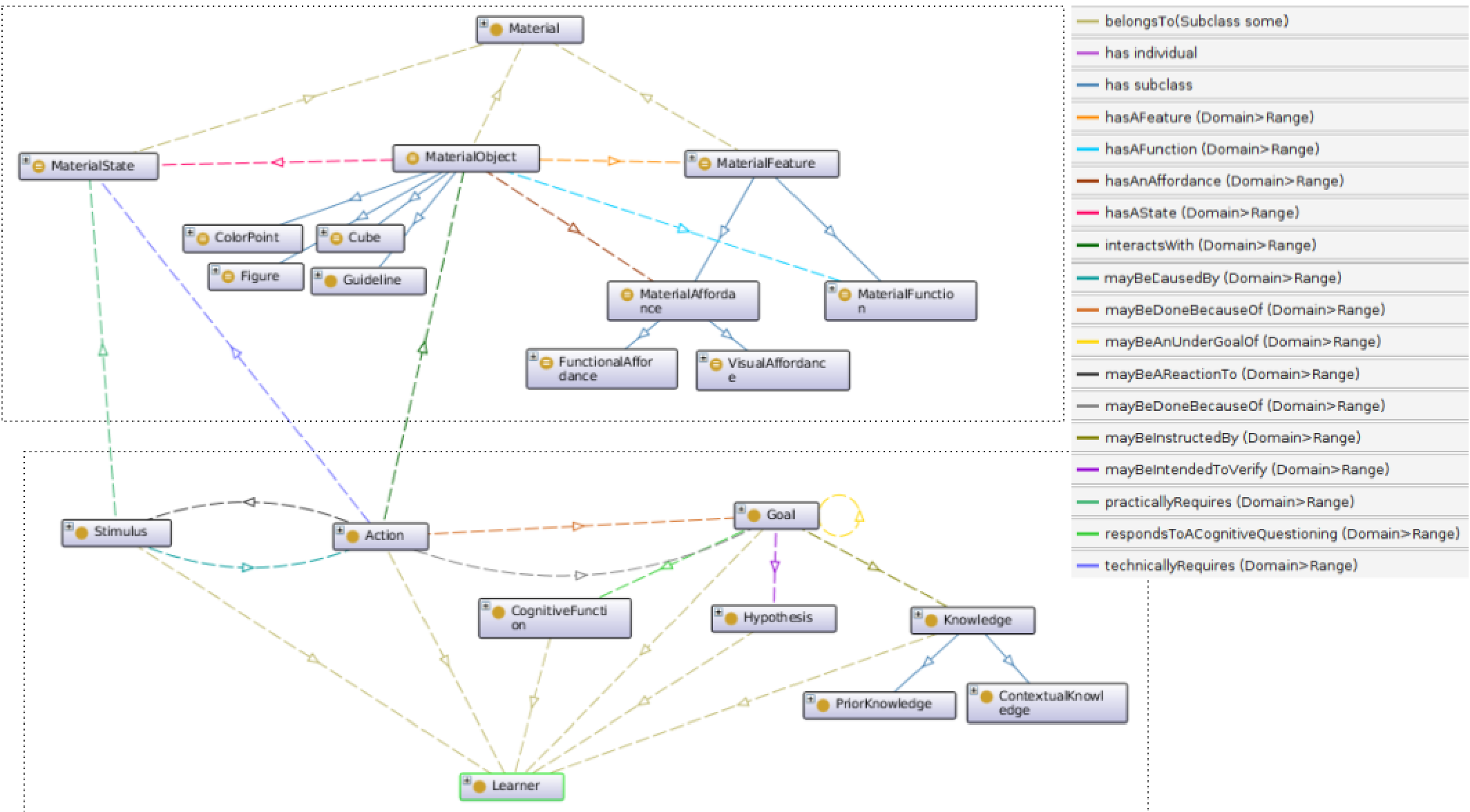 Figure 1: The Class Hierarchy showing the relationship between Task Material and Learner Cognition.
Experiments & Reasoning: From "Clicks" to "Thoughts"
To test the model, they recorded students solving the #CreaCube task and converted their actions into JSON logs. By running SPARQL queries against the ontology, they could perform "Inference."
The Scenario: A student flips a switch.
- The Query: Why did they do this?
- The Inference: The reasoner checks if the student previously observed the "Blue Cubelet" stimulus. If yes, it tags the action as "Exploration" (stimulus-driven). If the student was already trying to make the car move, it tags it as "Testing a Hypothesis" (goal-driven).
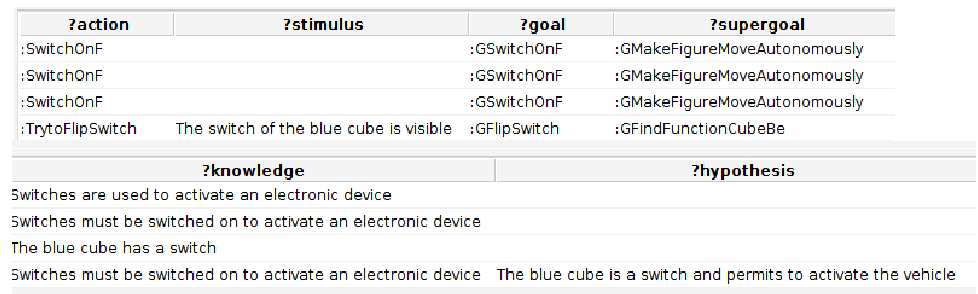 Figure 2: SPARQL query results showing how the model infers internal motivations from external observables.
Critical Analysis & Conclusion
Takeaway
This work is a significant step toward Educational Digital Twins. By formalizing the "Why" behind a student's action, we can design AI tutors that don't just give the right answer, but understand where a student's mental model is failing.
Limitations
As the authors admit, it is "preliminary." Manually defining every possible stimulus and hypothesis is labor-intensive. For this to scale, we need automated ways to populate these ontologies from raw video or sensor data.
Future Outlook
The "triple multidisciplinary" approach—combining Learning Science, Cognitive Neuroscience, and Computer Science—is the future. As we move toward more complex "unplugged" learning, these symbolic models will be essential for keeping the human element at the center of AI-driven education.