
ChemoTF: Beyond Connectivity—Building "Dream Teams" via Social Chemistry
Forming Dream Teams: A Chemistry-Oriented Approach in Social Networks YASHAR NAJAFLOU , (Member, IEEE) AND KRIS BUBENDORFER , (Member, IEEE)
This paper introduces ChemoTF, a novel algorithm for expert team formation in social networks. It shifts the paradigm from simple distance-minimization to a "Chemistry-Oriented" approach, utilizing Chemistry Level and dynamic Communication Cost to ensure effective collaboration while maximizing expertise.
TL;DR
The "Dream Team" problem—finding the perfect group of experts for a complex task—has long been reduced to finding the shortest path in a social graph. ChemoTF breaks this convention by introducing Social Chemistry, a metric that ensures experts don't just "know" each other through a graph, but actually possess the shared conceptual vocabulary required for high-stakes collaboration.
The "Graph Distance" Fallacy
In traditional Team Formation (TF), researchers aimed to minimize "Communication Cost," usually defined as the number of hops between experts in a network. However, this approach has two fatal flaws:
- Static Assumptions: It treats the cost of two people talking as a fixed number, ignoring that experts communicate differently depending on the specific skill or "Area of Expertise" they are currently exercising.
- Expertise Dilution: By obsessing over proximity, algorithms often pick a "nearby" novice over a "distantly connected" world-class expert, even if the latter could provide 10x the value for the same budget.
Methodology: The Chemistry-Oriented Approach
ChemoTF redefines the social network as a Multidimensional Social Network , where represents various "Areas of Expertise" (discovered via LDA topic modeling on nearly 1 million abstracts).
Core Metrics:
- Chemistry Level (ChemLvl): Measures the inherent similarity between two skills (e.g., "Machine Learning" and "Statistics" have higher chemistry than "Machine Learning" and "Ancient History").
- Dynamic Communication Cost (dCC): Unlike static metrics, dCC measures how well two experts share specific expertise dimensions within their relationship.
- Expertise Level (ExpLvl): A quantitative measure of an individual's track record in a specific skill.
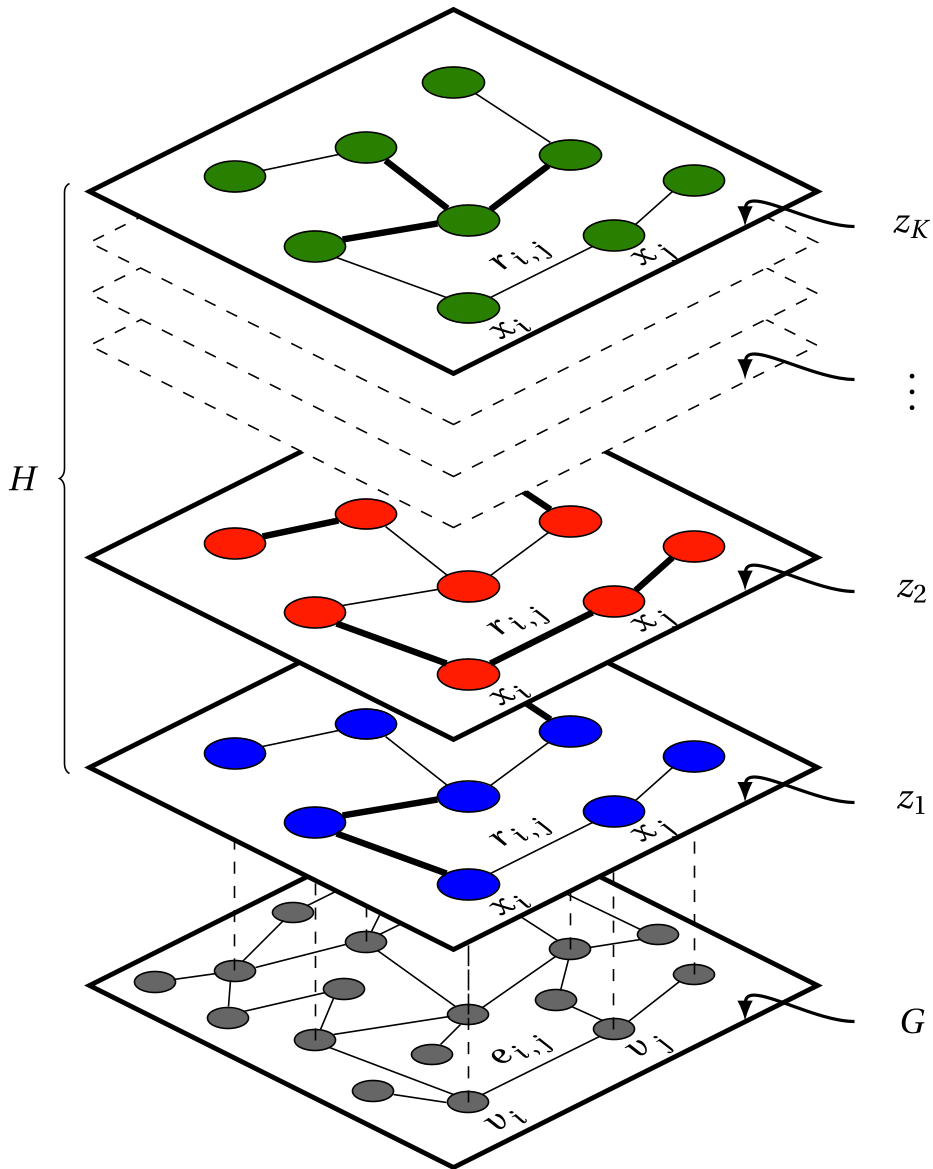 Figure 1: The Multidimensional Social Network where edges represent multifaceted communication channels.
Instead of just searching for the "closest" nodes, ChemoTF follows a strategy of:
- Filtering experts who meet the Chemistry threshold for the task.
- Selecting the candidate with the highest Expertise Level.
- Verifying the Expert Cost (derived from h-index and citation impact) stays within the project budget.
Experimental Results: SOTA Comparison
The authors tested ChemoTF against seminal algorithms like RarestFirst, EnSteiner, and MinSD using the CompScholarCorp, a massive dataset containing over 1 million publications.
Key Performance Indicators:
- Expertise Supremacy: ChemoTF produced teams with roughly 80% higher expertise than competing algorithms.
- Predictable Costs: It is the only algorithm that consistently formed teams under the average personnel cost (100% success rate compared to ~11% for others).
- Cohesion: Despite not explicitly minimizing graph distance, the resulting teams showed higher Density and Centrality, meaning they were more influential and had more internal communication channels.
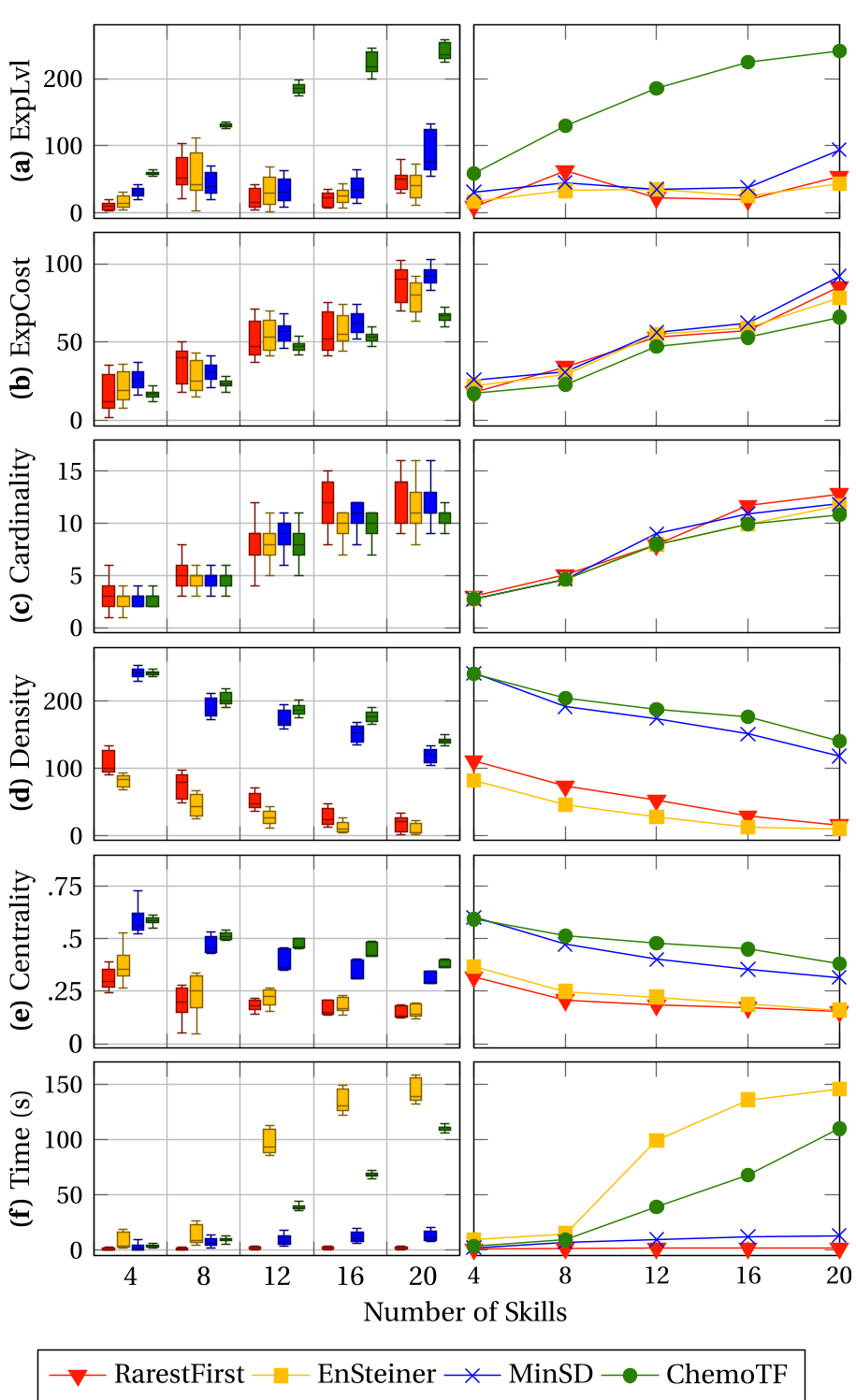 Figure 2: ChemoTF (Green) outperforms baselines in Expertise Level, Cost, and Density across different task sizes.
Critical Insight: Why it Works
The brilliance of ChemoTF lies in its use of Latent Dirichlet Allocation (LDA) to ground social relationships in content. By analyzing the textual output of collaborations (abstracts and keywords), the algorithm captures the "physics" of the collaboration. It recognizes that "Chemistry" is a proxy for reduced cognitive load—when two experts have high chemistry, they spend less time translating concepts and more time executing.
Conclusion & Future Outlook
ChemoTF demonstrates that in the era of Big Data, team formation must move beyond simple graph theory into the realm of semantic understanding. While the current model relies on scholarly corpora, the same principles could be applied to enterprise data (Slack, GitHub, Jira) to form the next generation of high-performance corporate teams.
Takeaway: Don't just hire for proximity; hire for "Conceptual Chemistry."