
U2C Algorithm: Engineering Cohesion in the e-Learning Social Revolution
Forming Homogeneous Classes for e-Learning in a Social Network Scenario
This paper introduces a multi-agent system (MAS) approach to form homogeneous e-Learning classes within Online Social Networks (OSNs). The core method, the User-to-Classes (U2C) algorithm, enables autonomous agents to dynamically match individual user profiles with evolving class profiles, achieving a stable and cohesive group environment.
TL;DR
The "e-Learning revolution" is often hindered by the chaotic nature of Online Social Networks (OSNs). This paper introduces the User-to-Classes (U2C) algorithm, a distributed multi-agent approach that models "Class Profiles" to automatically form and maintain homogeneous student groups. By minimizing a multi-dimensional dissimilarity measure, the system successfully increased group cohesion by over 60% in large-scale simulations.
Context: Why e-Learning in OSNs Fails
While OSNs offer flexibility and low costs, they are notoriously cluttered. Most platforms treat group formation as a static event or a simple recommendation task. However, for effective learning, a group (or "class") must remain homogeneous—meaning members should share similar interests, expertise, and social behaviors. Without dynamic management, interest wanes as the group becomes a "noisy" environment.
Methodology: The User-to-Class (U2C) Framework
The authors assign an autonomous software agent to every user and every class. These agents are responsible for maintaining a four-dimensional profile:
- T (Topics): Digital interest levels based on posting behavior.
- E (Expertise): Self-reported skill levels (e.g., Base, Medium, High).
- A (Actions): Behavioral traits, such as post frequency and response rates.
- F (Friends): Social connectivity overlap.
The Dissimilarity Engine
The heart of the system is the matching algorithm. It calculates a dissimilarity score () as a weighted mean of the differences across these four dimensions:

- User-Side Logic: User agents scan the network for classes that fall below a dissimilarity threshold ().
- Class-Side Logic: Class agents act as "gatekeepers," only accepting users who improve or maintain the class's homogeneity, or purging members who drift away from the class profile over time.
Experiments and Results
The researchers used ComplexSim to model a massive environment of 200,000 users.
1. Cohesion Stability
Starting from a state of high chaos (MAD = 0.479), the U2C algorithm iteratively refined the groups.
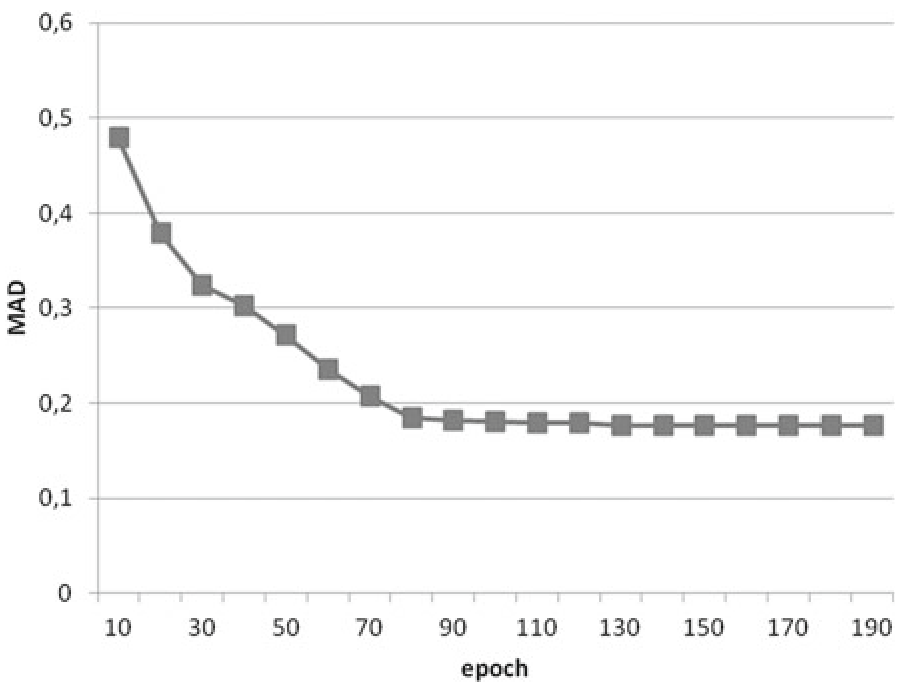 As shown in the graph, the network reaches a "stable configuration" around the 122nd epoch, where the Mean Average Dissimilarity settles at a much lower 0.176.
2. Scalability
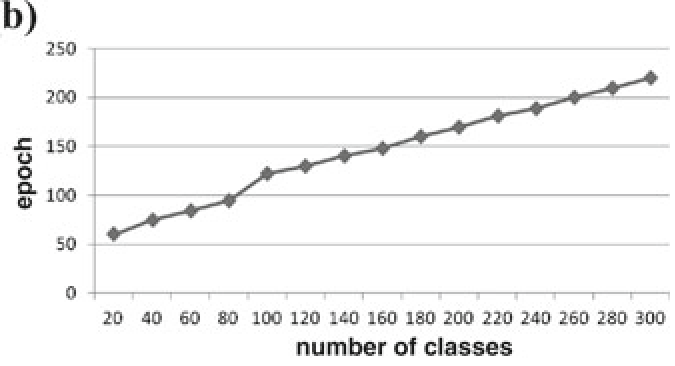
One of the critical findings is that the time required to reach stability increases linearly with the number of classes. This suggests that the distributed nature of the agents prevents the computational bottleneck typically found in centralized clustering algorithms.
Deep Insight & Conclusion
This work shifts the focus from content recommendation to community curation. By treating a "class" as a living entity with its own profile, the U2C algorithm ensures that the social environment evolves alongside its members.
Limitations: The current model relies on boolean variables for behavioral actions ("publishing > 2 posts") which might be too simplistic for complex human interactions. Future iterations could benefit from integrating Natural Language Processing (NLP) to capture the quality and sentiment of those posts.
Takeaway: For developers of e-Learning platforms, the message is clear: automation of group hygiene through Intelligent Agents is the key to preventing "learner's fatigue" in social-driven education.