
Beyond Similarity: Using Trust to Build Time-Stable Communities in Social Networks
Forming time-stable homogeneous groups into Online Social Networks
The paper introduces the U2G (User-To-Group) algorithm and a conceptual framework to form and evaluate time-stable homogeneous groups in Online Social Networks (OSNs). By integrating a novel measure called "Compactness"—a weighted combination of user similarity and mutual trust—it achieves higher homogeneity stability over time compared to traditional similarity-only methods on datasets like CIAO and EPINIONS.
TL;DR
Building a group based solely on shared interests is like building a house on sand—the interests shift, and the group collapses. This paper introduces the U2G algorithm, which utilizes a metric called Compactness. By blending user similarity with trust and reputation, the authors prove that groups can remain homogeneous and stable over long periods, even as individual user behaviors fluctuate.
The "Interest Decay" Problem
Most Online Social Networks (OSNs) suggest groups based on current interests. However, in the digital age, a user's passion for a specific product or topic can be fleeting. If a group's only bond is a shared interest in Music or Hardware, the group loses its "homogeneity" the moment users move on to new hobbies.
The authors identify a critical research gap: Time-Stability. Why do some groups survive while others die? Their insight is that similarity alone is a noisy, high-variance signal. To create a stable group, you need a "stabilizer"—and in human society, that stabilizer is Trust.
Methodology: The Anatomy of Compactness
The core of the paper is the concept of Compactness (), which balances two distinct forces:
- Similarity (): A weighted mean of Interests (), Behaviors (), and Access Modes ().
- Trust (): A combination of direct local reliability (past interactions) and global reputation (how the whole network views the user).
The U2G Algorithm
The User-To-Group (U2G) algorithm works through decentralized agents. Each user agent () and group agent () seeks to maximize the objective function: Where allows the system to tune the importance of similarity versus trust.
Note: The U2G algorithm uses a distributed directory facilitator (DDF) to manage communication between user and group agents, ensuring scalability.
Experiments: Proving the Stability
The authors tested their framework on two famous datasets: CIAO and EPINIONS. They divided the data into multiple time-windows to observe how "Average Similarity" (MAS) changed over time.
Key Findings:
- Trust is Resilient: Groups formed with a mix of trust and similarity (U2G-Comp) showed significantly less degradation in homogeneity than those formed by similarity alone (U2G-Sim).
- The "Uncorrelated" Factor: Even when the similarity components were "uncorrelated" (random/noisy), trust acted as a buffer, preventing the group from falling apart.
- Weight Sensitivity: Surprisingly, even a small weight assigned to trust () was enough to improve stability.
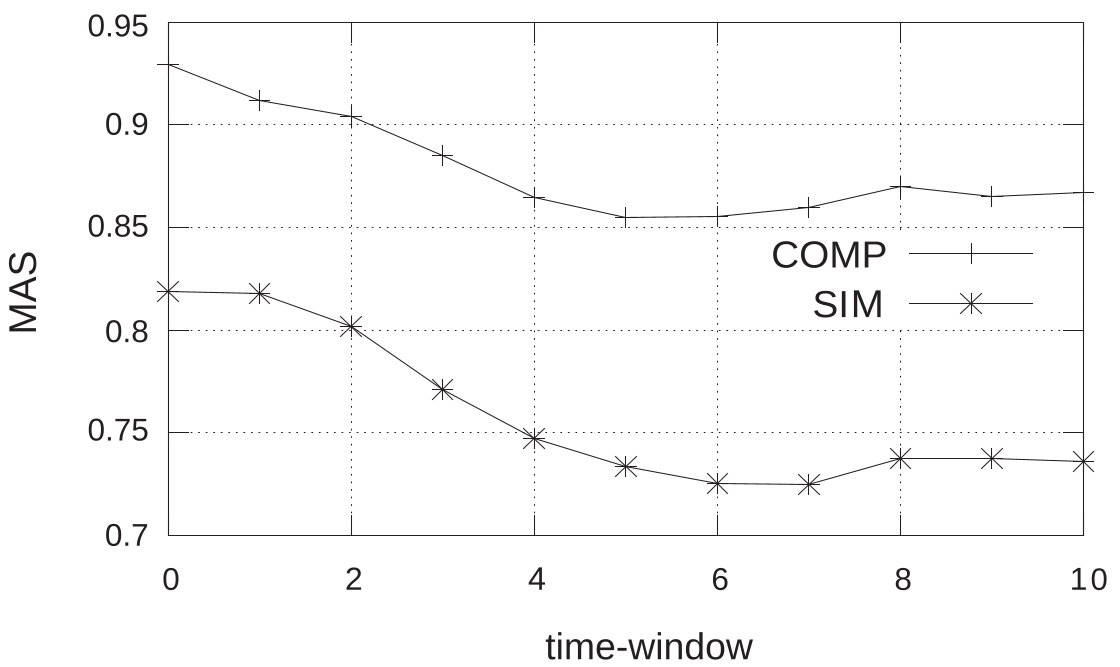 Fig 5: MAS measured over 10 time-windows showing the superior stability of U2G-Comp over U2G-Sim.
Critical Analysis & Conclusion
This research moves the needle from static group recommendation to dynamic community management. The primary contribution is proving that trust provides a "robustness" that covers for errors or shifts in similarity measures.
Limitations: The "Trust" in these datasets is often explicit (binary). In many modern OSNs, trust is implicit (shares, likes, dwell time), which might introduce more noise into the Compactness calculation. Additionally, the computational overhead of managing agent-based caches for a billion users remains a challenge for production environments.
Future Outlook: As AI community management becomes more prevalent, integrating Compactness into automated moderation and recommendation systems could lead to more resilient, less toxic, and longer-lasting digital "third places."