
Fabricius: Orchestrating Collective Intelligence in the Digital Classroom
Fostering collective intelligence education
The paper introduces Fabricius, a novel ICT-supported educational framework designed to foster Collective Intelligence (CI). By integrating idea management and real-time assessment, it shifts the pedagogical focus from individual performance to collaborative "learning by doing," achieving measurable improvements in student engagement and consensus-building.
TL;DR
As education moves beyond the "sage on the stage" model, researchers are looking toward Collective Intelligence (CI) to empower students. This paper presents Fabricius, a digital ecosystem that facilitates real-time idea management and collaborative assessment. By shifting the focus from individual testing to group-wide consensus and peer evaluation, the framework provides a structured approach to "learning by doing" that is both quantifiable and highly engaging.
The "Individual" Bottleneck
Despite the rise of Wikipedia and social networks, our classrooms remain largely individualistic. Most Educational Technology (EdTech) focuses on how an individual consumes content. The authors argue that this ignores the Collective IQ—the synergistic capacity of a group to innovate. The primary challenge isn't just "connecting" students, but providing a workflow where their collective output is greater than the sum of their individual parts.
Methodology: The Fabricius Engine
The authors propose a structured workflow divided into three technical pillars, moving from divergent thinking (brainstorming) to convergent action (decision making).
1. The Three Pillars of Fabricius
- Bestidea: A module for proposing and ranking ideas. It prevents "groupthink" by allowing individual submissions before collective voting.
- Guesscore: A real-time assessment tool where students grade each other. The "intelligence" here is measured by how accurately a student’s grade aligns with the expert (teacher) consensus.
- Miningant: The analytical layer that uses data mining to extract behavioral patterns from the interactions in the first two modules.
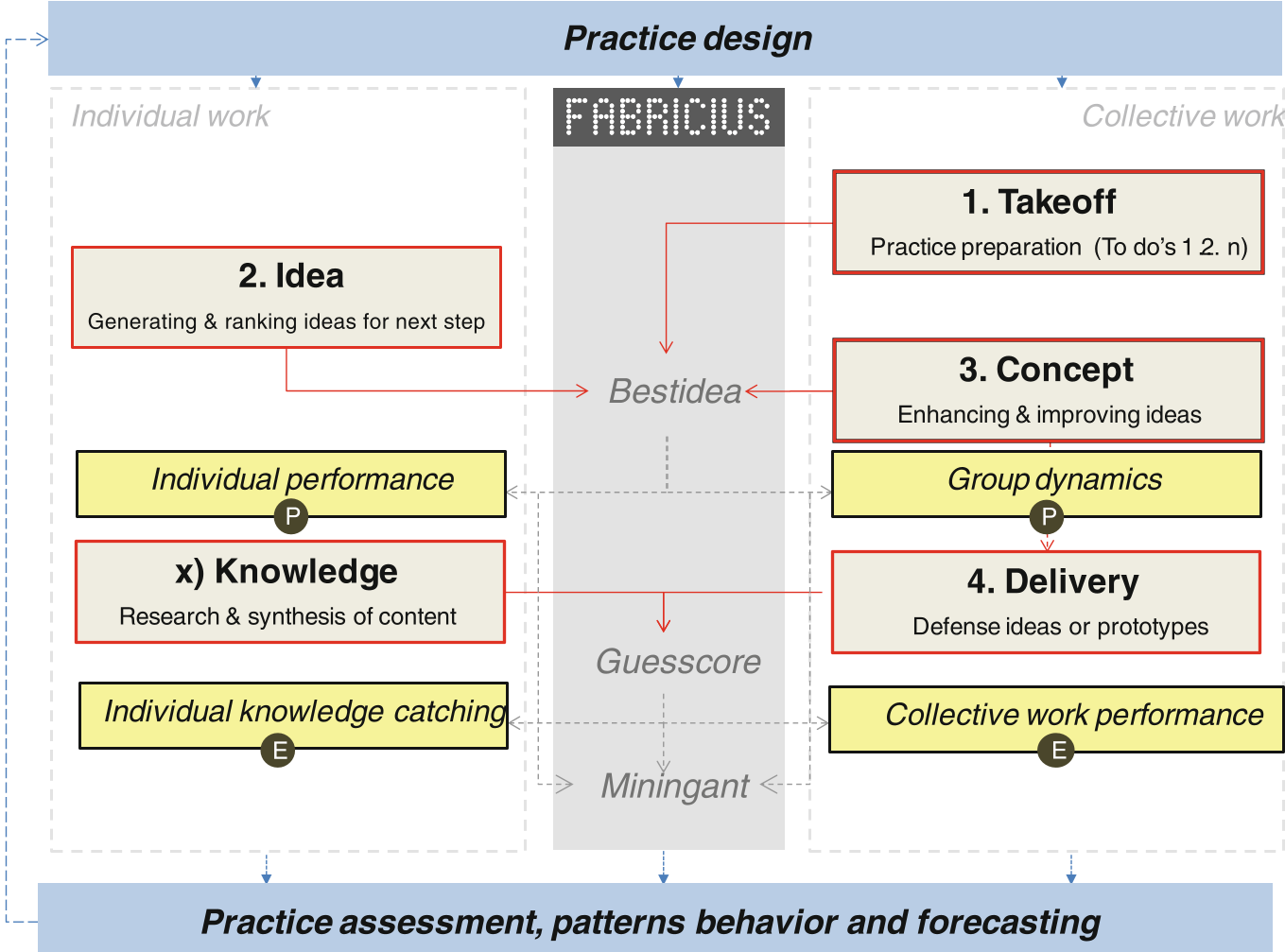 Figure 1: The Fabricius workflow combining individual production, collective filtering, and expert assessment.
2. The Learning Workflow
The process follows a "Take-off" to "Concept" trajectory. A unique aspect is the use of the Llullian method, where students are randomly assigned to vote on ideas from other groups (excluding their own), ensuring objectivity and broad engagement.
Experimental Results: Quantifying the Collective
The tool was tested in Spain and Ecuador across multiple disciplines. The experimental data revealed that students were not just passive participants but active "knowledge catchers."
Key Performance Indicators (KPIs)
To move CI from a vague concept to a rigorous metric, the paper proposes four DNA-like KPIs for education:
- Value from Ideas (Individual): How well did the crowd receive your specific suggestions?
- Accuracy in Assessment (Individual): Can you recognize quality? (Measured by the delta between student and expert scores).
- Value from Collective Work (Collective): The strength of the final group output.
- Self-assessment Accuracy (Collective): How well does the group understand its own performance?
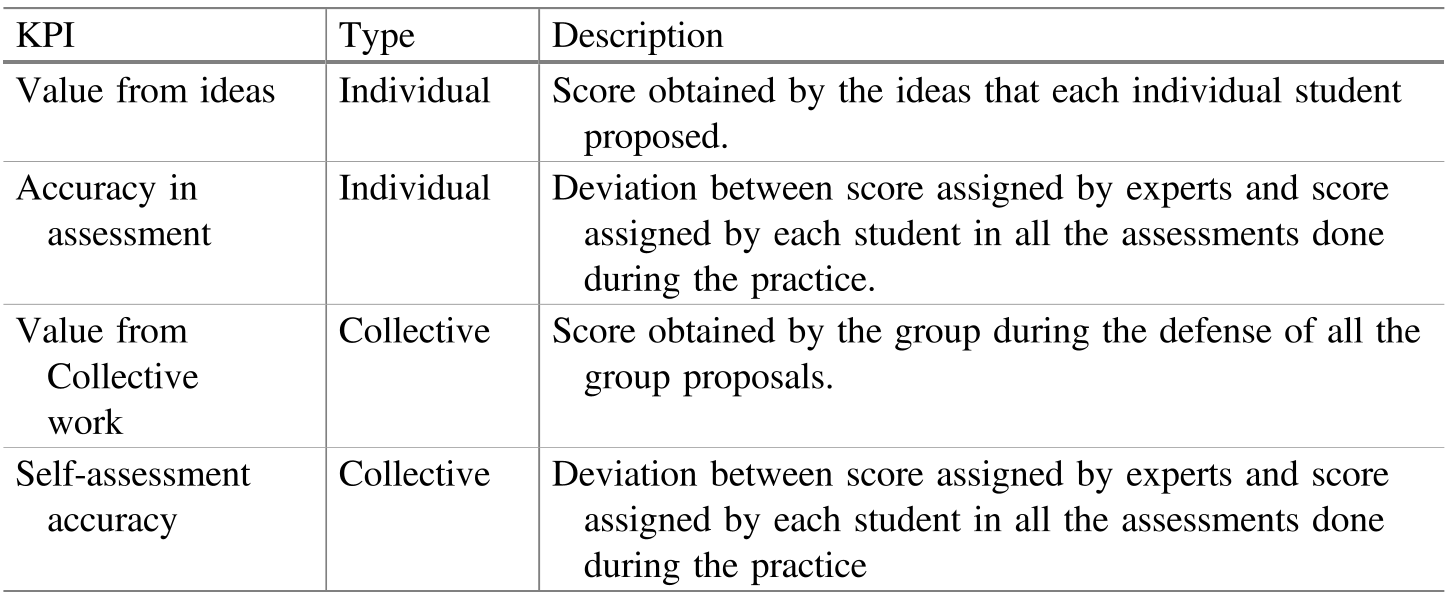 Table: Proposed KPIs to measure individual and collective performance.
Critical Insight: Transparency is Engagement
The brilliance of the Fabricius model lies in its transparency. By allowing students to see how their ideas rank in real-time and how their grading accuracy compares to experts, it creates a "gamified" sense of accountability.
However, the paper acknowledges a limitation: this is a "first approach." While the KPIs provide a great starting point, the "Miningant" (data mining) component requires more robust pattern recognition to truly predict student success before the course ends.
Conclusion
Fabricius demonstrates that Collective Intelligence is a designable feature of a classroom, not an accidental occurrence. By providing tools for structured debate and peer assessment, educators can transform a room of individuals into a high-functioning "collective brain." For future developers, the takeaway is clear: the next generation of EdTech must focus less on storing knowledge and more on orchestrating it.