
Beyond the Screen: Fostering Early Literacy through Embodied Cognition and Tangible Tech
1731_Fostering early literacy skills in children's libraries opportunities for embodied cognition and tangible technologies.
This research investigates the integration of Embodied Cognition and Tangible Technologies to foster early literacy in children's libraries. It proposes a conceptual framework for designing interactive library environments that move beyond traditional screen-based learning toward physical, multisensory engagement.
TL;DR
This research explores a paradigm shift in early childhood education: moving literacy from the page to the physical environment. By leveraging Embodied Cognition and Tangible Technologies, researchers from Arizona State University propose transforming libraries into interactive "Literacy Landscapes" where children learn letters and sounds through physical movement and object manipulation.
Motivation: The Literacy-Movement Gap
Traditional literacy education is often static. Children sit and look at books or screens. However, developmental psychology suggests that children learn best when their entire bodies are involved. Current library designs often miss the opportunity to integrate digital tools with the physical, architectural space of the library. The authors argue that by separating "digital learning" (screens) from "physical play," we are hindering the natural cognitive development of young readers.
Methodology: The Power of Embodiment
The core of this work is the application of Embodied Cognition. This theory posits that cognitive processes are deeply rooted in the body's interactions with the world.
1. Tangible User Interfaces (TUIs)
Instead of clicking a mouse, children interact with physical blocks or sensors. These "tangibles" bridge the gap between abstract symbols (letters) and physical reality.
2. The Literacy Landscape
The methodology envisions the library as a whole-body interface. For example, a child might walk across a floor sensor to "step on" a letter, triggering a sound, or arrange physical objects to create words that materialize on a wall-sized display.
 Figure 1: Conceptual mapping of how tangible interactions facilitate early literacy skills.
Designing for Libraries
The paper outlines specific opportunities for library interventions:
- Phonological Awareness: Using sound-reactive objects to help children "feel" the rhythm of language.
- Alphabetic Principle: Transitioning from 3D physical letters to 2D digital projections to help children understand the abstraction of writing.
- Collaborative Play: Unlike a single-user tablet, tangible landscapes allow multiple children to interact simultaneously, fostering social-emotional learning alongside literacy.
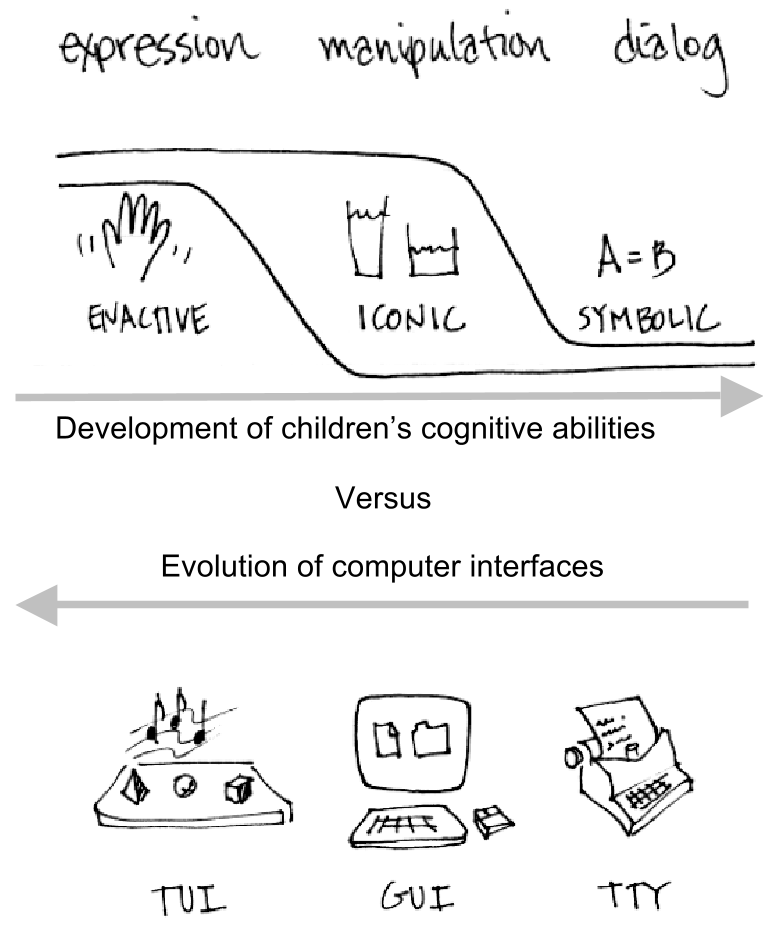 Figure 2: Examples of how children navigate physical spaces during interaction-heavy learning tasks.
Critical Analysis & Future Directions
The Impact
The primary value of this research is its design philosophy. It challenges the industry to move away from "iPad-centric" education. By grounding literacy in movement, we can potentially lower the barrier for children who struggle with traditional sedentary learning styles.
Limitations
- Implementation Cost: Deploying hardware-heavy "Literacy Landscapes" is significantly more expensive for public libraries than buying a few tablets.
- Scalability: The paper provides a conceptual framework but lacks a long-term longitudinal study on literacy outcomes compared to traditional methods.
Conclusion
As we look toward 2026 and beyond, the integration of the "Internet of Things" (IoT) with educational theory offers a path back to physical play. This paper serves as a foundational call to action for designers to treat the physical environment as an active participant in child development.
Takeaway: Real learning isn't just in the head; it’s in the hands and feet.