
FOUGERE: Reclaiming Location Privacy Through Decentralized Shuffling
FOUGERE: User-Centric Location Privacy in Mobile Crowdsourcing Apps
This paper introduces FOUGERE, a decentralized open-source middleware library designed to enhance user location privacy in mobile crowdsourcing. It employs an "a priori" anonymization strategy using opportunistic peer-to-peer (P2P) communication and local Location Privacy Protection Mechanisms (LPPMs) to defeat state-of-the-art privacy attacks.
TL;DR
Mobile crowdsourcing is a goldmine for data, but it’s often a nightmare for privacy. FOUGERE is an open-source middleware that stops sensitive location data from ever reaching a central server in its raw form. By leveraging Wi-Fi Direct to "shuffle" data between physically nearby users (multi-hop dissemination) and applying local obfuscation, it defeats state-of-the-art tracking attacks while maintaining high data utility.
Deep Dive into the Privacy Pain Point
Existing mobile crowdsourcing (e.g., MobiPerf, APISENSE) follows an "Upload First, Anonymize Later" paradigm. This is inherently risky for three reasons:
- Server Vulnerability: Even "secure" servers can be compromised, leaking raw spatio-temporal traces.
- Lack of Trust: Users are hesitant to share Sensitive Personal Information (SPI) with third-party aggregators.
- Spatiotemporal Linking: Even if a name is removed, a user's unique home-to-work routines act as a "fingerprint" that makes de-anonymization trivial.
FOUGERE shifts the focus to a priori anonymization: privacy happens on the device, before the data ever leaves the local network of peers.
Methodology: How FOUGERE Works
FOUGERE acts as an embedded proxy between the crowdsourcing app and the internet. Instead of a direct upload, it follows a three-step process:
1. SPI Classification & Filtering
The library identifies four types of sensitive data: Identifiers (IMEI/IDs), Points of Interest (GPS locations), Routines (Timestamps), and Markers (Device OS/Model). Users can set "Black areas" or "Time filters" to stop data collection in sensitive zones like their homes.
2. Multi-hop Opportunistic Dissemination
This is the core "shuffling" mechanism. When an app generates data, FOUGERE doesn't upload it immediately. It discovers nearby peers via Wi-Fi Direct and forwards the encrypted payload.
- TTL (Time-to-Live): Data is forwarded through hops between different users.
- Bloom Filters: Used to track which devices have already seen the data to prevent loops and ensure the data "travels."
3. Integrated LPPMs (Location Privacy Protection Mechanisms)
Beyond shuffling, FOUGERE applies:
- Distortions: Adding Laplace noise to coordinates or jittering timestamps.
- Aggregations: Implementing -anonymity locally (e.g., only uploading data if at least users are in the same vicinity).
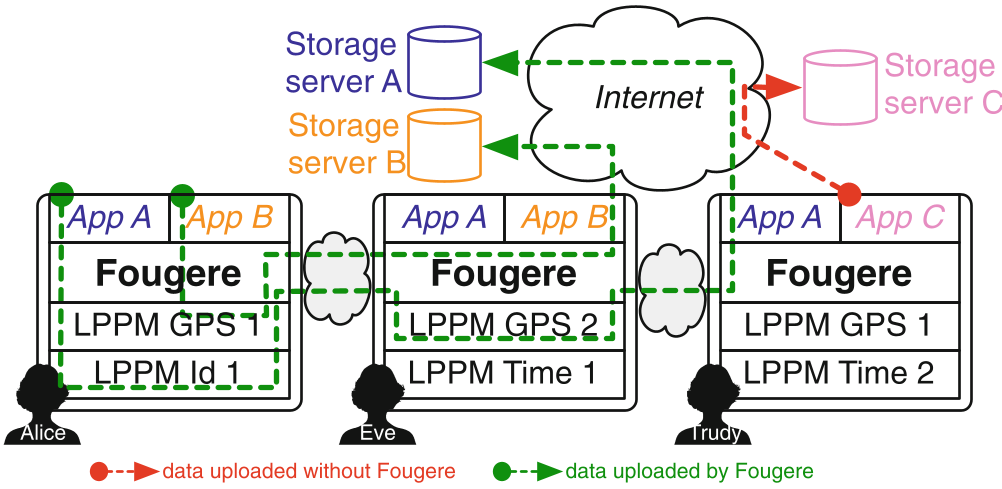 Figure: Difference between standard crowdsourcing (left) and FOUGERE’s decentralized proxy approach (right).
Experimental Results & Robustness
The authors tested FOUGERE against the LPM2 toolkit, a standard for evaluating location privacy. They replayed realistic cab mobility traces from San Francisco (SfCabs).
Key Performance Indicators:
- Travel Distance: In the default configuration (4 hops), 20% of the data was uploaded from locations over 10km away from where it was actually recorded.
- Anonymity vs. Utility: While the "Vanilla" approach has 100% utility but 0% anonymity, FOUGERE's "Weak Privacy" profile provided a massive jump in protection with only a minor drop in data quality.
- The "Outlier" Protection: FOUGERE naturally discarded data from isolated users (8 out of 500 in the large-scale test). While this lowers "utility" slightly, it is a deliberate security feature—if you are the only person in the countryside, any data you send is a privacy leak.
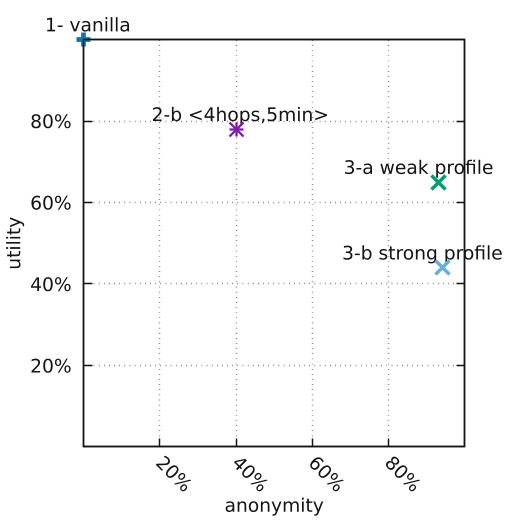 Figure: Robustness against location privacy attacks. Workers using FOUGERE (bars other than Worker 3) show significantly higher resistance to tracking.
Critical Analysis & Future Outlook
FOUGERE successfully proves that physical proximity can be a powerful tool for privacy. By mixing data with "neighbors," users hide in the crowd.
Strengths:
- No Single Point of Failure: Does not rely on a central "Anonymizer" server.
- Developer Friendly: Packaged as an Android library with simple
send()andforward()APIs.
Limitations:
- User Density: The system's effectiveness depends on the presence of other users nearby. In rural settings, data might take hours to upload or be discarded entirely.
- Battery Overhead: Wi-Fi Direct scanning and P2P communication consume more energy than a simple 4G upload.
Conclusion: As GDPR and other privacy regulations tighten, FOUGERE provides a blueprint for "Privacy by Design." It transforms mobile crowdsourcing from a potentially intrusive surveillance tool into a collaborative, community-driven data collection method.