
ROWL: Bridging the Trust Gap in the Semantic Web through Certified Reasoning
Foundational Challenges in Automated Semantic Web Data and Ontology Cleaning
This paper explores the foundational challenges of automated data cleaning in Knowledge Databases (KDBs) within the Semantic Web. It proposes ROWL (Reasonable Ontology Web Language), an extension of OWL that integrates formally certified Automated Reasoning Systems (ARS) to detect and repair semantic anomalies and inconsistencies.
TL;DR
Building a "Knowledge Database" (KDB) on the Semantic Web is easy; keeping it clean and consistent is hard. This paper argues that data and ontologies are indissolubly married and proposes ROWL (Reasonable Ontology Web Language). By embedding formally verified Automated Reasoning Systems (ARS) into our ontologies using the ACL2 logic, we can transition from "static metadata" to "active, self-cleaning agents" that certify the logical integrity of the Web.
The "Utopian" Semantic Web meets Reality
The original vision of the Semantic Web involves a layer of "Logic and Proof" acting as the foundation for "Trust." However, real-world data is messy. Inconsistencies arise from:
- Incomplete Knowledge: We cannot assume our KDBs are ever finished.
- Ontology Evolution: As ontologies change, the data committed to earlier versions becomes "anomalous."
- Skolem Noise: The unintended logical artifacts created when reasoning with "poor" or provisional ontologies.
Existing Automated Reasoning Systems (ARSs) act as assistants, but they often produce an "overspill" of info—generating thousands of arguments that no human expert can verify.
Methodology: From Static OWL to Reasonable ROWL
The core innovation is the Certified Generic Framework (CGF). Instead of using an external, unverified reasoner, the authors suggest the ontology should define its own reasoning framework.
The ROWL Architecture
ROWL extends the standard Web Ontology Language (OWL) by attaching:
- Computation Rules: To drive the deduction process.
- Measure Functions: To prove that the reasoning algorithms will eventually halt.
- Model Functions: To provide concrete examples of models.
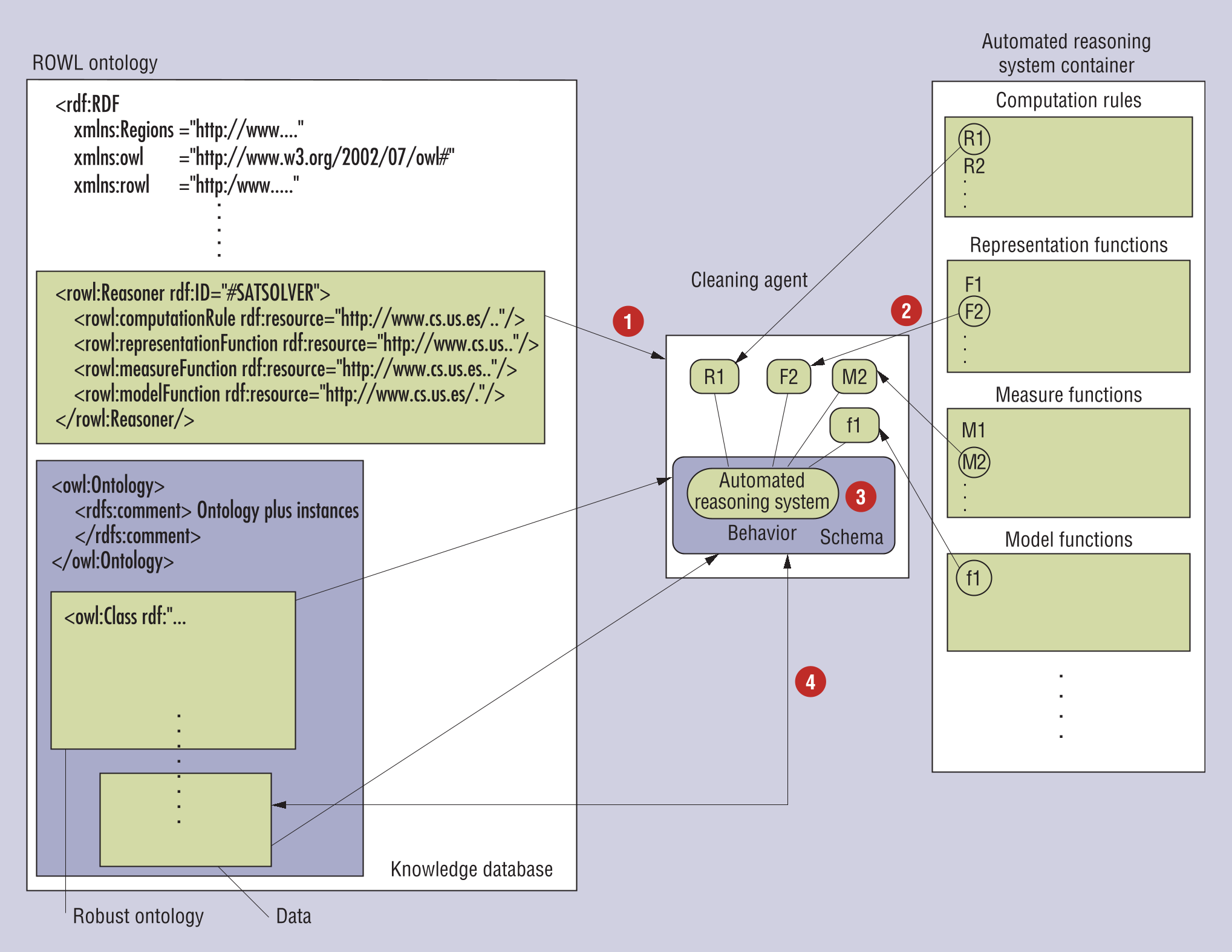 Figure: The proposed general-purpose logic-based agent architecture using ROWL.
By using ACL2 (a computational logic used for hardware/software verification), the authors synthesize an SAT prover that is sound, complete, and formally verified. This means if the cleaner says your data is inconsistent, you can trust that conclusion mathematically.
Experimental Validation: The "Tarzan" Paradox
To test the system, the authors designed an ontology where a character (Tarzan) is defined as both a Herbivore and a Carnivore—a logical contradiction.
The Cleaning Session
The ROWL agent performs a three-step process:
- Normalization: It transforms OWL axioms into propositional formulas.
- Synthesis: It generates a Davis-Putnam SAT solver tailored to the specific ontology.
- Verification: It checks for satisfiability.
 Figure: Transformation of OWL concepts into SAT-solvable logic formulas for consistency checking.
Performance Stats:
- SAT Solver Synthesis: 0.28 seconds.
- Satisfiability Check (Anomaly Detection): 0.02 seconds.
Deep Insight: Why Robustness Matters
The authors define a Robust Ontology as one where:
- The Core is clear and stable.
- Models of the core exhibit similar properties.
- Minor changes outside the core do not lead to a total collapse of consistency.
The "Skolem Noise" phenomenon (illustrated in the paper via spatial reasoning) shows that when we work with poor ontologies, the reasoner itself can suggest how the ontology should evolve—for instance, by adding new interpretations of spatial intersections.
Final Takeaway
The future of the Semantic Web isn't just about "linking data"; it's about linking reasoning. ROWL provides a path toward agents that don't just find errors but can prove they found them, providing the "Certified Reasoning" necessary for a secure and trustworthy Web.
Limitations & Future Work
While the synthesis is fast, the resulting provers currently lack the performance of state-of-the-art C++ SAT solvers. Future research aims to utilize more efficient data structures within the ACL2 framework to bridge the performance gap while maintaining formal correctness.