
Foundations of Schrödinger Bridges: The Unified Theory of Generative Modeling
Foundations of Schr\" odinger Bridges for Generative Modeling
This paper provides a unified mathematical foundation for Schrödinger Bridges (SB) in generative modeling, framing the transformation of probability distributions as an entropy-regularized optimal transport problem. It develops a comprehensive toolkit—spanning static and dynamic SB, stochastic optimal control, and path-space projections—to generalize diffusion models, score-based modeling, and flow matching into a single theoretical framework.
TL;DR
Generative modeling is undergoing a shift from "denoising noise" to "bridging distributions." This comprehensive guide establishes Schrödinger Bridges (SB) as the foundational principle unifying diffusion, flow matching, and optimal transport. By framing generation as a minimal-entropy path between two arbitrary marginals, SB theory allows us to move beyond Gaussian priors into structured, high-dimensional data translation and scientific simulation.
Background Positioning: The Grand Unification
For years, diffusion models and flow matching were treated as separate lineages. This paper argues they are merely special cases of the Schrödinger Bridge problem—a variational challenge originally posed by Erwin Schrödinger in 1931. In the academic coordinate system, this work acts as a foundational bridge, connecting the physics of stochastic processes with the practical requirements of deep generative AI.
Problem & Motivation: Beyond the Gaussian Cage
Standard score-based models are restricted: they must start from an uninformative noise distribution. This is inefficient when our "prior" has a rich structure (e.g., a blurred image or a specific cellular state).
The core limitation of prior work (Monge-Kantorovich Optimal Transport) is its deterministic nature, which often leads to "unstable" or "collapsed" mappings. By introducing Entropy Regularization, SB theory ensures that mass is spread smoothly across probability space, providing a unique, stable solution that handles stochasticity gracefully.
Methodology: The Math Behind the Magic
1. The Hopf-Cole Transform
The most profound insight in SB theory is the linearization of the non-linear dynamics. The optimal transition is governed by two coupled PDEs: the Hamilton-Jacobi-Bellman (HJB) and Fokker-Planck (FP) equations. Through the Hopf-Cole Transform, we can factorize the optimal density into two scalar potentials: This decouples the system into forward and backward linear heat equations, making the problem of finding the "optimal drift" equivalent to estimating the gradient of a log-potential.
2. Forward-Backward SDEs (FBSDEs)
Instead of just one SDE running forward, we now have a dual-SDE system. The forward SDE transports samples from , while the backward SDE propagates the "influence" of the target distribution back to the start.
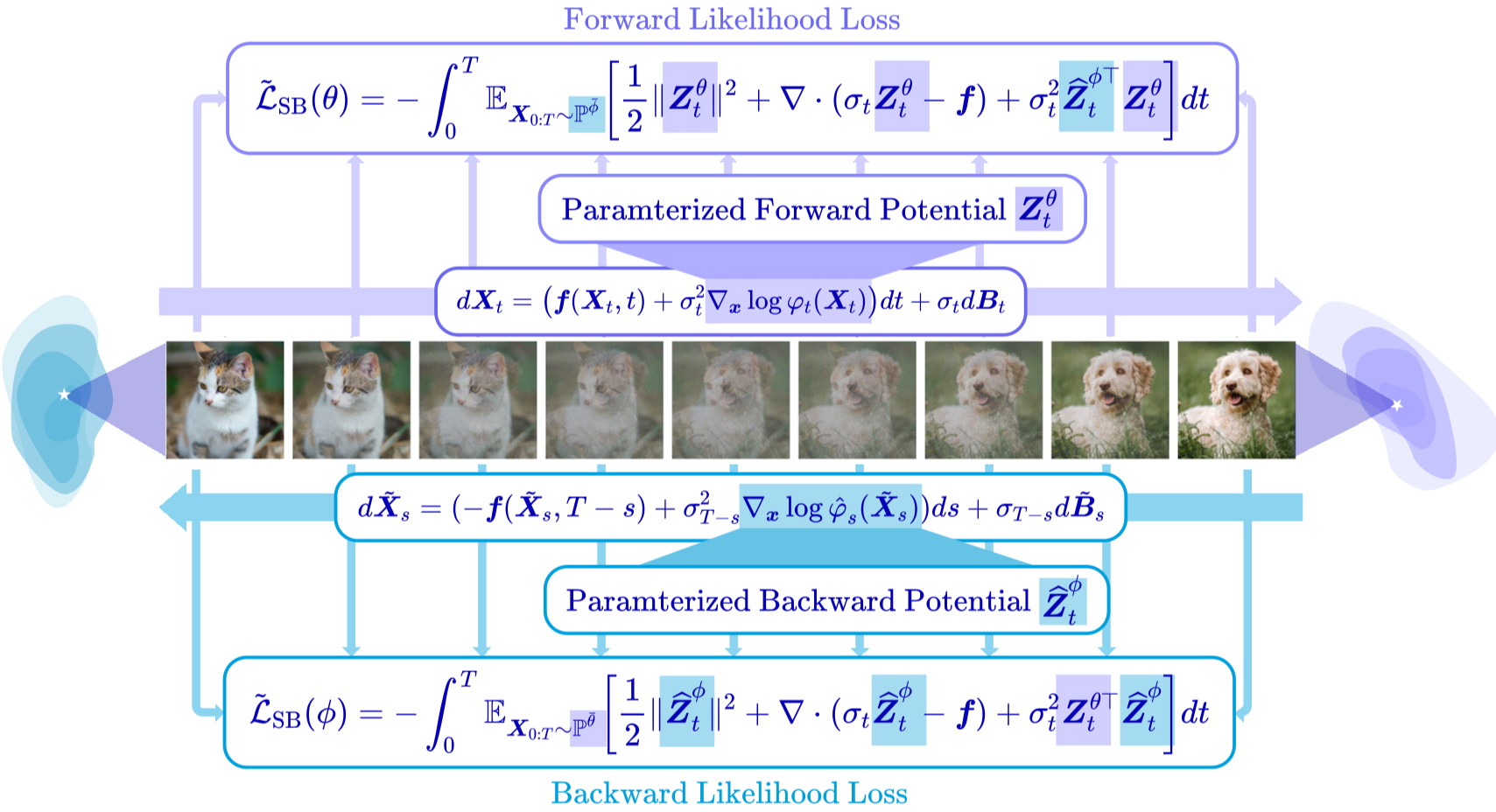 Figure: The interaction between forward potential drifts and backward correctors defines the optimal path.
3. Iterative Markovian Fitting (IMF)
How do we actually train this? The paper details the IMF procedure, which alternates between:
- Markovian Projection: Finding the best Markov drift to approximate a complex bridge.
- Reciprocal Projection: Ensuring the endpoints match the target labels. This is effectively "Sinkhorn's Algorithm" for the space of stochastic paths.
Specialized Variations: Tackling Real-World Complexity
One of the paper's strengths is its extension of SB to non-standard settings:
- Gaussian SB: Proving the bridge between two Gaussians has a closed-form solution on the Bues-Wasserstein manifold.
- Unbalanced SB: For systems where mass is created or destroyed (essential for biology, where cells divide or die).
- Branched SB: Modeling a single source splitting into multiple terminal nodes (e.g., cell differentiation lineages).
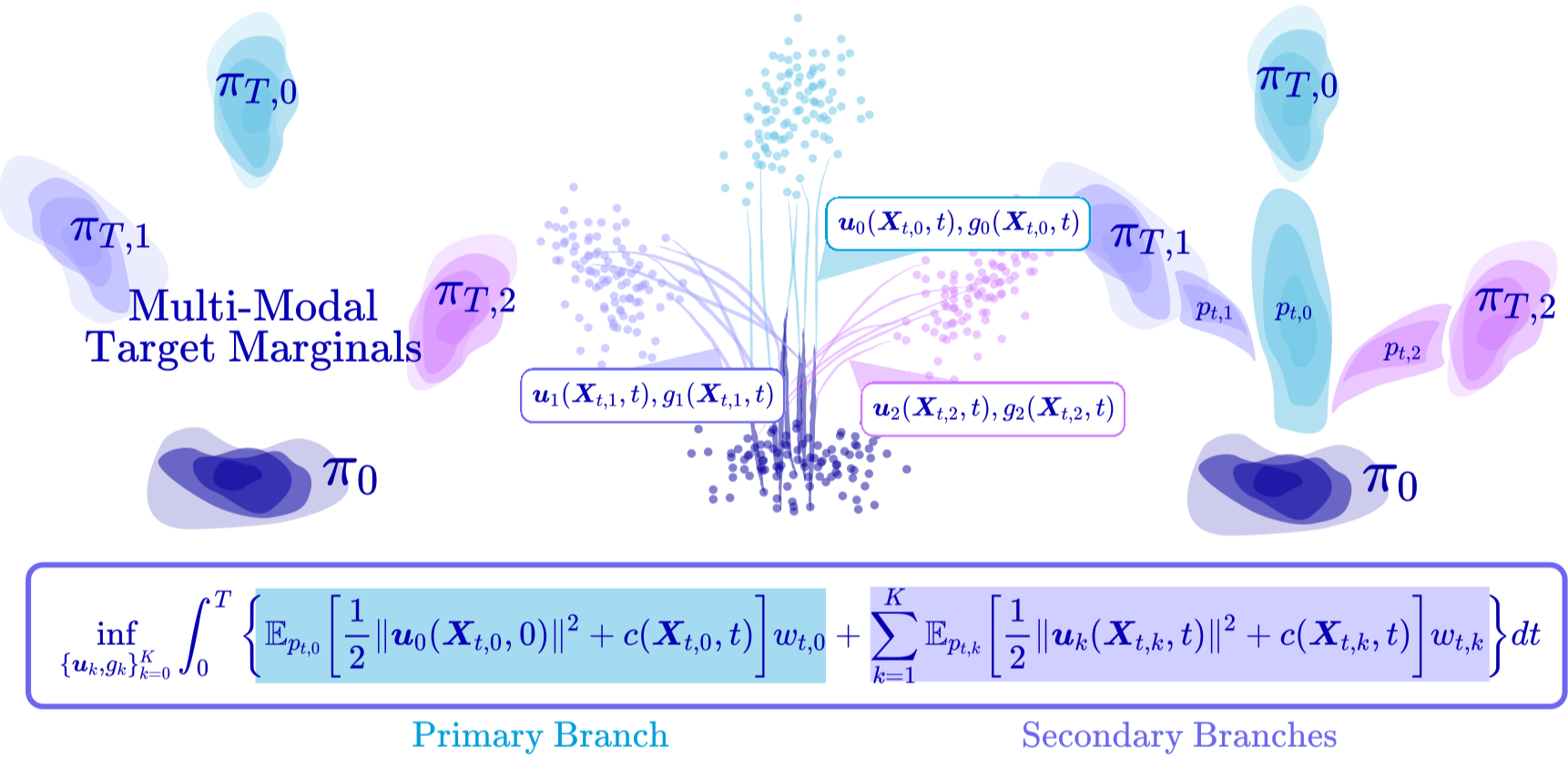 Figure: The Branched SB enables probabilistic splitting of trajectories into multiple target modes.
Experimental Insights & Applications
The paper highlights transformative applications:
- Boltzmann Sampling: Learning to sample from unnormalized energy functions by treating it as a terminal cost in an SOC objective.
- Single-Cell Dynamics: Reconstructing the "bridge" between snapshots of cell gene expressions taken days apart.
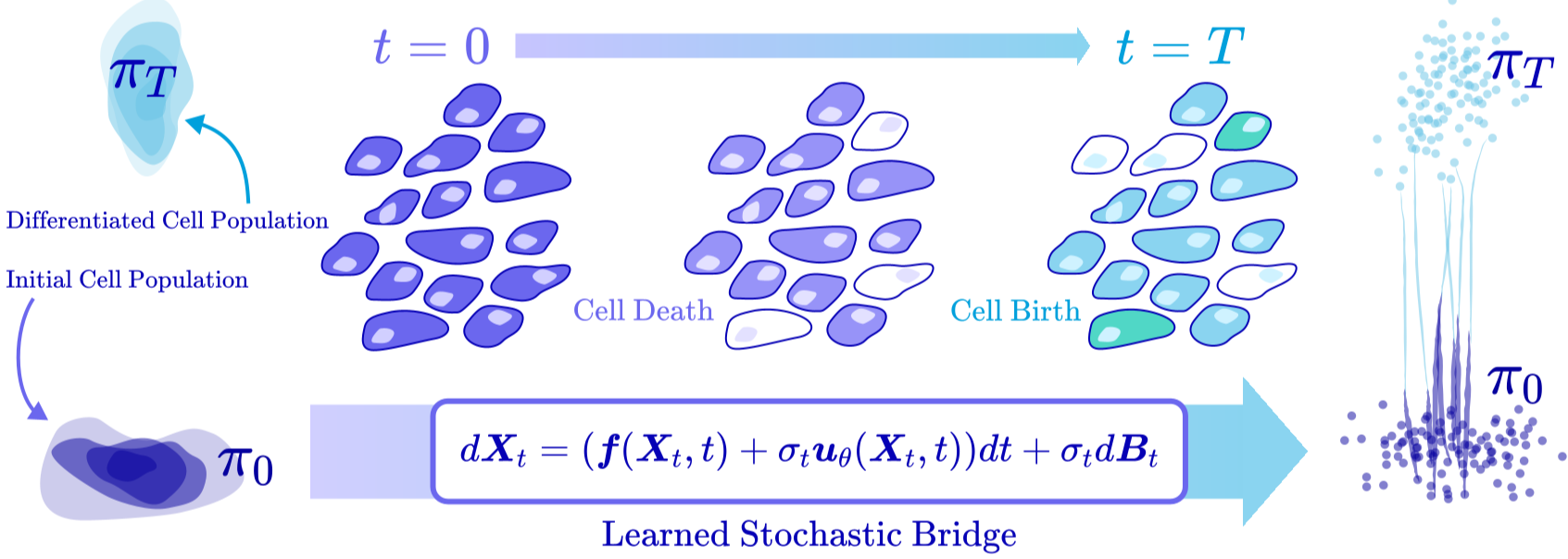 Figure: SB successfully interpolates the continuous flow of cell states from static snapshots.
Critical Analysis & Conclusion
Takeaway
The Schrödinger Bridge is more than an algorithm; it is a principled toolkit. By viewing generative modeling through the lens of path-measure relative entropy, we can design models that are physically grounded and statistically optimal.
Limitations
Despite the mathematical elegance, the computational cost of simulating full SDE trajectories during training remains a bottleneck for very high-dimensional data (like 4K video) compared to simple flow matching.
Future Work
The next frontier lies in Simulation-Free Adjoint Matching, which promises to train these complex bridges without ever needing to integrate an SDE during the inner loop of training, potentially making SB as fast to train as standard GANs or diffusion models.