
Fractal Intelligent Privacy Protection: Balancing Security and Utility in Social Networks
8582_Fractal Intelligent Privacy Protection in Online Social Network Using Attribute-Based Encryption Schemes.
This paper proposes a multi-layered intelligent privacy protection framework for Online Social Networks (OSNs). It integrates a Hybrid Hierarchy Genetic Algorithm-Radial Basis Function (HHGA-RBF) neural network for security prediction, Attribute-Based Encryption (ABE) for fine-grained access control, and Particle Swarm Optimization (PSO) to enhance privacy robustness.
TL;DR
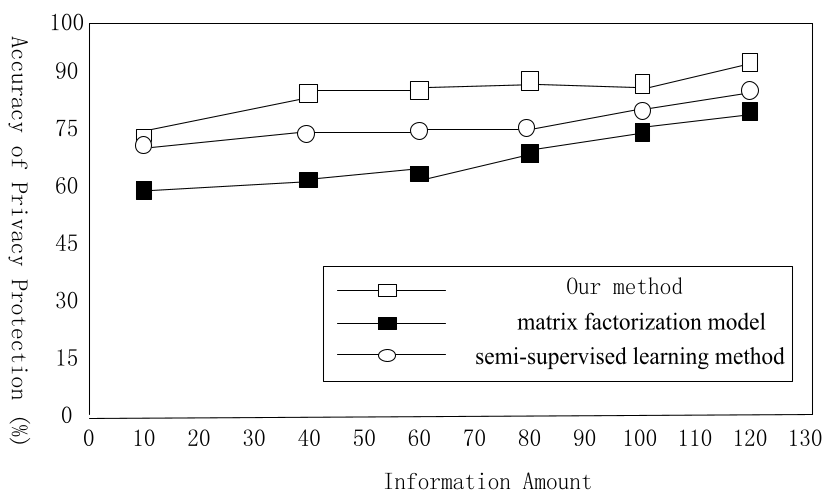
Researchers have developed a comprehensive "intelligent computing" framework for Online Social Networks (OSNs) that combines neural network predictions, Attribute-Based Encryption (ABE), and Particle Swarm Optimization (PSO). The system achieves a staggering 94.2% encryption accuracy while maintaining a low information loss ratio (17.59%), significantly outperforming traditional semi-supervised and matrix factorization models.
Context & Motivation: The Social Network Paradox
Online Social Networks are built on sharing, yet this very openness creates a massive surface for privacy leaks. The authors identify two critical flaws in existing SOTA (State Of The Art) methods:
- Rigidity: Current access control can't handle the complex, attribute-heavy relationships of modern users.
- Structural Vulnerability: Anonymizing names isn't enough; attackers can use "subgraph matching" (friend diagrams) to re-identify users based on their connections.
Methodology: The Intelligent Defense Stack
The paper introduces a pipeline that moves from prediction to protection:
1. Security Prediction with HHGA-RBF
The system doesn't just react; it predicts. By using a Hybrid Hierarchy Genetic Algorithm (HHGA) combined with a Radial Basis Function (RBF) neural network, the model determines the current security state of the network. The HHGA optimizes the neural network's architecture (using management genes to toggle hidden layers) to prevent the slow convergence typical of standard RBF networks.
2. Fine-Grained Access Control (ABE)
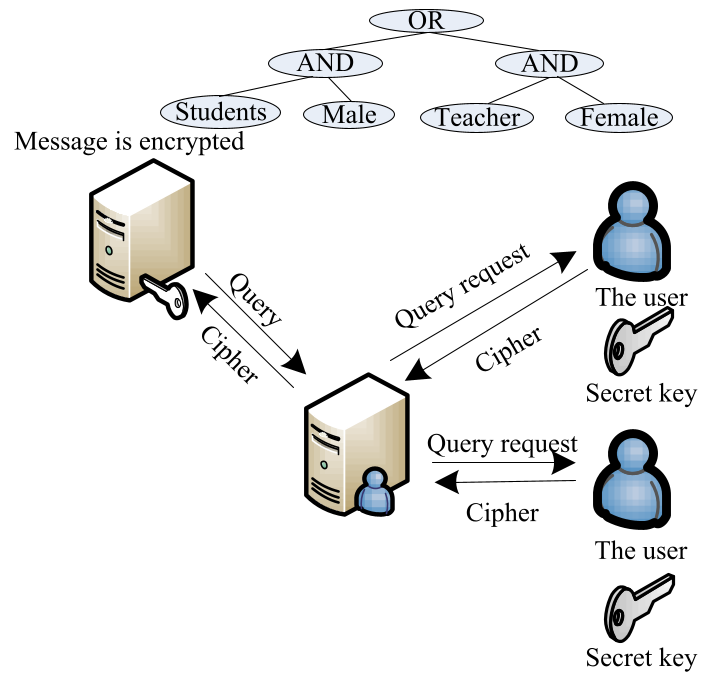
Instead of simple passwords, the paper employs Attribute-Based Encryption (ABE).
- How it works: Data is encrypted using an access tree. A user can only decrypt it if their set of attributes (e.g., "Friend," "Alumni," "Colleague") satisfies the logic of the tree.
- Visual Process:
3. Privacy Preservation via PSO
To prevent structural attacks, the authors use Particle Swarm Optimization (PSO). This simulates bird flocking behavior to find the "global optimal" way to confuse the social graph (adding/removing noise) so that an attacker's sub-graph query returns multiple possible matches, effectively hiding the target in a "crowd."
Experimental Battleground: Results that Matter
The authors benchmarked their "Fractal Intelligent" method against clustering, semi-supervised learning, and matrix factorization models.
Key Metric 1: Accuracy and Speed
The proposed method achieved an average encryption accuracy of 94.2%, dwarfing the clustering method's 53.2%. Crucially, this wasn't at the cost of speed; the secret key generation time was cut by 0.2 seconds compared to classical approaches.
Key Metric 2: Efficiency vs. Information Loss
A major problem with privacy protection is that "over-protecting" makes data useless. This method achieved a low information loss ratio (17.59%), meaning the social network remains functional and data-rich for legitimate use while staying secure.
Critical Insight: Why This Works
The "magic" lies in the synergy between biological optimization and cryptographic rigor. Cryptography (ABE) provides the "hard" locks, while biological optimization (PSO/GA) handles the "soft" complexity of network structures. By treating privacy protection as a multi-objective optimization problem (maximizing security while minimizing loss), the authors move away from "one-size-fits-all" security.
Conclusion & Future Outlook
This work sets a new benchmark for OSN security. However, the authors note that the future of privacy lies in defending against topological similarity attacks. Their next steps involve integrating chaotic encryption and graphical encryption into the ABE framework to stay one step ahead of increasingly intelligent privacy adversaries.
Takeaway for Architects
If you are building data-sharing platforms, the lesson is clear: don't rely on a single layer. Combine predictive modeling (what is the threat level?) with attribute-centric encryption (who actually gets access?) and graph optimization (how can we mask the structure?).