
Beyond Integer Physics: Leveraging Fractional Derivatives to Detect Handwriting Difficulties in Children
Fractional Order Derivatives Evaluation in Computerized Assessment of Handwriting Difficulties in School-aged Children
This paper introduces a novel computerized framework for identifying Handwriting Difficulties (HD) in school-aged children by employing Fractional Order Derivatives (FD) for kinematic analysis. By utilizing the Grünwald-Letnikov approximation to extract non-integer order velocity and acceleration, the study demonstrates that FD-based features significantly enhance the quantification of "in-air" movements compared to conventional integer-order derivatives.
TL;DR
Handwriting is not just about the ink on the paper; it’s about the "dance" of the pen in the air. This study moves beyond traditional physics by using Fractional Order Derivatives (FD) to analyze the handwriting of school-aged children. By calculating non-integer acceleration and velocity, the researchers uncovered hidden patterns of hesitation and dysfluency that traditional methods miss, providing a more robust objective tool for diagnosing developmental dysgraphia.
Background: The Limits of Visual Inspection
Handwriting Difficulties (HD) affect up to 34% of children, impacting their academic achievement and self-esteem. Historically, therapists have relied on visual inspection—checking legibility, letter formation, and speed. However, this "product-based" assessment is subjective and ignores the "process." Even early computerized methods focused on basic kinematic features (velocity, acceleration) defined by standard calculus (1st and 2nd order derivatives). The problem? Standard derivatives assume a level of smoothness that impaired handwriting simply doesn't have.
The Insight: Why Fractional Calculus?
The core intuition of this paper is that human movement, especially when impaired, is fractal and non-smooth. Traditional derivatives (, ) are "local" operators. In contrast, Fractional Derivatives have "memory"—they take into account the history of the signal. This makes them exceptionally sensitive to the jerky, hesitating, and inconsistent movements (especially "in-air" movements) seen in children with HD.
Methodology: Capturing the In-Air "Phantom" Strokes
The researchers used a Wacom digitizing tablet to capture coordinates and pressure at 150 Hz. They specifically looked at:
- On-surface movement: When the pen touches the paper.
- In-air movement: When the pen is within 1.5 cm of the surface but not touching.
They replaced standard velocity and acceleration formulas with the Grünwald-Letnikov approximation. By testing different orders (), they essentially tuned their "mathematical lens" to find the exact level of sensitivity needed to distinguish healthy controls (HC) from those with HD.
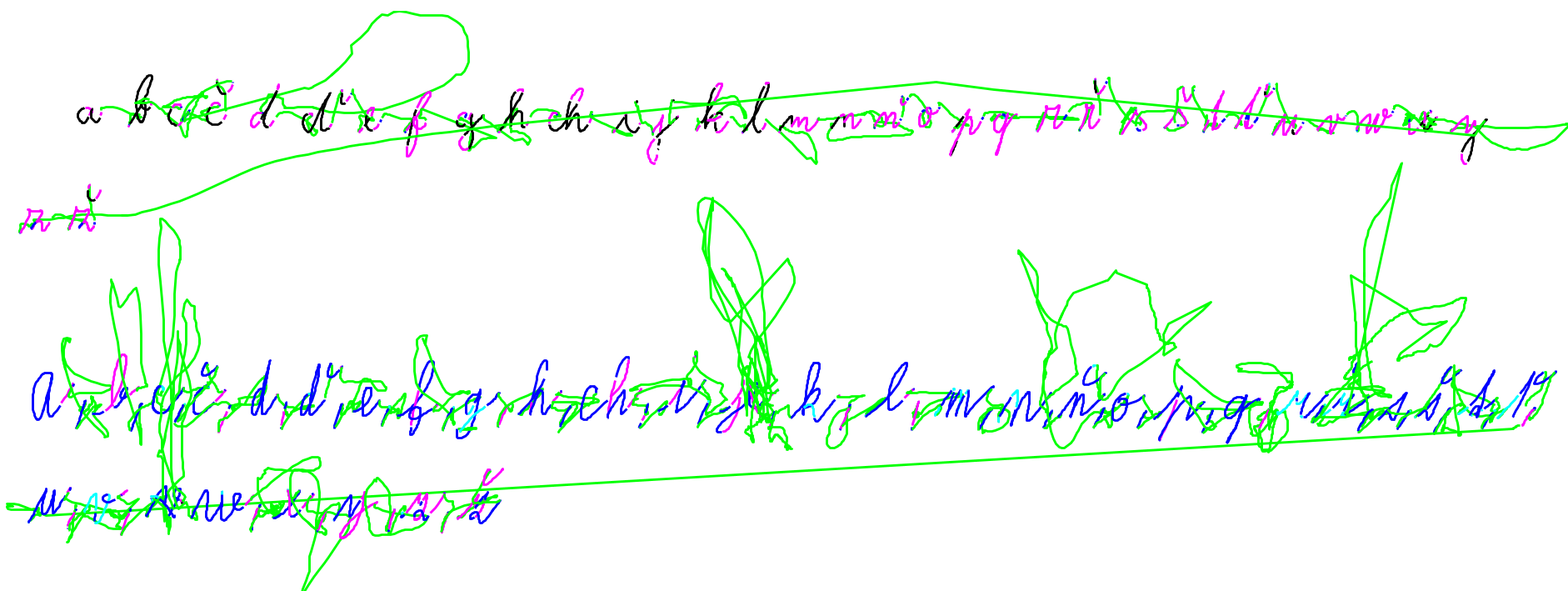 Figure 1: Comparison between a healthy child (top) and a child with HD (bottom). Note the green "in-air" trajectories—children with HD spend significantly more time hesitating between strokes.
Experimental Results: The Power of
The results were striking. While conventional features like peak velocity are useful, FD-based features showed a more direct correlation with clinical questionnaires (HPSQ–C).
- The "In-Air" Signal: The best-performing FD features were almost exclusively derived from in-air trajectories. This confirms that HD is characterized by "inter-stroke hesitation"—the child knows what to write but struggles with the motor planning required to start the next stroke.
- Optimal Order: The study found that derivative orders in the ranges of 0.1–0.3 and 0.7–0.9 provided the best discriminative power. This suggests that the "noise" of dysgraphia lives in the non-integer space of kinematics.
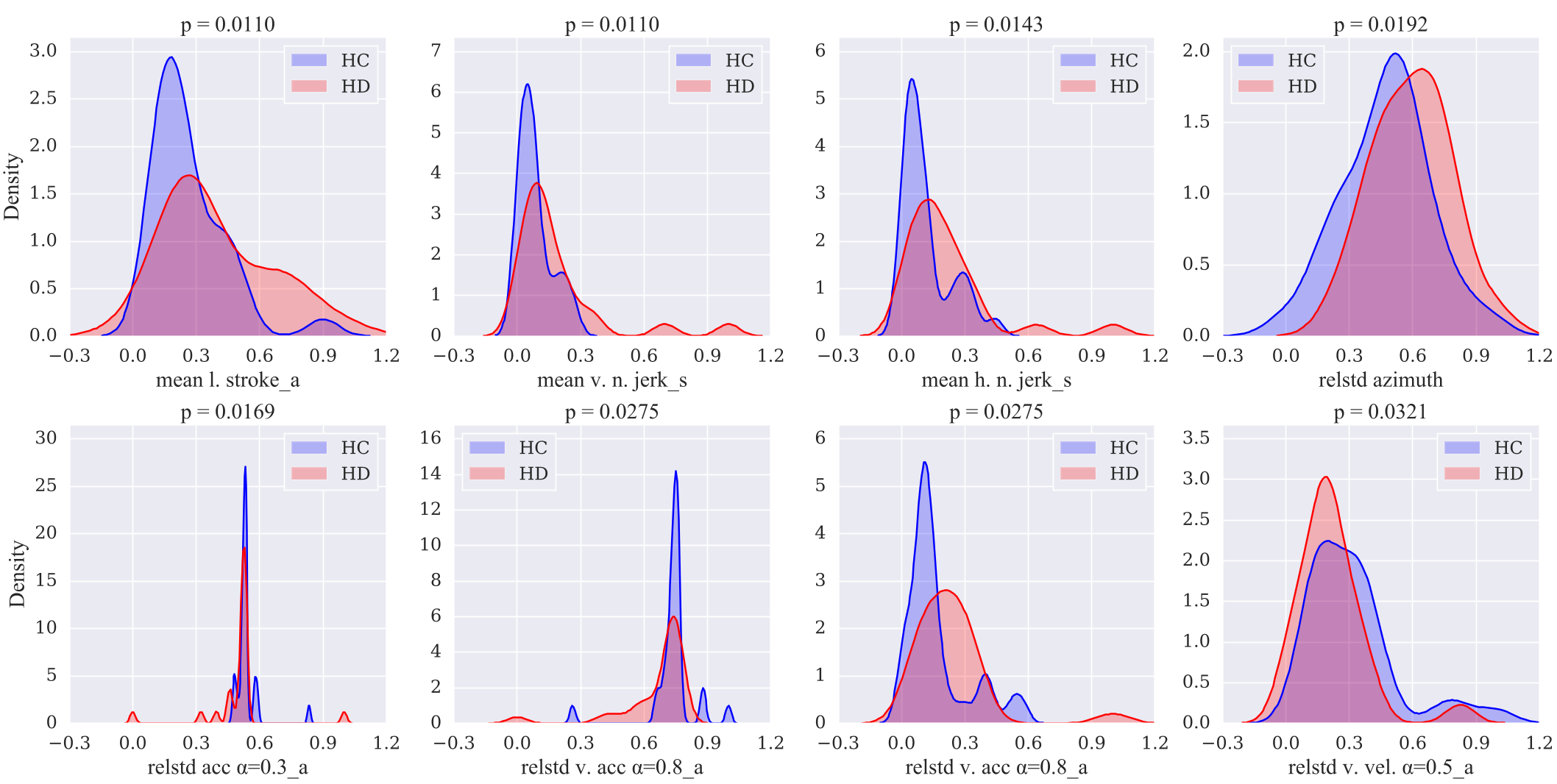 Figure 3: Kernel density plots showing how FD features (bottom) provide a clearer separation between healthy (HC) and impaired (HD) groups compared to some conventional metrics.
Critical Analysis & Conclusion
This work demonstrates that HD diagnosis is moving from "Art" to "Data Science." By utilizing Fractional Derivatives, we can quantify micro-jerkiness that is invisible to the human eye.
Limitations:
- The sample size (55 children) is small for broad clinical adoption.
- The "Alphabet Task" used might be too simple; more complex tasks like sentence copying might yield even stronger FD signals.
The Future: The intersection of Fractional Calculus and Machine Learning (specifically "Fractional Neural Networks") could lead to automated screening apps on consumer tablets, allowing for early intervention before a child's academic confidence is affected. This study is a vital first step in proving that the "physics of handwriting" is best described in fractional dimensions.
Final Takeaway: To understand why a child struggles to write, don't just look at the ink—look at the math of the pauses in between.