
The Fragility of Truth: How Suspended Users Warp Our View of Social Networks
The Fragility of Twier Social Networks Against Suspended Users
This paper investigates the impact of suspended users on Twitter social network analysis. By analyzing a dataset of 87 million tweets from the MENA region, the authors quantify how the removal of malicious accounts (bots and extremists) alters structural metrics and topical trends.
TL;DR
Researchers from Carnegie Mellon and Arizona State University reveal that Twitter-based network structures and content rankings are remarkably unstable. By removing accounts suspended for spam or extremism, the authors demonstrate that key indicators of "influence" and "community" can shift by up to 100%, especially in regions experiencing civil unrest.
Background: The "Cultural Pulse" or a Hallucination?
In the era of Big Data, we often treat Twitter as a giant, real-time sensor for the "cultural pulse" of a region. From disaster response to political forecasting, we rely on Social Network Analysis (SNA) to tell us who is influential and what the crowd cares about. However, this "pulse" is often contaminated by malicious actors—bots, trolls, and extremists. When Twitter swings the "ban hammer," the network we were just studying changes fundamentally. This paper asks a critical question: How fragile are our scientific conclusions when these nodes disappear?
The Core Insight: Two Sources of Bias
The authors identify a dual-threat to data integrity:
- Bots (Fake Nodes): Accounts that shouldn't be there, inflating metrics like degree centrality and creating artificial noise.
- Suspended Humans (True Nodes): Malicious but real users (e.g., ISIS recruiters or violent activists) whose removal deletes genuine social interactions, biasing our understanding of a conflict's true breadth.
Methodology: Snapshot of a Region in Turmoil
The study focused on 17 countries in the MENA region (e.g., Syria, Egypt, Saudi Arabia) during the height of the Arab Spring and the Benghazi attacks.
Structural Analysis
The researchers generated "before and after" snapshots of mention networks across various countries.
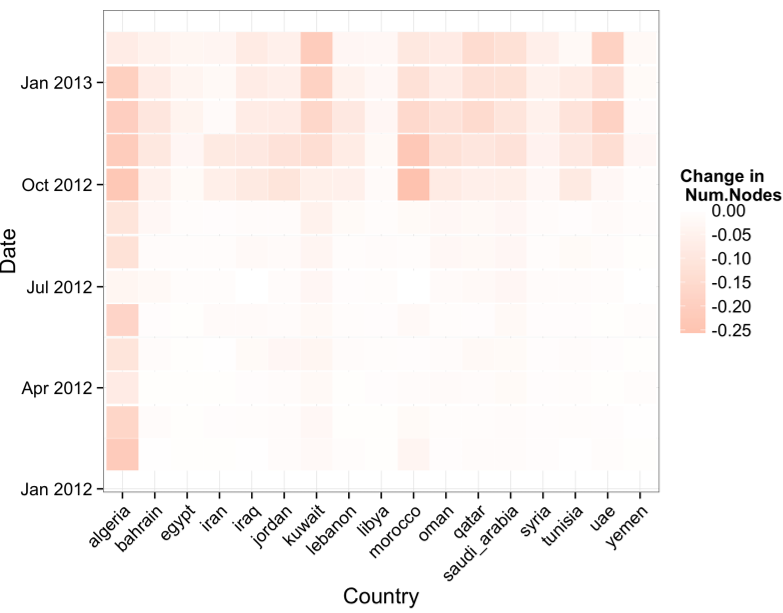 Figure 1: The percentage of suspended users varies wildly by country and event, with Algeria showing the highest fragility.
They measured traditional metrics:
- Degree Centrality: Local influence.
- Closeness Centrality: How "central" a user is to the whole network.
- Clustering Coefficient: How tightly knit the community is.
Content Analysis (LDA & Hashtags)
Using Latent Dirichlet Allocation (LDA), they tracked 200 topics. They introduced a "matching score" to see if the top hashtags changed after removing suspended accounts.
Key Findings: Fragility Discovered
1. The Peripheral Menace
The data showed that suspended users often reside on the periphery of the network. In countries like Kuwait and Qatar, removing these users increased closeness centrality by 100%. This suggests that bots often reach out to the core from the fringes, "stretching" the network. When they are removed, the "normal" network becomes significantly more cohesive.
2. The Hashtag Divergence
While "what" people talk about (broad topics) remains relatively stable, the Hashtag Rankings are highly fragile.
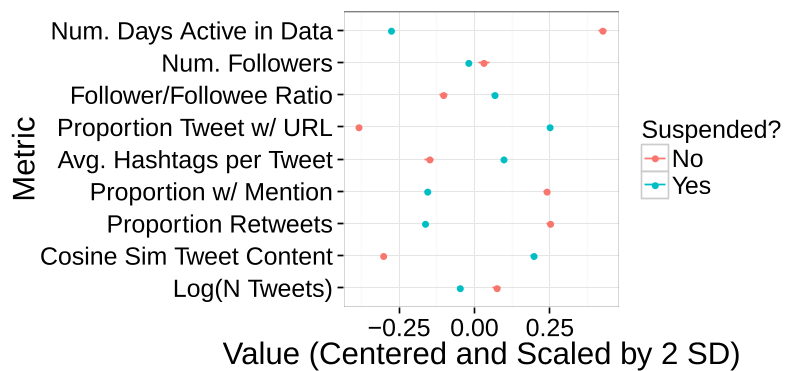 Figure 6: The matching score for hashtags (RH) diverges significantly from the reference line, indicating suspended users drive specific hashtag subgroups.
3. Not All Suspended Users are Bots
Using Gaussian Mixture Modeling, the authors identified clusters of users. While some (Clusters 1, 3, 6) were clearly gibberish-spewing bots, others (Clusters 2 and 5) were Extremists or Activists. For example, suspended accounts in Cluster 2 were found sharing technical instructions on how to bypass government internet blackouts in Syria.
Summary & Future Outlook
This work serves as a warning for social scientists and intelligence analysts: your data is only as good as your cleaning process.
Takeaways for the Industry:
- Cleaning is not optional: Standard SNA on raw Twitter data is likely to misidentify the "top influencers."
- Context Matters: The impact of suspended users is highest in zones of civil unrest, where the line between "malicious bot" and "political activist" is blurred.
- Beyond Binary Removal: Future tools shouldn't just delete suspended users; they should categorize them. A "militant" account might have more sociological value than a "spam bot" trying to sell fake followers.
Limitations: The reason for suspension remains a "black box" controlled by Twitter. Analysts must infer whether a user was banned for spamming or for political reasons, which adds a layer of uncertainty to the classification.