
Beyond Static Graphs: Decoding the Evolution of Dynamic Social Networks
A framework for analysis of dynamic social networks
The paper introduces a formal mathematical framework for analyzing "Dynamic Social Networks" by explicitly incorporating the timing of social interactions. It defines the "Metagroup"—a sequence of similar social groups over time—and provides linear-time algorithms to identify persistent, stable, and large social structures in time-varying datasets.
TL;DR
Social networks are not frozen in time, yet our tools often treat them that way. This seminal paper by Berger-Wolf and Saia introduces a computational framework that treats time as a first-class citizen. By defining Metagroups—sequences of evolving social clusters—the authors provide a rigorous way to track how groups form, persist, and vanish, offering new insights into everything from disease spread to corporate management.
The "Static Trap" and Modern Motivation
In classical Social Network Analysis (SNA), if Alice talks to Bob on Monday and Bob talks to Charlie on Friday, a static graph shows a path from Alice to Charlie. But if Alice has a virus on Monday and Bob only meets Charlie after Bob is no longer contagious, the virus cannot spread to Charlie.
Static models discard the concurrency and order of interactions. The authors argue that very different dynamic interactions can result in the same static graph, leading to dangerously wrong decisions in public health or intelligence.
 Figure 1: Two entirely different temporal interaction patterns (top) can collapse into the exact same static representation (bottom).
Methodology: The Metagroup Framework
The core of the paper is the Metagroup. Instead of a single graph, the input is a set of partitions (one for each time step).
1. Defining Connection
Two groups at different time steps are connected if their similarity (often Jaccard similarity) exceeds a threshold . This allows the framework to handle "turnover"—individuals leaving or joining a group while the group's identity remains stable.
2. The Metagroup DAG
The system builds a Metagroup-graph, a Directed Acyclic Graph (DAG) where nodes are groups and edges represent temporal transitions.
- Persistence (): How long a group lasts.
- Turnover (): How much the group changes between steps.
- Membership (): How often an individual must appear to be "part" of the metagroup.
Key Algorithms & SOTA Performance
The authors leverage the properties of DAGs to solve complex social questions with efficient algorithms:
- Most Persistent Metagroup: Solved using a Longest Path algorithm in time.
- Largest Membership Metagroup: A dynamic programming approach that finds the path maximizing the union of individuals across groups.
- Shattering the Network: To stop a disease, which groups should be removed? The paper proves the general "Min k-Path Vertex Shattering Set" is NP-complete (related to Vertex Cover) but provides a polynomial-time solution for finding the smallest set to disrupt the longest possible paths (-paths).
Note: The paper utilizes BFS-based passes over the DAG to calculate metagroup statistics and extract extremal paths.
Case Study: The Southern Women Data
The authors validated their model using the famous "Southern Women" dataset (1930s). While other methods categorized these women into two static clusters, the Metagroup framework revealed the stability of these clusters over time. It identified that certain "core" members were present across almost all events, while "periphery" members were transient, providing a more nuanced view of social hierarchy than static clustering could offer.
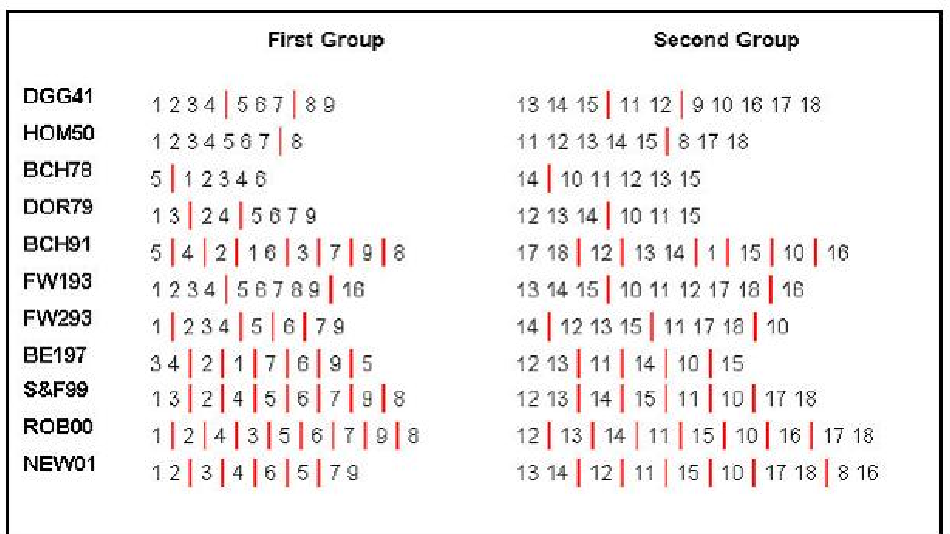 Table 1: Comparing the Metagroup approach (Bottom columns) against 21 other SNA methods. It achieves results comparable to the best algebraic topology methods while adding temporal dimensions.
Critical Insight & Limitations
The beauty of this framework lies in its Inductive Bias: it assumes social groups have a "life span."
However, there is a notable challenge: The Identity Paradox. The authors point out that if (similarity) is set too high (identity), the network becomes fragile. Removing just one person could technically "break" a group’s identity, even if the social structure remains. They suggest greedy heuristics to find "Critical Individuals," but this remains a computationally difficult area.
Conclusion
This work moved the field from snapshot-based analysis to a continuous "filmstrip" view of society. For modern AI researchers, these concepts are the precursors to Temporal Graph Networks (TGNs) and dynamic embeddings. Whether it's tracing a viral tweet or a viral pathogen, understanding the "metagroup" is essential for predicting the future of any collective system.