
Unlocking Cross-Platform Intelligence: A Framework for Next-Gen Mobile Social Apps
Framework for building intelligent mobile social applications
The paper presents a comprehensive framework for building intelligent mobile social applications by merging data from multiple Online Social Networks (OSNs) like Facebook and Foursquare. The core contribution is an overlay social network that enables similarity analysis and content recommendation directly on mobile devices without exhausting hardware resources.
TL;DR
The paper introduces a developer-centric framework that bridges the gap between fragmented social platforms (like Facebook and Foursquare) and mobile contexts. By creating an Overlay Social Network, it enables intelligent features—like recommending a "Japanese restaurant" based on a friend's Facebook likes—without the heavy computational overhead usually associated with AI.
Positioning: This work is a "Structural Framework" that simplifies the orchestration of heterogeneous social APIs into a unified, context-aware developer toolset.
The "Silo" Problem and Mobile Constraints
In the current mobile ecosystem, social data is isolated. Facebook knows what you "Like," and Foursquare knows where you "Check-in," but mobile applications rarely have the capability to combine these insights to understand why you are there or what you might enjoy next.
From an implementation standpoint, developers face two major hurdles:
- Resource Scarcity: Running complex data mining or NLP algorithms directly on a smartphone drains the battery and creates latency.
- Unstructured Chaos: Most social content is natural language. Converting a "Like" for a movie into an actionable data point for a restaurant recommendation requires a specific intelligence layer that didn't exist in a reusable format for mobile.
Methodology: The Three Pillars of the Framework
The authors propose a modular architecture designed for the Android platform, focusing on separation of concerns.
1. The OSN Module (Overlay Network)
The framework doesn't just call APIs; it merges them. By implementing IRetrievable and ISharable interfaces, the framework parses JSON data from various SDKs into a unified graph.
- Insight: Nodes represent users; edges represent relationships. An edge can be "Long-term" (Friendship) or "Short-term" (a shared comment).
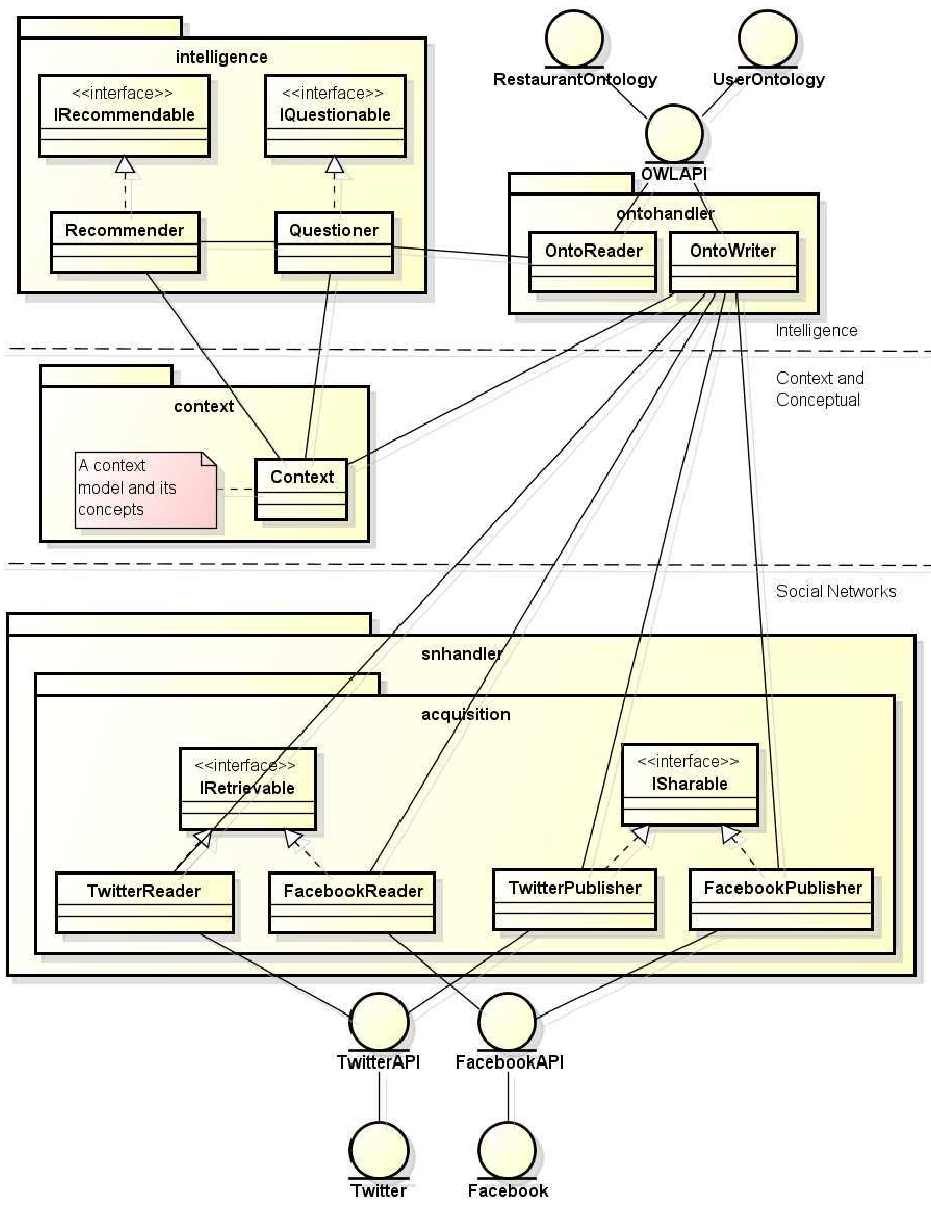
2. The Context Module
This layer captures both Static (Profile, Profession) and Dynamic (GPS, Movement Pattern) information. It turns the device into a sensor that feeds the social graph.
3. The Intelligence Module
This is the "brain" where the developer defines what "similarity" means. Whether it is matching users by music preferences or physical proximity, the module uses interfaces like IQuestionable to calculate matches between users within the overlay network.
From Concept to Execution: The Android Case Study
To prove the framework's utility, the authors built a multi-OSN application. The workflow follows a clean pipeline: Retrieve -> Map -> Reason -> Recommend.
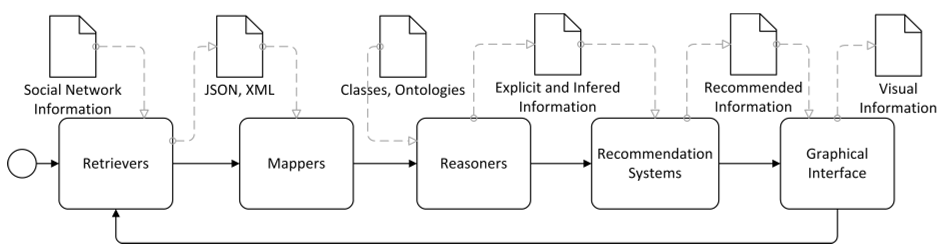
Key Capabilities Demonstrated:
- Contextual Notifications: Alerting a user when they are near a place saved in their "To-Do" list.
- Algorithmic Sorting: Ranking friends by metrics like "Similar Likes" or "Check-in Frequency."
- Visual Proximity: Mapping friends’ recent locations relative to the user’s current coordinates.
Critical Analysis & Conclusion
Takeaway
The framework’s strength lies in its Extensibility. By abstracting the OSN-specific logic (Retrievers) and the data-parsing logic (Mappers), it allows developers to focus on the "Reasoning" phase—defining the actual business logic of the intelligent app.
Limitations
- Privacy Reliance: The framework is heavily dependent on the OAuth permissions granted by users and the openness of third-party APIs (which have become more restrictive since the paper was published).
- Semantic Depth: While it mentions ontologies, the initial implementation relies on basic counting of similar likes, which may not capture nuanced user interests.
Future Outlook
As mobile processors now include dedicated AI engines (NPUs), the future of this framework lies in integrating Local LLMs to perform "Emotion Mining" and more complex NLP tasks on the unstructured social data retrieved by the framework, truly bridging the gap between social data and local intelligence.