
Hybrid Vigilance: Bridging the Gap Between AI and Human Intelligence in Surveillance
Towards a Framework for Collaborative Video Surveillance System Using Crowdsourcing
This paper introduces a collaborative framework for video surveillance that integrates automated image analysis with human crowdsourcing. By utilizing a multi-stage verification process, the system aims to achieve both high recall and high precision in detecting suspicious events for crime prevention.
TL;DR
Automated surveillance systems often fail due to the "noise" of false alerts. This paper proposes a collaborative framework that plugs human crowdsourcing into the detection pipeline. By using machines for broad scanning (high recall) and humans for final verification (high precision), the system achieves a level of accuracy that neither could reach alone.
Academic Positioning: This work sits at the intersection of Human-Computer Interaction (HCI) and Distributed Systems, moving beyond pure "Computer Vision" to solve the inherent reliability limits of current AI.
The Precision-Recall Paradox
In the world of security, missing a single event is a failure (low recall), but if a system cries wolf every few minutes (low precision), security personnel eventually ignore it. Automated image analyzers struggle with the sheer variation of human behavior and environmental complexity.
The authors argue that while computers are great at processing high volumes of data, human intelligence is superior at identifying nuanced "suspiciousness."
Methodology: The Plug-and-Play Framework
The framework is built around a centralized Collaboration Service Server that manages "Surveillance Profiles." These profiles define how different modules interact:
- Low-Level Detection: Performed at the edge (Camera Device) to save bandwidth.
- High-Level Analysis: Sophisticated algorithms analyze the narrowed-down footage.
- Human Verification: If an algorithm flags an event, a notification is sent to a decentralized crowd of workers.
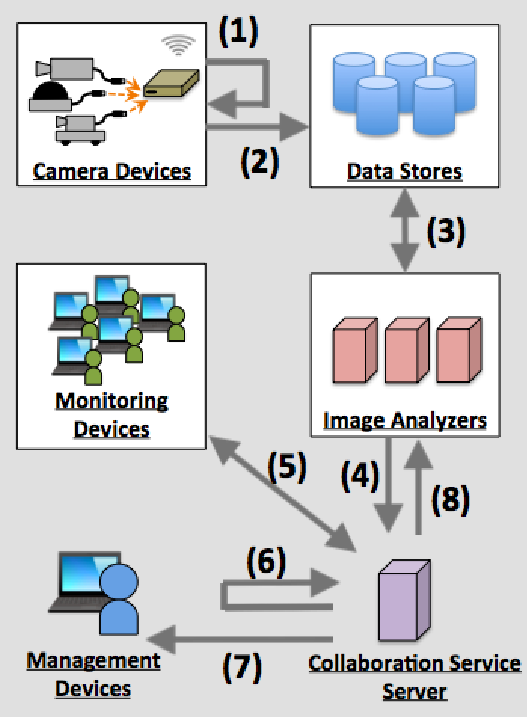
The brilliance of this design is the incentive layer. By assigning rewards, camera owners can "rent" human verification as a service, making professional-grade security accessible to individual users without hiring a full-time guard.
Experimental Validation: Proof of Concept
The researchers built a prototype using off-the-shelf hardware (Raspberry Pi 2) and standard computer vision libraries (OpenCV).
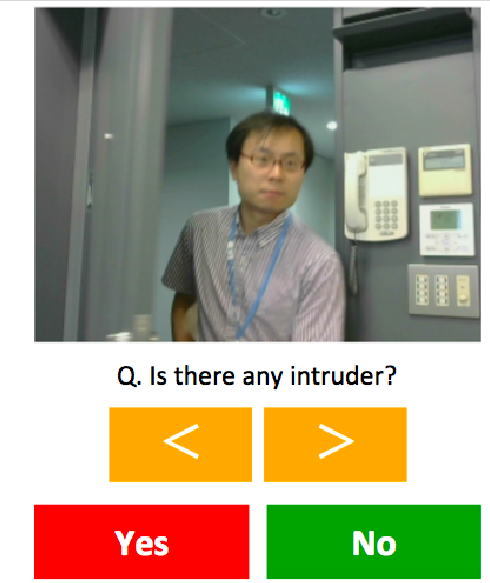
- The Setup: A face-detection task where any detected face sent a URL to 15 laboratory members via email.
- The Interface: A simple Yes/No UI allowed workers to verify detections in seconds on their smartphones.
- The Result: The "human filter" successfully scrubbed the false positives generated by the basic OpenCV detector, effectively "cleaning" the alert stream before it reached the property owner.
Critical Analysis & Future Outlook
Essential Takeaway
The paper shifts the focus from building "perfect AI" to building "efficient workflows." In the context of 2016 (when this was published), it correctly anticipated the rise of VSaaS (Video Surveillance as a Service) and the necessity of human feedback loops.
Limitations
- Latency: The "human-in-the-loop" adds a delay. While milliseconds matter for AI, seconds matter for human crowds. The paper doesn't deeply address the physical response time of the crowd.
- Privacy: Sending surveillance footage to "the crowd" raises massive privacy concerns. Future iterations need robust anonymization (e.g., blurring faces before crowdsourced verification).
Looking Ahead
With modern advances in Foundation Models and Large Vision Models (LVMs), we can now automate many of the high-level tasks the authors assigned to humans. However, the framework remains highly relevant—especially for "Black Swan" events that AI has never seen before, where human judgment is the final line of defense.