
Beyond Approximation: Why MLE Reigns Supreme in Social Network Modeling
A framework for the comparison of maximum pseudo-likelihood and maximum likelihood estimation of exponential family random graph models
This paper provides a rigorous comparative framework for assessing estimators in Exponential Family Random Graph Models (ERGMs), specifically comparing Maximum Likelihood Estimation (MLE), Maximum Pseudo-Likelihood Estimation (MPLE), and a newly proposed Maximum Bias-corrected Pseudo-Likelihood Estimator (MBLE). Using realistic simulations based on social network data, it demonstrates the definitive superiority of MCMC-based MLE over pseudo-likelihood variants in terms of bias, efficiency, and coverage.
TL;DR
For years, the "Pseudo-likelihood" (MPLE) was the necessary evil of social network analysis—a fast but flawed approximation for Exponential Family Random Graph Models (ERGMs). This paper presents a definitive showdown between MPLE and the gold-standard Maximum Likelihood Estimation (MLE). The verdict is clear: MLE is vastly superior in handling the "messy" dependencies of real-world networks, especially when it comes to structural features like transitivity.
The Core Conflict: Accuracy vs. Tractability
Statistical modeling of social networks is notoriously difficult because "ties" are rarely independent; if Alice is friends with Bob and Bob is friends with Charlie, Alice is likely friends with Charlie. This is the Inductive Bias of transitivity.
Traditional ERGMs capture this via a likelihood function that includes a "normalizing constant"—a mathematical nightmare that requires summing over every possible network configuration. To bypass this, researchers used Pseudo-likelihood, which treats the network as a set of independent logistic regressions. But what is the cost of this "short-cut"?
Methodology: The Mean-Value Insight
The authors don't just compare raw parameters (). They introduce the Mean-Value Parameterization ().
- Natural Parameter (): The "log-odds" scale typically used in models.
- Mean-Value Parameter (): The scale of actual network statistics (e.g., how many edges or triangles we expect to see).
By simulating 1,000 networks based on the famous "Lazega Law Firm" dataset, they tested how well each estimator could recover the "True" parameters. They also introduced the MBLE (Maximum Bias-corrected Pseudo-likelihood), applying Firth’s penalty to see if pseudo-likelihood could be "saved" through bias reduction.
 The fundamental ERGM formula where the normalizing constant represents the primary computational barrier.
Key Results: The Failure of Pseudo-Likelihood
The study finds that pseudo-likelihood methods are particularly poor at estimating structural effects (like the Geometrically Weighted Edgewise Shared Partner, or GWESP).
- Efficiency Loss: In high-transitivity networks, the relative efficiency of MBLE/MPLE dropped to ~20% compared to MLE. This means you would need 5 times more data to get the same precision as MLE.
- Deceptive Confidence: Perhaps most importantly, MPLE's "perceived" standard errors were far too small. A nominal 95% confidence interval for structural parameters often covered the true value less than 75% of the time (see Table 3 in the paper).
- MBLE is a "Better" Pseudo-likelihood: While still inferior to MLE, the MBLE consistently outperformed the standard MPLE, making it the preferred "budget" option.
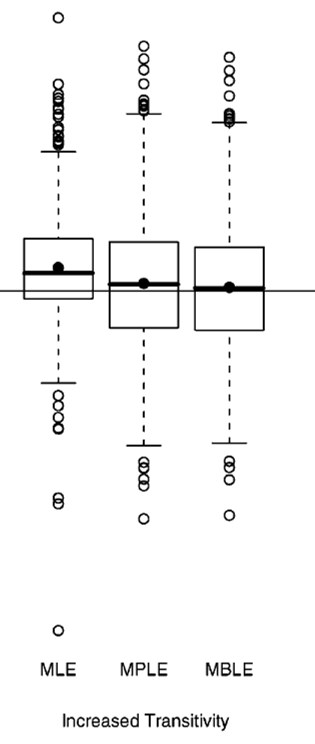 Fig 1: Boxplots showing the MLE (left) vs MPLE/MBLE (right). Note how the MLE distributions are centered more accurately on the truth (the horizontal line) with less skew.
Critical Insight: Who Should Care?
If you are a practitioner using the statnet or ergm packages in R, this paper serves as a warning: Don't trust Pseudo-likelihood for structural inference.
- For Nodal Attributes: If you only care about "Do senior lawyers collaborate more than juniors?", MPLE is "fine" but still risky.
- For Network Structure: If you are studying how communities form or how "triangles" close, you must use MCMC-based MLE. The "speed" of MPLE isn't worth the statistical "noise."
Future Outlook and Limitations
The primary limitation identified is Model Degeneracy. In very dense or highly transitive networks, even MLE can struggle to converge as the model moves toward the edge of the "convex hull." The paper points toward mean-value parameterization not just as an evaluation tool, but as a potential way to stabilize these models in the future.
Conclusion: This work solidified the shift in network science from deterministic approximations to stochastic simulation methods. It remains a foundational text for anyone questioning the reliability of approximated network models.