
Beyond Settings: Quantifying Privacy Risk via Item Response Theory
A Framework for Computing the Privacy Scores of Users in Online Social Networks
The paper introduces a mathematically rigorous framework for quantifying individual user privacy risk in Online Social Networks (OSNs) by calculating a "Privacy Score." Utilizing Item Response Theory (IRT), the method evaluates risk based on information sensitivity and visibility, achieving a superior fit to real-world data compared to naive frequency-based models.
TL;DR
Managing privacy on social networks is currently a "guessing game" for users. This paper proposes a formal Privacy Score framework that calculates risk by measuring the sensitivity of shared data (like your mother's maiden name vs. your gender) and its visibility (how many people can see it). By borrowing Item Response Theory (IRT) from the world of psychological testing, the authors create a model that is mathematically sound and consistent across different social platforms.
The Problem: The "Privacy-Sharing" Paradox
Social network users often value their privacy but compromise it for social capital. The root of the problem is twofold:
- Lack of Quantification: Users cannot "see" their total risk in a single number.
- Configuration Complexity: Privacy settings are confusing, leading many to stick with dangerous defaults.
While previous work focused on how companies can anonymize graphs, this paper focuses on the individual, answering the question: "Given what I've shared, how much trouble am I in?"
Methodology: Psychometrics Meets Social Networks
The genius of this paper lies in its application of Item Response Theory (IRT). In a standard exam, IRT measures a student's ability based on whether they get easy or hard questions right.
The authors translate this to privacy:
- User Attitude (): A user's "extroversion" or willingness to share.
- Item Sensitivity (): How "private" a specific piece of information (e.g., phone number) is by nature.
- Item Discrimination (): How well a specific item distinguishes between a private and a public person.
The Probability of sharing an item is modeled as:
Architecture & Logic
The authors use an Expectation-Maximization (EM) algorithm to find the best-fit parameters for and when they are unknown. This allows the system to "learn" that a phone number is more sensitive than a gender simply by observing that fewer people share it.
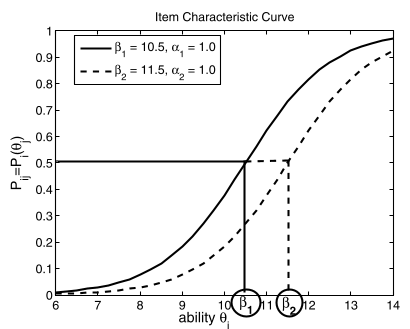 In the figure above, (a) illustrates how items with different sensitivity () shift the probability curve.
Why IRT over "Naive" Counting?
A naive approach would simply count how many people share an item. However, this is population-dependent. If you only look at extroverts, you might think a phone number isn't sensitive. The IRT approach provides Group Invariance, meaning the sensitivity of an item remains stable regardless of whether the group being measured is conservative or extroverted.
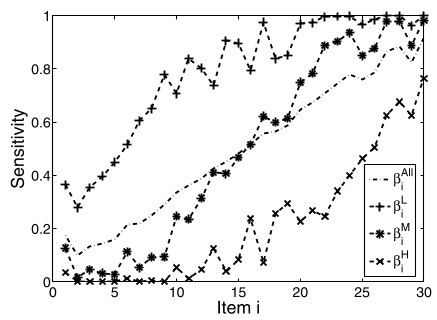 The experiment shows that IRT (a) maintains consistent sensitivity estimates across different user groups (L, M, H), whereas the Naive model (b) fluctuates wildly based on user attitudes.
Experimental Insights
Using a real-world survey of users across 18 countries, the authors discovered:
- Sensitivity Hierarchy: "Mother’s Maiden Name" is the most sensitive, while "Gender" is the least.
- Geographic Trends: Users in North America and Europe generally have higher Privacy Scores (take more risks) than those in Asia. This suggests a cultural or social pressure in Western regions to be more "digitally present."
Critical Insight & Conclusion
The Privacy Score is not just a theoretical number; it is a tool for Privacy Awareness. By quantifying risk, platforms could:
- Provide Real-time Alerts: "Sharing this item increases your privacy score by 20%."
- Benchmark: "Your privacy score is higher than 90% of your friends."
While the paper doesn't account for inference attacks (predicting private data from public data), it provides a robust, scalable framework for the "Front-end" of privacy management. In an era of data oversharing, turning a philosophical concern into a "score" might be the only way to help users reclaim their digital boundaries.