
Beyond Surveys: Decoding Customer Satisfaction Through Social Media Sentiment
A framework for evaluating customer satisfaction
The paper introduces a structured framework for evaluating customer satisfaction by performing sentiment analysis on social media data (Twitter). Specifically, it develops a lexicon-based approach using WordNet and VADER to categorize customer feedback across ten distinct service dimensions for six major American airlines.
TL;DR
In the digital age, customers express their true feelings on Twitter rather than in corporate surveys. This paper presents a comprehensive framework to scrape, clean, and analyze 14,560 tweets to evaluate six American airlines. By constructing specialized dictionaries and using high-precision sentiment scoring, the authors move beyond simple "positive/negative" flags to provide a 10-dimensional view of service quality, from WiFi connectivity to cabin staff performance.
Background Positioning: The Authenticity of Social Media
While traditional surveys are often seen as a chore by consumers, social media acts as an "unfiltered" channel of feedback. The authors position their work as a bridge between raw social data and actionable business intelligence, using American airlines—a highly vocal industry on social media—as their primary case study.
The Pain Points of Traditional Evaluation
Current methods for assessing brand health face two major hurdles:
- Survey Fatigue and Bias: People often give neutral or dishonest answers in structured surveys to finish quickly.
- Lack of Granularity: Knowing a customer is "unhappy" isn't enough; companies need to know if the issue is the legroom (Seat Comfort) or the expensive snacks (Value for Money).
Methodology: Building a "Well-Knit" Dictionary
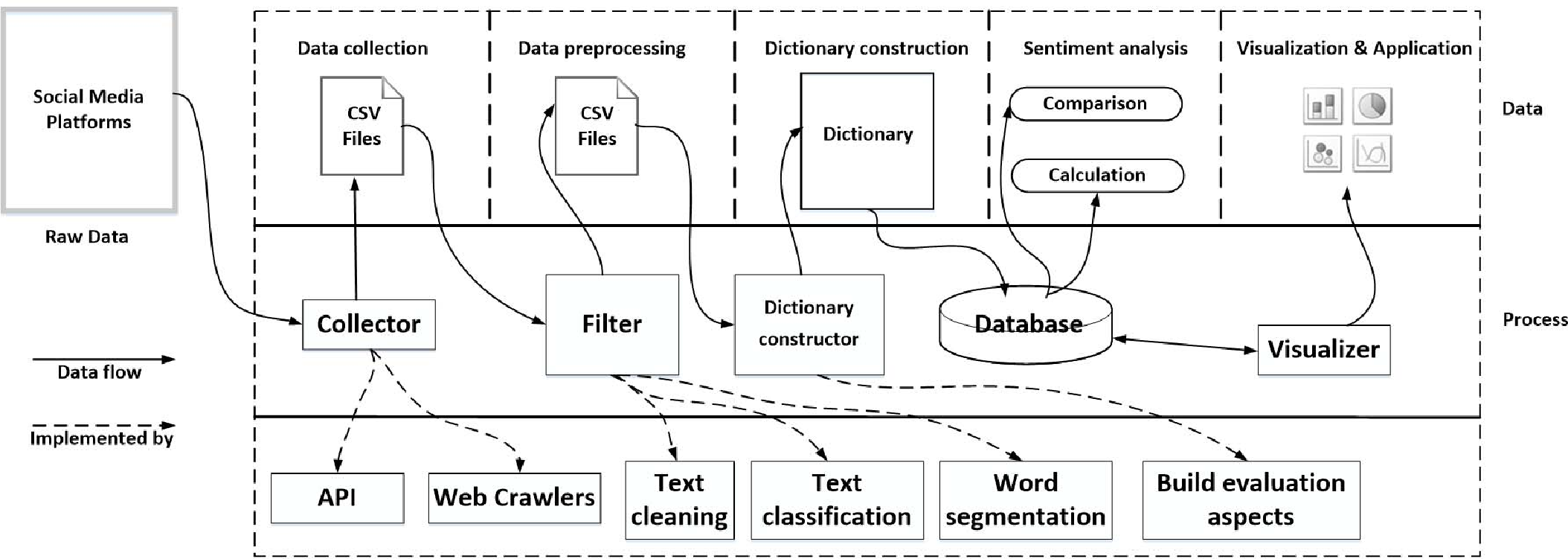
The core of the methodology lies in its Lexicon-Based Approach. Unlike black-box machine learning models, this approach offers transparency by building specific dictionaries for 10 evaluation aspects.
The Pipeline
- Crawling & Cleaning: Pulling data via Tweepy and removing URLs/special characters.
- Iterative Expansion: Starting with a small seed set of opinion words (e.g., "good"), the system uses WordNet to find synonyms and antonyms, building a robust vocabulary.
- VADER Integration: To handle the nuances of social media language, the authors used VADER (Valence Aware Dictionary and Sentiment Reasoner) to assign sentiment scores ranging from -10 to 10.
Experimental Analysis: Which Airline Truly Rules the Skies?
The study analyzed six carriers: Virgin America, United, Southwest, Delta, US Airways, and American Airlines.
Key Findings
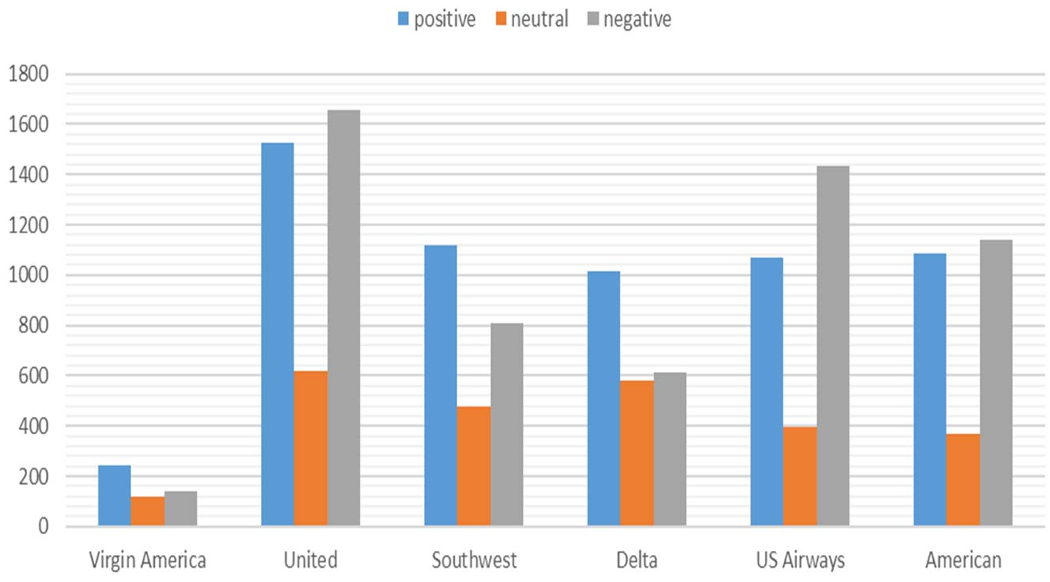
- Emotional Polarization: The data proves that people rarely tweet neutral opinions; they either praise or complain. In all six companies, neutral comments were the minority.
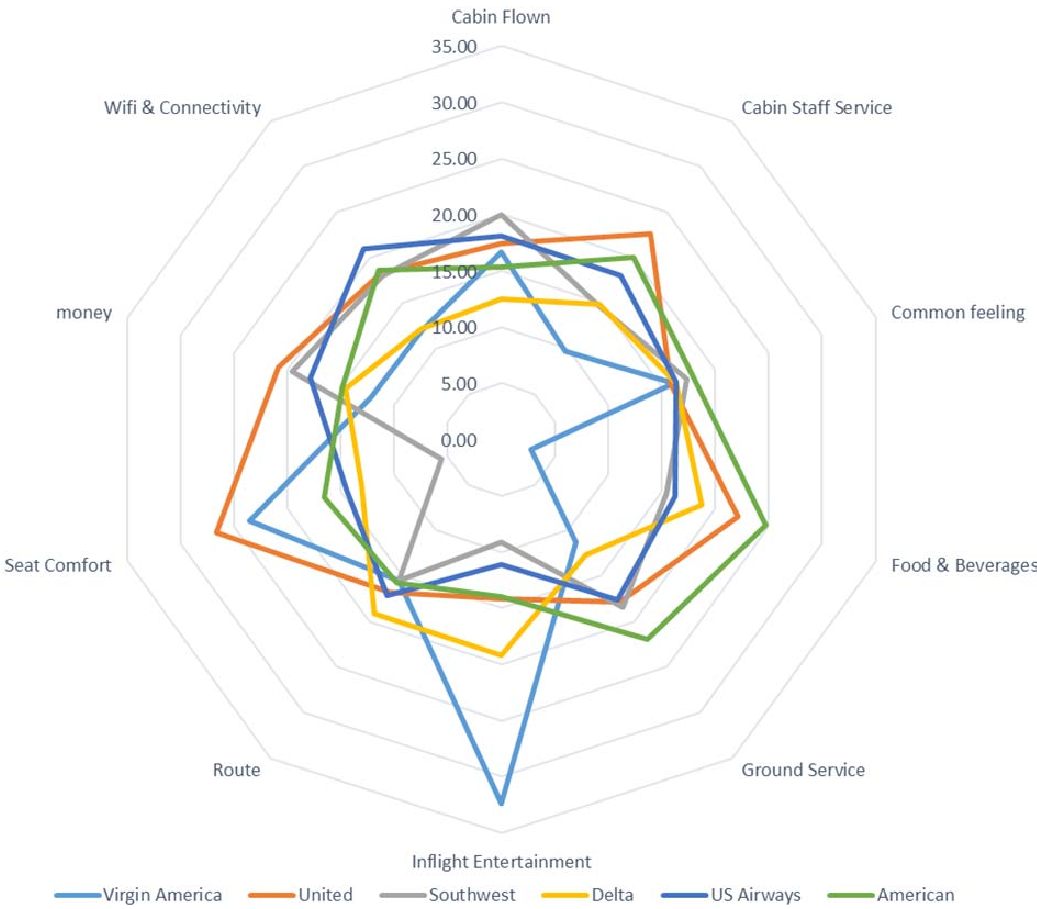
- Winner & Loser: Virgin America emerged as the leader in customer satisfaction, particularly praised for its Inflight Entertainment. Conversely, US Airways suffered the highest percentage of negative sentiment.
- Operational Insights: United Airlines, despite having mixed overall reviews, outperformed all others in Seat Comfort.
The Radar Chart: A Multi-Dimensional Perspective
The most valuable output for a manager is the Radar Chart (Fig. 3). It visualizes the performance of each airline across the 10 dimensions. A larger area within the radar signifies a more "accepted" airline overall. This visualization allows potential customers to choose a flight based on their specific priorities (e.g., choosing United for long-haul comfort or Virgin for entertainment).
Critical Insight & Future Directions
The framework’s strength is its simplicity and interpretability. Using a lexicon-based approach ensures that businesses can see exactly which words are driving their scores.
Limitations: The paper relies on data from 2015. Modern social media has evolved with more heavy use of emojis, memes, and video content, which would require more advanced NLP techniques (like multi-modal LLMs) to decode.
Conclusion: This framework serves as a "small recommender system." By applying a simple Weight Algorithm, a user can input their preferences (e.g., 50% weight on 'Value for Money') and receive a mathematically optimal airline choice based on real-world passenger experiences.