
Deciphering the Hierarchy: A New Framework for Organizational Structure in Dynamic Networks
A framework for exploring organizational structure in dynamic social networks
This paper introduces a formal framework for exploring organizational structures in dynamic social networks using a novel data structure called a "Community Tree." It combines a modified PageRank with Random Walks to derive hierarchical subordinations and proposes a tree learning algorithm based on tree edit distance to track evolutionary changes in dynamic environments.
TL;DR
Social network analysis (SNA) is moving beyond finding "who talks to whom" to "who leads whom." This paper presents a comprehensive framework to map the Community Tree—a structure that captures leadership and subordinations within social groups. By combining PageRank logic with Random Walks and Tree Learning, the authors provide a way to visualize how organizations evolve, split, and merge in real-time.
Problem & Motivation: Beyond Flat Clusters
Most community discovery algorithms treat a network like a school of fish—a group of nodes that are tightly knit but lack internal order. In reality, networks have Organizational Structures. There are leaders, influential agents, and foot soldiers.
The authors identified two major gaps:
- Lack of Hierarchy: Clustering doesn't distinguish between a manager and their assistant if they belong to the same dense group.
- Temporal Fragmentation: In dynamic networks, a member may temporarily vanish from a "snapshot," leading standard algorithms to mistakenly conclude they left the organization.
Methodology: The Community Tree
The core of the paper is the Community Tree, where every node is assigned an m-Score (importance) and an immediate leader (parent).
1. Calculating the m-Score (Modified PageRank)
The importance of a member isn't just about their local connections but the weight of their information flow. The authors adapt the PageRank algorithm for weighted, undirected graphs to determine who the "heavy hitters" are.
2. Transition Probabilities (Random Walks)
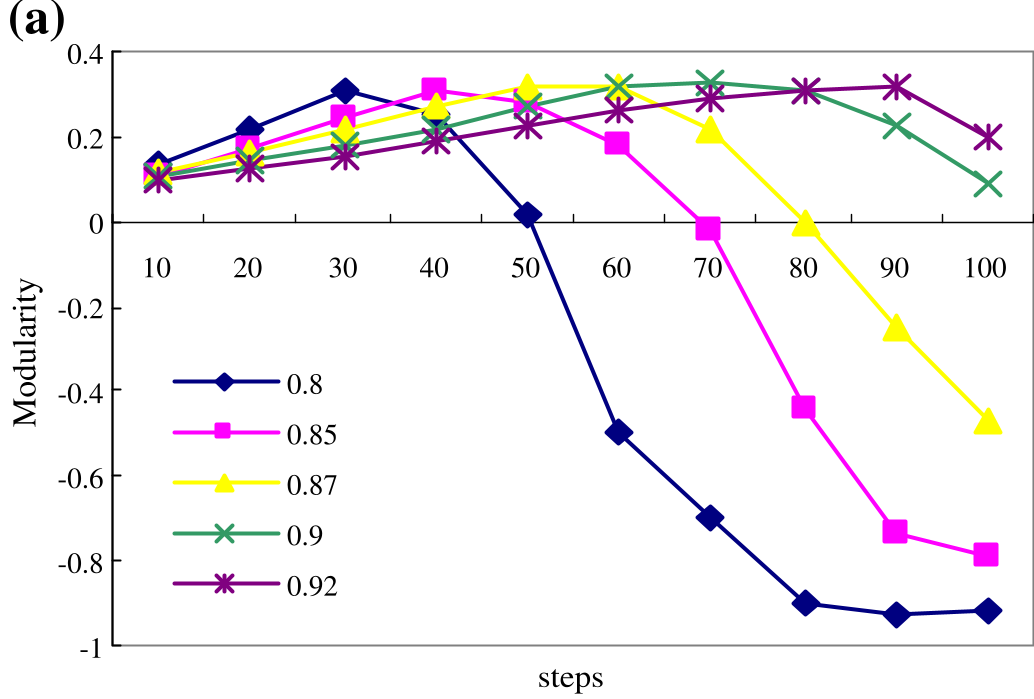
To find a member's leader, the framework uses a -step random walk. If a path from Node A most frequently ends at Node B, and Node B has a higher m-Score, Node B is designated as the parent of A.

3. Dynamics: Evolving Community Trees
To handle time, the authors introduce ECT_Learning. This uses a "Tree Edit Distance" scoring function. It ensures that the transition from Time to is "smooth," effectively "filling in the blanks" for members who might be temporarily inactive but still part of the social backbone.
Experiments & Results: The Enron Case Study
The researchers tested their model on the infamous Enron email corpus.
Identifying Virtual vs. Real Teams
By analyzing "Life-lines" (how long a community exists) and "Stability," they made a discovery:
- Real Organizations: Highly stable groups with a long life-line (e.g., the Portland Sales Team).
- Virtual Organizations: Groups that form for a specific event and dissolve thereafter (e.g., the task force handling the 2001 California Electricity Crisis).
Agent Roles in Hierarchy
In the Enron analysis, they found that certain nodes, like Dasovich-j, appeared as "cores" (leaders) in the community tree. In reality, he was a Government Relations Executive. The framework revealed that in the email flow, he acted as a high-level agent for top executives, highlighting the difference between formal corporate charts and actual operational influence.
Deep Insight & Conclusion
This work demonstrates that information flow is a proxy for authority. By observing transition probabilities through random walks, we can reconstruct the invisible "management layers" of any digital community—be it a corporate email server, a criminal network, or a web forum.
Takeaway: If you want to find the real backbone of an evolving network, look for "Life-lines" that maintain high stability. These aren't just clusters; they are the persistent organizational units that define the network's identity.
Limitations: The primary bottleneck is the computational complexity of the Tree Edit Distance. Calculating optimal edits for massive networks (millions of nodes) remains a challenge for future hardware-accelerated SNA tools.