
C3PO: Building Social Networks Without the Internet
A Framework for Opportunistic Networking in Spontaneous and Ephemeral Social Networks
The paper introduces the C3PO framework, a Java-based middleware designed for Spontaneous and Ephemeral Social Networks (SESNs). It leverages opportunistic networking and multi-interface connectivity (Bluetooth, Wi-Fi, Wi-Fi Direct) to enable peer-to-peer multimedia sharing in environments with limited or no Internet access.
TL;DR
The C3PO framework introduces a middleware solution for Spontaneous and Ephemeral Social Networks (SESNs). By utilizing the wireless interfaces already in our pockets—Bluetooth and Wi-Fi—it creates a decentralized, opportunistic network that allows attendees of events (like marathons or festivals) to share content without relying on a centralized server or a cellular data connection.
The Decentralization Motivation
Most social media platforms (Facebook, X, Instagram) are "brokers." They own your data and require you to be "online." In crowded sports events or remote festivals, cellular networks often fail or become congested. The authors argue for a shift toward SESNs, where the network exists only as long as the event does, and the data stays among the participants.
The technical challenge is high: mobile devices have short radio ranges and users are constantly moving, leading to "network fragmentation" where users are split into isolated islands of connectivity.
Methodology: Micronets and Macronets
To solve the connectivity gap, C3PO introduces a two-tier architectural abstraction:
- Micronets: These are single-hop clusters using a specific technology (e.g., a Bluetooth piconet or a Wi-Fi Direct group).
- Macronets: These are clusters of micronets. A device with multiple active interfaces acts as a gateway, bridging a Bluetooth micronet to a Wi-Fi micronet.
The Store-Carry-and-Forward Logic
Because an end-to-end path between two users may never exist at a single point in time, the framework treats every mobile device as a "data mule."
- Store: Save the message in a local cache.
- Carry: Move physically with the device.
- Forward: Relay the message when a new neighbor (a "contact") is discovered.
Software Architecture & API
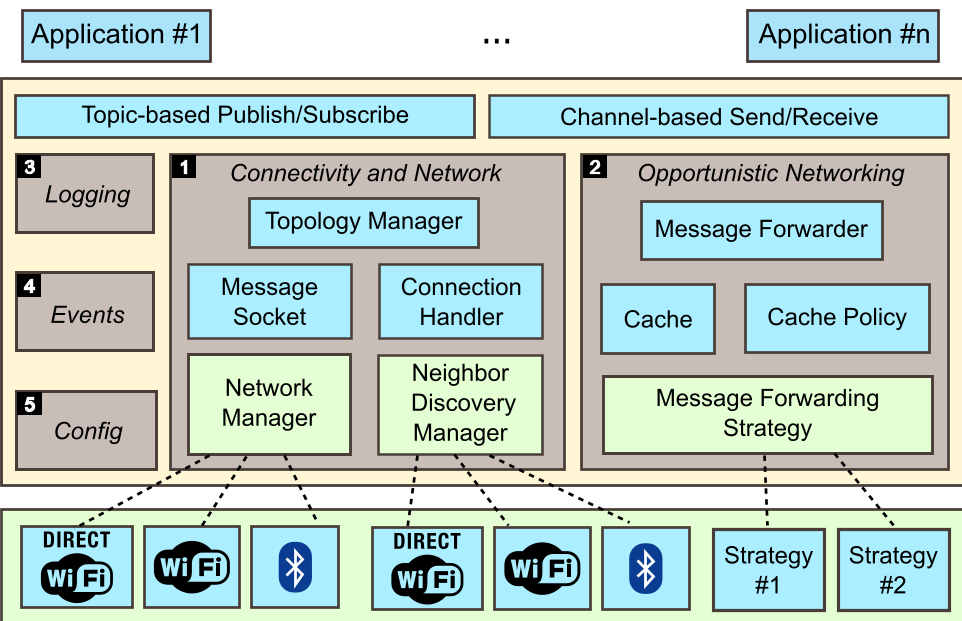
The framework is Java-based and highly modular. It provides two main paradigms for developers:
- Publish/Subscribe: Ideal for news feeds or event updates.
- Channel-based: Ideal for direct peer-to-peer messaging.
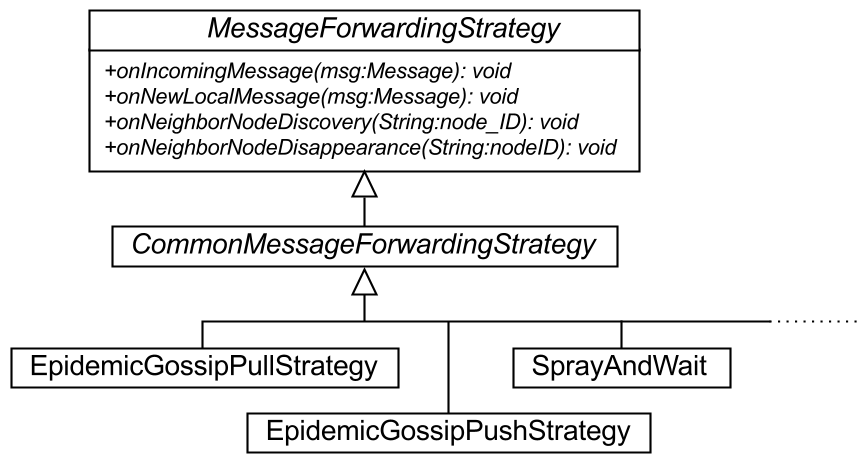
One of the cleverest parts of the implementation is the Epidemic Gossip Pull Strategy. Instead of flooding the network with data, devices exchange "catalogs" (lists of message IDs they have). A device only requests (pulls) the specific messages it is missing, drastically saving bandwidth and battery.
Critical Analysis
The C3PO project successfully addresses the "heterogeneity problem"—making Bluetooth and Wi-Fi talk to each other seamlessly. However, the paper acknowledges major industry hurdles:
- OS Limitations: Android and iOS often restrict background Wi-Fi scanning or require root privileges for certain ad-hoc modes.
- Energy Consumption: Continuous neighbor discovery is a "battery killer."
- Security: In an open opportunistic network, preventing "spam" or malicious data injection remains a secondary focus in this specific framework.
Conclusion
C3PO represents a significant step toward sovereign, infrastructure-less social networking. By moving logic from the cloud back to the "edge" (the smartphones themselves), it provides a blueprint for communication in high-density or restricted environments where the traditional Internet is either unavailable or undesirable.