
Beyond Global Averages: Redefining Spatial Insights with Regional Association Rule Mining
A Framework for Regional Association Rule Mining in Spatial Datasets
The paper introduces a spatial data mining framework that combines a reward-based supervised clustering algorithm (SCMRG) with association rule mining to discover localized patterns. It evaluates this approach on a Texas water supply dataset, identifying geographical "hotspots" and "coldspots" for arsenic contamination and extracting region-specific rules.
TL;DR
Researchers have developed a framework that stops treating entire maps as uniform blocks. By using a novel supervised clustering algorithm (SCMRG), the system identifies specific "hotspots" (e.g., high-risk arsenic areas) and extracts "Regional Association Rules" that are often completely hidden in global data. In a Texas water study, it successfully localized environmental risks that statewide analysis missed.
Background: The "Average" Place Doesn't Exist
In spatial science, there is a fundamental law: whole map statistics are seldom useful. A county is not a state; a state is not a country. Most data mining algorithms are "global-scale" thinkers—they look for patterns that appear frequently across the entire dataset.
The problem? If an environmental hazard (like arsenic) is highly concentrated in one small valley but absent elsewhere, global algorithms will discard it as "statistical noise" or "low support." This paper argues that we must find the regions first, then mine the rules.
Methodology: The Two-Phase Framework
The authors solve the regional discovery problem through a clever two-step process.
Phase 1: Identifying "Interesting" Subregions
Instead of manually drawing boundaries, they use SCMRG (Supervised Clustering using Multi-Resolution Grids).
- The Intuition: It starts with a coarse grid of the map and "drills down" into specific cells only if those cells show a higher density of a specific class (e.g., "Dangerous" wells) compared to the global average.
- The Reward Function: It uses a fitness function that rewards both the "purity" of the region and its size (controlled by a parameter ), ensuring the discovered regions are both statistically significant and large enough to be meaningful.
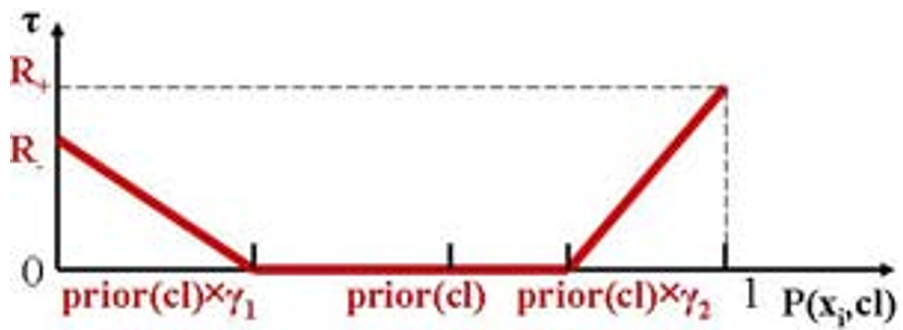 Figure 1: The SCMRG algorithm recursively partitions the space to isolate regions with high reward values.
Phase 2: Supervised Association Rule Mining
Once regions are isolated, the system runs an adapted Apriori algorithm. Unlike standard mining, it enforces a class-guided structure, ensuring every rule found relates specifically to the class of interest (e.g., Attribute A + Attribute B -> Arsenic: Dangerous).
Case Study: The Texas Arsenic Crisis
The framework was tested on the Texas Ground Water Database. Arsenic is a "silent killer" in water supplies, and its presence is highly dependent on local geology.
Global vs. Regional Results
When mining the entire state of Texas:
- The Result: Over 100,000 rules were generated.
- The Quality: Most were redundant or overly general (e.g., "Safe wells are often in Basin 19").
When using the Regional Framework:
- The Result: Specifically identified 4 regions (Hotspots 1 & 3, Coldspots 2 & 4).
- The Insight: In Region 3, a specific rule was found with 100% confidence: Wells with very low Nitrate levels (<0.085 mg/l) are almost always dangerous for Arsenic.
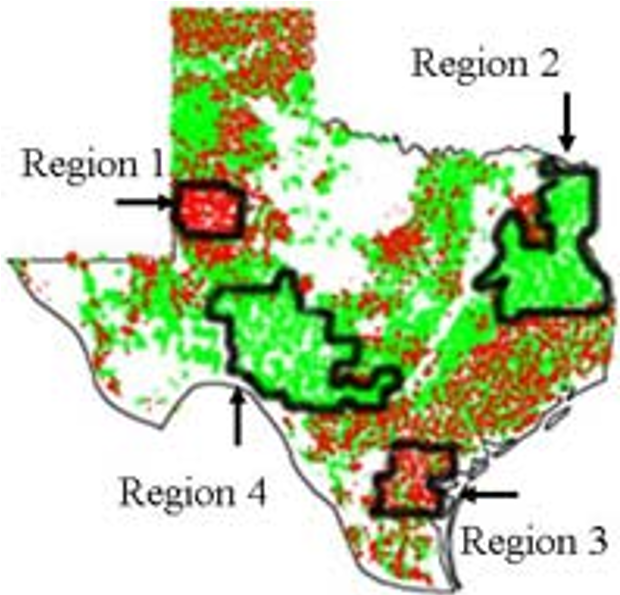 Figure 2: Discovery of high-risk (Hotspot) and low-risk (Coldspot) regions in Texas.
Critical Insight: Why This Matters
The most striking takeaway is the inverse relationship between regional and global rules. Some rules that hold 100% confidence in a localized hotspot actually have zero support in the rest of the state. This proves that "Generalizing" in spatial data is often a path to missing the most critical, life-saving information.
Conclusion & Future Outlook
This work provides a bridge between pure clustering (where?) and association mining (why?). By allowing the algorithm to "zoom in" on interesting sub-grids, researchers can uncover hidden causal hypotheses—like the link between well depth, iron concentration, and arsenic—that would otherwise be buried under a mountain of global noise.
Future extensions of this work could involve dynamic thresholds, where the "min_support" automatically adjusts based on the density of the localized region, potentially uncovering even more granular insights.