
Social Device Networking: Bridging the Gap Between People and Smart Objects
A Framework for Social Device Networking
This paper introduces a framework for the "Social Device Networking" domain, integrating the Internet of Things (IoT) with Social Networking Services (SNS). It utilizes the Device Profile for Web Services (DPWS) to enable seamless, service-oriented communication between humans and smart devices within a social-like environment.
TL;DR
This research proposes a paradigm shift from simple device connectivity to Social Device Networking. By integrating Web Service technologies (DPWS) with Social Networking Services, it creates a framework where devices "chat" with users, offer intelligent recommendations, and collaborate autonomously to solve user needs.
Background & Positioning
As we move into the post-mobile era, the Internet of Things (IoT) is no longer just about sensors; it’s about "Connectedness." This paper positions its work at the intersection of Social Networking Services (SNS) and the Web of Things (WoT). Unlike early IoT projects that merely stored data, this framework treats devices as social entities capable of proactive communication and context-aware interaction.
The Problem: The "Passive" Device Trap
Current IoT ecosystems suffer from several bottlenecks:
- Siloed Interactions: Devices often require specific apps and cannot communicate across different manufacturer ecosystems.
- Lack of Intelligence: Most "smart" devices are reactive. If a printer is out of ink, it simply stops, rather than finding a "friend" (another device) to help the user.
- Scalability: Earlier attempts to integrate social features relied on proprietary APIs or rigid platforms like Facebook, making them fragile and hard to scale.
Methodology: The Four-Layer Social Architecture
The core of this framework is its ability to turn hardware functionalities into Social Device APIs. The architecture is structured into four distinct layers:
- Device Layer: Uses the DPWS (Device Profile for Web Services) stack to wrap low-level hardware in a standard Web Service interface.
- Service Layer: Handles service discovery (UDDI) and provides the gateway functionality to bridge local device networks with the public internet.
- Intelligence Layer: The "brain" of the system. It uses ontologies and semantic reasoners to understand user preferences and device capabilities.
- Socialization Layer: The front-end interface (ThingsChat) where users interact with devices through a familiar social feed and chat interface.
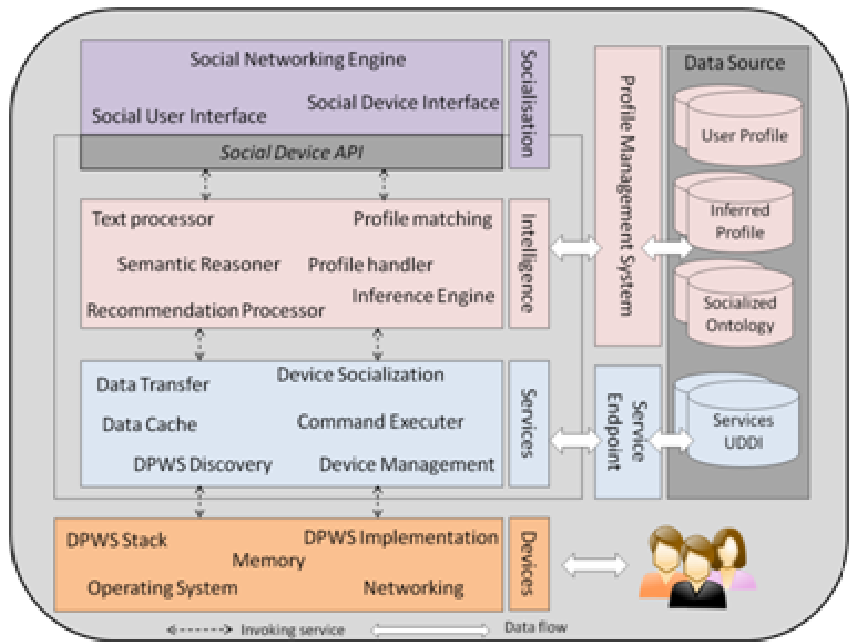 Fig 1: The proposed 4-layer architecture for Social Device Networking.
Experiments & Real-World Use Cases
The authors validated their framework through a prototype involving DPWSim (a device simulator) and ThingsChat (a custom SNS).
The Semantic Printer Scenario
In one of the most compelling use cases, a user attempts to print a color document. The local printer, detecting it is out of toner, doesn't just error out. Instead, it:
- Notifies the IT department automatically.
- Searches for another color printer nearby.
- Recommends the alternative printer to the user based on her stored preference for color documents.
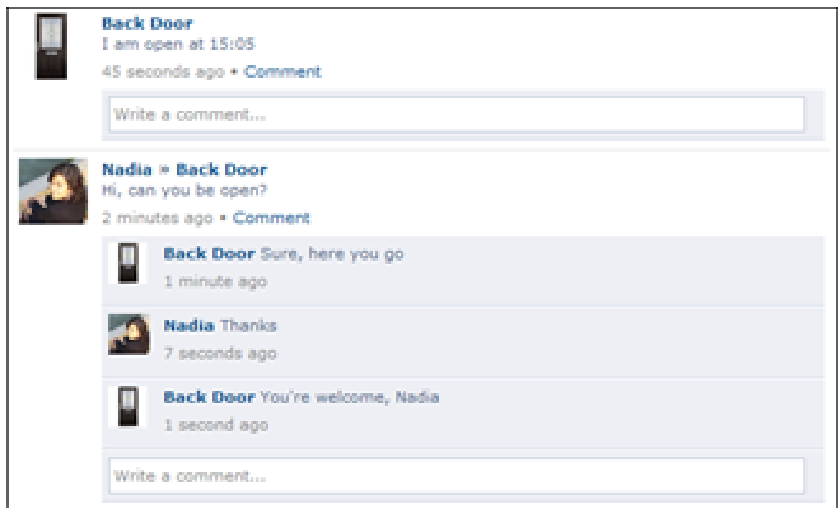 Fig 2: A demonstration of a user interacting with a "Back Door" device via a chat interface.
Critical Insight & Future Outlook
The genius of this work lies in its use of DPWS. While REST has become the industry standard for simplicity, DPWS offers a structured "Service-Oriented Architecture" (SOA) that is natively discovery-oriented. This allows for the "plug-and-play" social integration required for a truly connected world.
Takeaway: The future of IoT is not just a network of things, but a community of things. However, for this to succeed, industry-wide adoption of standardized communication protocols like DPWS—combined with robust security and privacy modules—is essential.
Limitations: The paper acknowledges that security remains a hurdle and that "smartness" currently depends on centralized intelligence. Moving forward, the integration of Cloud Computing and more advanced Semantic Web tools will be necessary to handle the massive scale of 1 trillion connected devices.