
SenseFace: Bridging the Gap Between Body Sensors and Social Networks for Ubiquitous e-Health
A Framework to bridge social network and body sensor network: An e-Health perspective
SenseFace is an e-Health framework that integrates Body Sensor Networks (BSN) with interpersonal Social Networks. It leverages RESTful web services and mobile gateways to enable real-time health monitoring and automated emergency alerting across platforms like Facebook and Twitter.
TL;DR
SenseFace is an innovative framework designed to break the silos of medical monitoring. By treating wearable sensors as "Social Entities," it allows vital signs (ECG, Heart Rate, etc.) to be dynamically pushed to a patient’s social circle—including doctors, family, and emergency responders—using standard web technologies (REST, JSON, and Social Media APIs).
Background Positioning: This work sits at the intersection of Ambient Intelligence and Social Computing, moving e-Health from a closed-loop medical device model to an open-source, web-centric communication model.
Problem & Motivation: The "Proprietary Silo" Issue
Most existing e-Health solutions are trapped within "proprietary walls." They use specific hardware and protocols that only work within a hospital or a pre-configured smart home.
The authors identify a critical gap: What happens when an elderly patient is outdoors or at work?
- Isolation: Proprietary medical devices often lack the flexibility to communicate over public cellular networks.
- Context Poverty: Raw data (e.g., "high heart rate") is useless without context (e.g., "is the patient currently driving or falling?").
- Latency in Action: Manual reporting of emergencies is often impossible for the patient.
The Insight here is simple yet powerful: Everyone already has an existing "Support Network" (Social Network). If we can bridge a Body Sensor Network (BSN) directly to these digital social circles, we create an automated, real-time safety net.
Methodology: The SenseFace Architecture
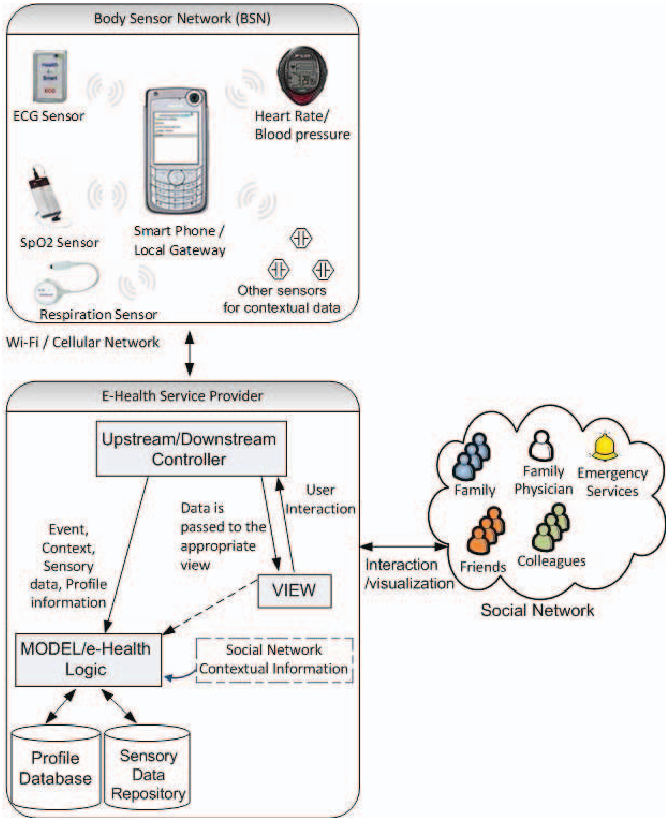
SenseFace uses a three-tier architecture: the BSN, the e-Health Service Provider, and the Social Network.
1. The Smartphone as a Gateway
Instead of a custom medical hub, SenseFace uses a standard smartphone.
- Connectivity: Sensors connect to the phone via Bluetooth (Star Topology).
- Logic: The phone runs an MVC (Model-View-Controller) pattern. It determines if data is "Normal" (stored locally) or "Alarming" (pushed to the cloud).
2. The RESTful Interface
The core of the system is the treatment of sensors as Web Resources. In SenseFace, an ECG sensor isn't just a hardware ID; it's a URL:
http://www.mcrlab-eHealth.com/[User_ID]/ECG
3. Bi-directional Communication
- Upstream (Push): Triggered by an emergency. The phone sends an HTTP POST to the service provider, which then blasts alerts via SMS, Facebook, or automated Fax.
- Downstream (Pull): A doctor can send an HTTP GET request to the framework to view the patient's current real-time heart rate or past history.
Experiments & Implementation
The authors developed a proof-of-concept using:
- Hardware: Nokia N95/N80 (Symbian OS) as the gateway.
- Software: PHP-based REST framework (Konstrukt) and J2ME.
- Integration: Successful real-time updates to Facebook, Twitter, LinkedIn, and Skype.
The system was tested for multi-modal output, meaning an emergency could trigger an MP3 voice mail (via Text-to-Speech) or a KML file to track the patient's precise GPS coordinates on a map.
(Note: The original paper focuses on architecture; the implementation confirms the feasibility of cross-platform social alerts.)
Critical Analysis & Conclusion
Takeaway
SenseFace proves that e-Health doesn't need new, expensive networks. By leveraging the RESTful Web and existing Social Networks, we can transform a smartphone and a few wearable sensors into a life-saving infrastructure.
Limitations
- Privacy: The paper assumes a level of trust in social networks that may be problematic today. Sharing health data on Facebook involves massive privacy risks.
- Power Consumption: Continuous Bluetooth polling and GPRS data transmission on older mobile platforms (like Symbian) significantly impact battery life.
Future Outlook
As we move toward Smart Cities, SenseFace's vision of integrating personal health with the social "ambient" environment will likely move toward more secure, decentralized protocols (like Blockchain) to ensure that while the network is "social," the data remains "private."