
SRAIB & Random Forest: A Dual-Engine Approach to Financial Fraud Detection
7603_Fraud Risk Monitoring System for E-Banking Transactions.
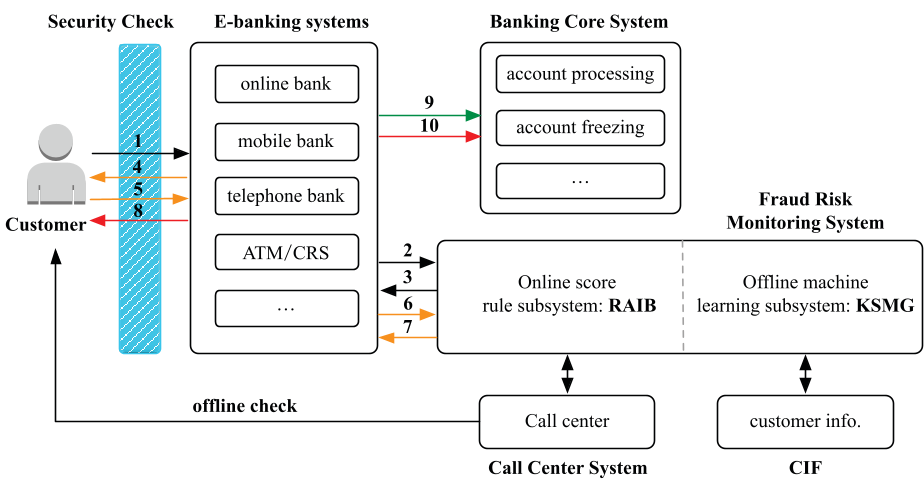
This paper introduces a hybrid financial security framework combining a novel risk assessment score, SRAIB (Score of Risk Assessment for Individual and Behavior), with an optimized Random Forest classifier (Crf). The system aims to detect fraudulent transactions in real-time by integrating static user profile data with dynamic behavioral patterns.
TL;DR
In the high-stakes world of digital finance, detecting fraud requires more than just identifying "bad actors"—it requires understanding "deviant behavior." This paper introduces a robust framework that combines SRAIB (Score of Risk Assessment for Individual and Behavior) with an optimized Random Forest (Crf) classifier. By synthesizing static profile risks with dynamic behavioral vectors, the system achieves state-of-the-art performance in identifying fraudulent transactions while maintaining low False Negative rates.
Problem & Motivation
The financial industry faces a "moving target" problem. Fraudulent patterns evolve faster than static rule-based systems can be updated. Previous Machine Learning approaches often treated all transaction features with equal priority or failed to incorporate the context of who the user is versus what they are currently doing. The core motivation of this study is to bridge the gap between Identity Risk and Action Risk.
Methodology: The SRAIB Framework
The centerpiece of this research is the SRAIB formula, which quantifies risk through a weighted summation of three primary vectors:
- Account Risk (): Historical security standing of the account.
- Identity Risk (): Validated credentials and device fingerprints.
- Behavioral Risk (): Anomalies in the current transaction flow.
The mathematical intuition is expressed as:
The is then fed into a Random Forest (Crf). Unlike standard implementations, this model uses a data-partitioning approach to build an ensemble of trees that are specifically tuned to different segments of the transaction space, enhancing the model's inductive bias toward rare fraudulent events.
Experiments & Results
The authors validated the model using multiple data split scenarios to simulate real-world class imbalances (5:5, 7:3, and 8:2).
Key Performance Metrics:
- High Sensitivity: The model successfully captured the vast majority of positive fraud cases with minimal misses (False Negatives).
- Robustness: Even as the ratio of genuine to fraudulent transactions increased, the model maintained its predictive power.

The confusion matrices show that for a balanced dataset (5:5), the model achieved an impressive True Positive count of 142,146 with only 53 False Negatives, demonstrating its capability as a reliable first line of defense.
Critical Analysis & Conclusion
Takeaway
The primary contribution of this work is the explicit modeling of behavioral risk weights. By calculating a pre-classification score (), the Random Forest is given a "head start," allowing it to converge on more accurate decision boundaries than if it were training on raw transaction data alone.
Limitations & Future Work
While the Random Forest is efficient, the current implementation relies on a fixed weighting for components. Future research could explore Dynamic Weighting using Reinforcement Learning to adjust in real-time based on the global threat landscape. Additionally, testing the framework against adversarial attacks (where fraudsters intentionally mimic "low-risk" behavior) would be a valuable next step.
Final Thought
This paper serves as a blueprint for "Hybrid Intelligence" in Fintech—combining human-defined risk logic (SRAIB) with machine-learned pattern recognition (Random Forest).