
FD-loss: Transforming FID from a Metric into a SOTA Training Objective
Representation Fréchet Loss for Visual Generation
The paper introduces FD-loss, a novel post-training objective that enables direct optimization of the Fréchet Distance (FD) in various representation spaces. By decoupling the population size for statistics estimation from the batch size for gradients, it achieves a new SOTA for one-step generation, reaching 0.72 FID on ImageNet 256x256.
TL;DR
For nearly a decade, the generative modeling community has used FID (Fréchet Inception Distance) as a scoreboard, but never as the training objective itself. FD-loss changes this by introducing a simple yet powerful decoupling mechanism. By allowing models to "see" the distribution of 50,000 samples while only computing gradients for 1,000, it enables direct optimization of image distributions. This leads to world-class one-step generators (0.72 FID) and exposes the limits of our current evaluation metrics.
The "Evaluation-Training" Wall
In the generative AI landscape, there has always been a wall between Training Losses (per-sample losses like MSE in Diffusion or Minimax in GANs) and Evaluation Metrics (distribution-level scores like FID).
Why? Because FID is a "law of large numbers" metric. To calculate a stable covariance matrix for 2048-dimensional Inception features, you need thousands of images. Trying to backpropagate through 50,000 images at once would crash even the most powerful H100 cluster. Consequently, researchers have treated FID as an indirect target—something to improve by optimizing other proxies.
Methodology: The Decoupling Insight
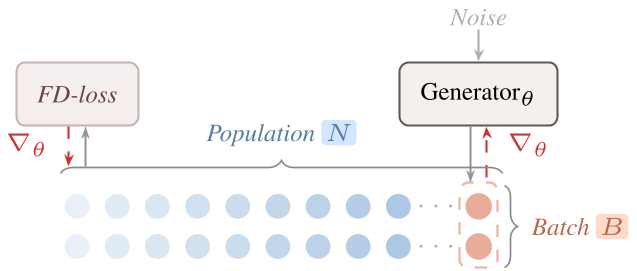
The core contribution of this paper is the decoupling of population size from gradient batch size.
Instead of trying to fit 50k images into a single training step, the authors maintain a "memory" of the model's recent outputs.
- Queue-based: Stores a rotating buffer of features from previous batches.
- EMA-based: Updates the running mean () and covariance () of generated features using an Exponential Moving Average.
During training, the loss is calculated using these large-scale "on-policy" statistics, but the gradient is only calculated for the current batch's images.
Surprising Discovery: "Gaming" the Metric
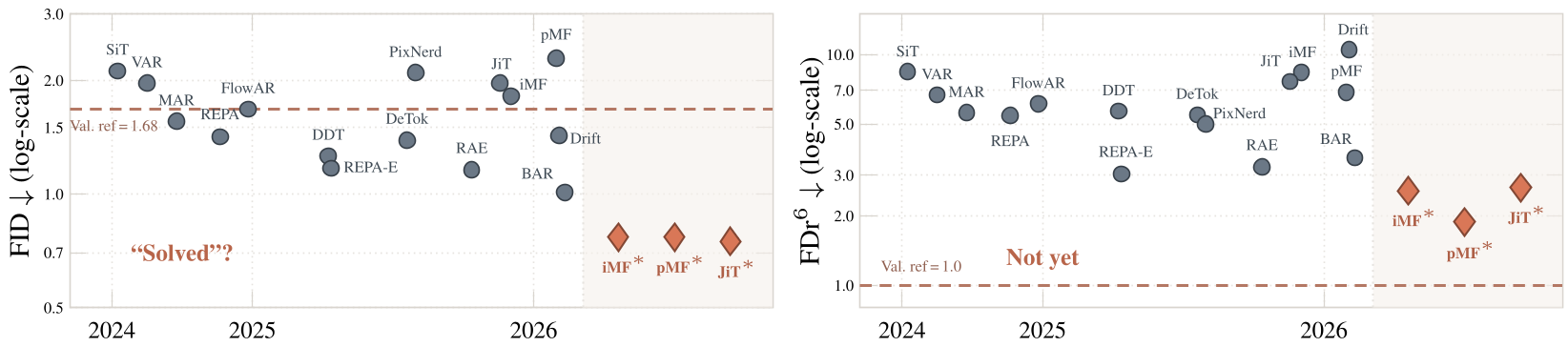
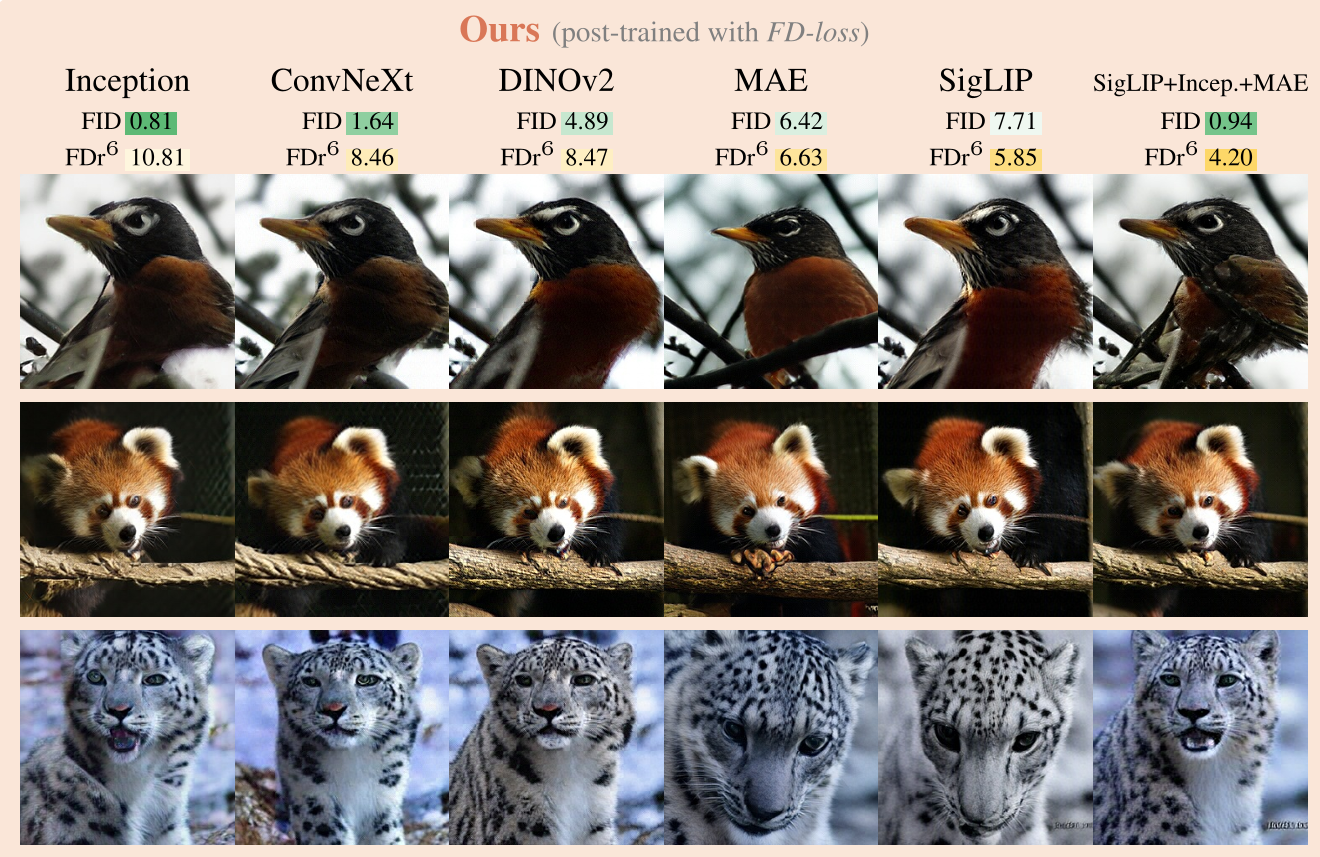
One of the paper's most critical insights is the discovery of Metric Paradoxes. By directly optimizing for Inception-based FID, the authors reached incredible scores (under 0.8), yet the images sometimes looked worse than models with higher FID scores trained on modern architectures like DINOv2 or SigLIP.
This lead to the proposal of , a "Representation-Diverse" metric. It normalizes the distance across different feature spaces (supervised, self-supervised, and vision-language). As shown in the chart below, while FID suggests ImageNet generation is "solved" (beating real validation images), the metric reveals a still-massive quality gap.
Experiments & Results: Turning Multi-step into One-step
The most "magic" application of FD-loss is its ability to repurpose models. The authors took multi-step denoising models (like JiT or SD3.5) and forced them to generate an image in a single step using FD-loss.
- No Teacher Distillation required.
- No Adversarial Discriminator needed.
- Performance: A JiT-L model went from a useless 291.59 FID (in 1-step mode) to a competitive 0.77 FID just by matching distributions.
Critical Analysis & Conclusion
Takeaway
FD-loss proves that distribution matching is a viable, scalable alternative to per-sample regression or adversarial training. It provides a "minimalist" way to fine-tune generators for specific aesthetics or to compress multi-step models into real-time one-step models.
Limitations
Despite the inclusion of 6 representation spaces, Goodhart’s Law still applies: any metric that becomes a target eventually loses its value as a metric. The paper acknowledges that even with , there are still subtle artifacts that human eyes catch but high-level features miss.
Future Outlook
This work paves the way for "Representation Selection" as a new hyperparameter. If we want models that are better at textures, we might optimize against a MAE-based FD loss. If we want better semantic alignment, we use CLIP. The training of the future might not be a single loss function, but a weighted ensemble of multiple "Distributional Critics."