
Frequency Assignment in Cellular Systems: Why Constraint Satisfaction Outperforms Neural Networks
Frequency assignment for cellular mobile systems using constraint satisfaction techniques
The paper presents a Constraint Satisfaction (CS) approach to the frequency assignment problem in cellular networks. By introducing cell-level variables and Limited Discrepancy Search (LDS), the authors achieved state-of-the-art results on standard benchmarks, outperforming neural networks and traditional heuristic sequential methods.
TL;DR
This paper tackles the classic Frequency Assignment Problem (FAP) in cellular mobile systems. By moving away from individual call-based variables and adopting a cell-centric Constraint Satisfaction (CS) model, the authors managed to break the bottleneck of call symmetry. Their approach, which integrates Forward-Checking and Limited Discrepancy Search (LDS), achieves significantly better spectral efficiency than Neural Network (NN) competitors on established benchmarks.
Contextual Positioning
In the landscape of Resource Allocation, the frequency assignment problem is a NP-hard combinatorial challenge. Historically, researchers have bounced between simple greedy heuristics (SE) and "black-box" approaches like Neural Networks (NN). This paper acts as a "strategic return" to logic-based AI, proving that with the right data representation, exact search methods can beat connectionist models in structured domains.
The "Call Symmetry" Problem & Intuition
Most early CS formulations treated every single frequency demand (call) as a unique variable. However, calls within the same cell are essentially identical. If Cell A needs three frequencies, it doesn't matter if they are assigned as (f1, f2, f3) or (f2, f1, f3). Standard algorithms waste millions of iterations exploring these redundant permutations.
The authors' core insight was to collapse individual calls into cell-level variables. By determining cell values step-by-step and enforcing separation constraints (), they effectively pruned the search space before the solver even started.
Methodology: The Search Engine
The algorithm is built on three pillars:
- Cell-Centric Representation: Drastically reduces variable count and eliminates intra-cell symmetry.
- Forward-Checking: A look-ahead mechanism that prunes the domains of future variables by removing frequencies that would violate constraints with the current assignment.
- Limited Discrepancy Search (LDS): Since finding the absolute optimum is hard, LDS allows the algorithm to explore paths that "deviate" slightly from a greedy heuristic, increasing the probability of finding a high-quality solution within a limited time budget.
(The architecture emphasizes a transition from individual call-graph coloring to a structured cell-variable search tree.)
Experiments & Results
The authors tested their method against three benchmark instances: K1, K2, and K3. The goal was to minimize the maximum frequency used (a measure of spectral efficiency).
| Instance | CS (Proposed) | Neural Networks (NN) | Sequential (SE) |
|---|---|---|---|
| K1 | 168 | 168 | 178 |
| K2 | 422 | 435 | 473 |
| K3 | 619 | 630 | 673 |
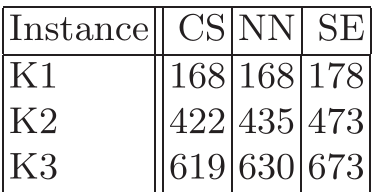
The CS method dominated the results. In the most complex scenario (K3), it used 11 fewer frequency units than the NN-based approach. While a difference of 11 might seem small, in the telecommunications industry, a 2% increase in spectral efficiency can save millions in licensing costs and infrastructure.
Critical Insight & Future Outlook
Takeaway: This paper is a masterclass in "Problem Representation." It shows that the difficulty of an NP-hard problem is often a function of how we describe it to the machine. By eliminating symmetry, the authors turned an intractable graph-coloring problem into a manageable optimization task.
Limitations: The paper focuses on static assignment. In modern 5G/6G environments, demands fluctuate in milliseconds. Future work would need to adapt this CS framework into a Dynamic Frequency Assignment model, perhaps by using the current search results as a warm-start for real-time adjustments.
Conclusion: Sometimes, the best way forward in AI is to look back at foundational logic and constraint satisfaction techniques. When combined with modern search heuristics like LDS, these methods provide a level of precision and reliability that purely statistical models still struggle to match.