
Decoding Neuronal Cultures: Frequency Variation Analysis as a Gateway to Biological Computing
Frequency variation analysis in neuronal cultures for stimulus response characterization
This paper introduces a novel frequency variation analysis method to characterize stimulus responses in in vitro neuronal cultures using Multi-Electrode Arrays (MEAs). By utilizing the slope of Inverse Inter-Spike Intervals (IISI) combined with a Multilayer Perceptron (MLP) neural network, the authors successfully distinguish stimulation sites with high accuracy (97.9%).
Executive Summary
TL;DR: Researchers have developed a new method to "read" the minds of dissociated neurons in a dish. By analyzing how the frequency of firing changes over time (IISI slopes) and applying Artificial Neural Networks, they can identify exactly where a stimulus entered the network with nearly 98% accuracy.
Field Context: This work advances the field of Hybrots—hybrid systems merging biological neural networks with robotic hardware. It moves beyond the limitations of the traditional Post-Stimulus Time Histogram (PSTH) into the realm of global, frequency-based topological analysis.
Problem & Motivation: The Connectivity Curse
In the quest to use neuronal cultures as computational engines, the primary bottleneck is characterization. How do we know which electrode acts as a "sensor" (input) and which as a "motor" (output)?
Previous methods like PSTH were effective only in sparsely connected networks. In a dense, self-organized culture, a single stimulus triggers a cascade of activity across the entire array. Finding "isolated" pairs of electrodes becomes impossible. The authors realized that instead of looking for isolated signals, we should embrace the Global Activation Topology. They hypothesized that each stimulation site generates a unique, culture-wide "fingerprint" defined by the rate of change in firing frequencies.
Methodology: The Global Fingerprint
The core innovation lies in the transition from Spike Counting to Frequency Slope Analysis:
- IISI Estimation: After a stimulus, the Inverse Inter-Spike Interval (IISI) is calculated for each of the 26 responsive electrodes.
- Linear Regression: Instead of a mean value, the authors calculate the slope of the IISI over a 150ms window. This captures the temporal decay or acceleration of the response.
- Normalization: Slopes are converted using the
arctan()function into angles (radians). This squashing function bounds the data, making it ideal for Neural Network training. - ANN Classification: A Multilayer Perceptron (MLP) takes these 26 angles as a "fingerprint" to classify which electrode was stimulated.
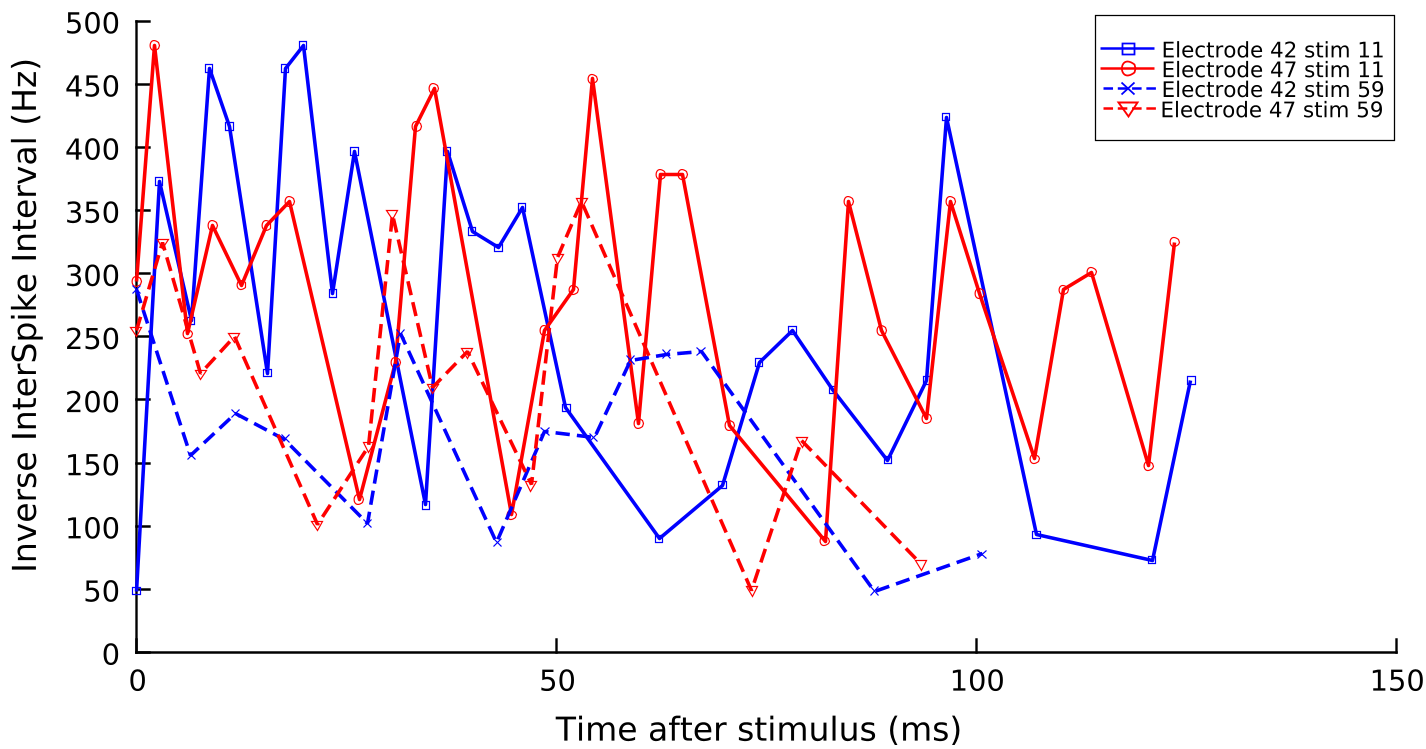 Figure 1: A sample of activity across all electrodes illustrating the global response to a single stimulation event.
Experiments & Results
The experimental results validate the robustness of the IISI-slope approach:
- High Precision: The ANN achieved 97.9% accuracy in distinguishing between two different stimulation sites.
- Distributed Intelligence: When the most "obvious" responsive electrodes were removed from the dataset, the accuracy stayed at 69%, proving that information about the stimulus is distributed throughout the network's latent connections.
- Longevity: The method was tested over the lifetime of the culture. While cell migration and connection pruning caused fluctuations, the classification accuracy remained consistently high (above 80%).
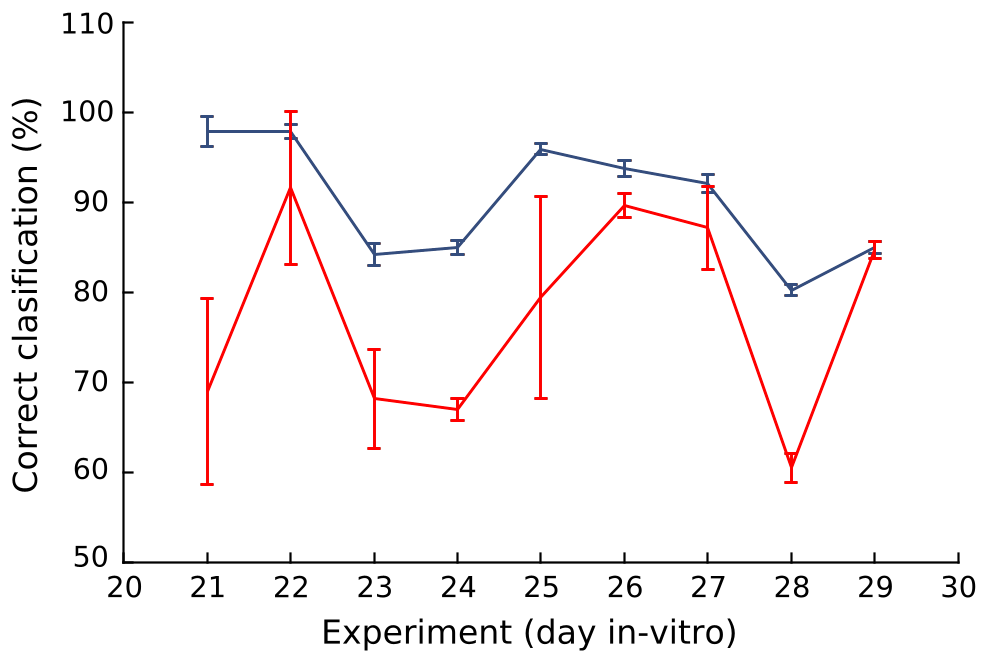 Figure 2: The percentage of correct classification over different days, demonstrating the stability of the frequency variation method.
Deep Insight & Conclusion
Takeaway
The neural code is not just about "if" a neuron fires, but "how the rhythm changes." By focusing on the variation of frequency, this research provides a mathematical bridge between biological non-linearity and machine learning classification.
Limitations & Future Work
While successful, the study currently focuses on a small subset of stimulation electrodes. The real challenge lies in scaling this to a high-dimensional input space (e.g., stimulating 10+ electrodes simultaneously). The researchers suggest that adjusting stimulus amplitude and frequency, alongside using GABA/glutamate blockers, could further reveal the transition between deterministic and chaotic dynamical states in these biological circuits.
Ultimately, this work brings us one step closer to Braitenberg’s vehicles—robots that don't just follow code, but are driven by the living dynamics of a self-organizing biological brain.