
FLMin: Bridging the Gap Between Who You Are and Who You Know in Social Networks
Frequent Links: An Approach That Combines Attributes and Structure for Extracting Frequent Patterns in Social Networks
The paper introduces FLMin (Frequent Link Mining), a novel pattern discovery algorithm that identifies frequent connections between groups of nodes sharing similar attributes in social networks. Moving beyond traditional topology-only subgraph mining, it focuses on "frequent links" to capture the interplay between network structure and node characteristics.
TL;DR
Frequent pattern mining in social networks has historically focused on topology—the shape of the graph. This paper argues that the attributes of the people involved are just as important. They introduce FLMin, an algorithm that discovers "Frequent Links": patterns where specific types of people (e.g., employed 40-year-olds) consistently connect to other specific types (e.g., unemployed youth). By leveraging a bottom-up pruning strategy, they achieve significant computational gains over exhaustive search.
Problem & Motivation: The "Blind Spot" of Subgraph Mining
Standard algorithms like gSpan or AGM are brilliant at finding recurring subgraphs. However, in a social context, a triangle is just a triangle unless you know if it connects friends, colleagues, or strangers.
The authors identify a major gap: node attributes (age, gender, sociability) are often treated as labels rather than core components of the pattern. Their vision is to redefine a pattern not as a structure, but as a relational regularity between populations. Why? Because behavior and decision-making in networks are driven by the characteristics of the entities as much as their connections.
Methodology: The "Frequent Link" Framework
The core of the paper is the formalization of a Frequent Link.
- Itemsets: A logical expression of attributes (e.g.,
Age=40 AND Job=Yes). - Link Support: The proportion of total edges in the network that connect two nodes matching specific itemsets.
To handle the exponential search space of all possible attribute combinations, the authors use an Apriori-style Property:
If a link between simple attribute groups (e.g., Gender=Male) is not frequent, then a link between specific sub-groups (e.g., Gender=Male AND Age=20) cannot be frequent either.
The FLMin Algorithm
FLMin starts with 1-itemsets (single attributes) and builds upward. It only evaluates complex attribute pairs if their simpler "sub-links" already passed the frequency threshold.
 Above: The formal definition of Frequent Link support.
Experiments: Performance and Insight
Using a large-scale proximity network from the city of Portland (3,000 nodes, 4,683 links), the authors tested both the quality of discovered patterns and the efficiency of the engine.
1. Qualitative Findings
FLMin successfully found that low support thresholds () reveal highly specific patterns (3-itemset links), while high thresholds reveal only general sociodemographic trends. For instance, it could pinpoint exactly what percentage of social ties exist between workers and non-workers.
2. Quantitative Efficiency
The algorithm's performance is impressive:
- Runtime Gain: Systematically over 85% to 99% improvement over naive search across various configurations.
- Scalability: The runtime grows linearly with the number of nodes, making it practical for real-world social datasets.
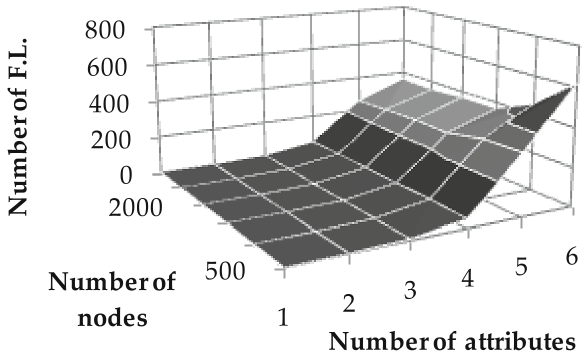 Figure: Runtime evolution across different support thresholds.
Critical Analysis & Conclusion
Takeaway
FLMin turns the problem of graph mining into a relational database problem optimized for network structures. Its greatest value lies in its flexibility; it adapts easily to directed, undirected, and multipartite (e.g., user-to-product) networks.
Limitations
While efficient, the algorithm's complexity still hinges on the number of attributes. In modern datasets with hundreds of features per node (e.g., embedding vectors), the itemset approach might encounter the "curse of dimensionality."
Future Outlook
The authors suggest that these frequent links can serve as a predictive foundation. If we know that "Attribute Group A" frequently links to "Attribute Group B," we can predict new links as soon as a node with Group A characteristics enters the network. This has massive implications for recommender systems and epidemiological modeling.
Disclaimer: This blog post is based on "Frequent Links: An Approach That Combines Attributes and Structure for Extracting Frequent Patterns in Social Networks" by Stattner and Collard.