
Beyond the Like Count: Leveraging Freshness and Diversity in Social-Aware Search
Fresh and Diverse Social Signals: Any Impacts on Search?
The paper introduces a novel Information Retrieval (IR) framework that integrates social signals from multiple platforms (Facebook, Twitter, Google+, etc.) as document priors. By focusing on "Freshness" (temporal relevance) and "Diversity" (cross-community interest), the approach achieved top performance in the INEX Social Book Search competition.
TL;DR
This research investigates how social "signals" (likes, tweets, ratings) can be transformed into powerful search ranking factors. Unlike previous attempts that simply count clicks, this paper proposes a model that prioritizes fresh interactions and diverse cross-platform validation. By integrating these into a Language Model as document priors, the authors demonstrated a significant boost in precision for book and movie search tasks.
The Problem: The "Static Signal" Trap
In the world of Information Retrieval (IR), we often use "Document Priors"—information known about a page before a user even types a search query. While social signals (Facebook likes, Tweets) are gold mines for relevance, most systems treat them statically.
Two major flaws exist in current approaches:
- The Age Bias: An old article has had years to accumulate likes, making it appear more "relevant" than a viral, highly relevant news piece published an hour ago.
- The Echo Chamber: 1,000 likes from a single Facebook group reflects high community interest, but 100 likes spread across LinkedIn, Twitter, and Reddit suggests a much broader, more objective "crowd authority."
Methodology: Engineering the Social Prior
The authors utilized a Language Modeling (LM) approach. They redefined the probability of a document by focusing on , the document prior.
1. Freshness via Gaussian Kernels
To solve the "Age Bias," the authors applied a Gaussian kernel function to weight each social action. Recent actions are given a weight close to 1, while older actions decay exponentially toward 0. This ensures that "Fresh" user interest is amplified.
2. Signal Normalization
They introduced resource-age normalization. By multiplying signal counts by a decay factor based on the document's publication date, they effectively "level the playing field" for new content.
3. Quantifying Diversity
Using the Shannon-Wiener Index, the model calculates the entropy of signals across six different social networks. A document with an equitable distribution of signals across Facebook, Twitter, and LinkedIn receives a higher "Diversity Factor" than one dominated by a single source.
Experiments and Insights
The study was validated on the INEX SBS (Social Book Search) and IMDb datasets, enriched with external social data.
Key Findings:
- The Power of Rating Date: For the SBS dataset, incorporating the date of ratings (RatingTa) resulted in a massive performance jump compared to just using the average rating score.
- Diversity Matters: The "All Criteria Div" model (combining all social platforms with a diversity weight) consistently outperformed "TotalFacebook," proving that cross-network validation is a stronger signal than single-network popularity.
- Feature Importance: Using the Weka framework, the authors performed a feature selection study. Interestingly, Facebook "Likes" and "Shares" remained the most robust individual features, but their utility was significantly enhanced when biased by document age (TD).
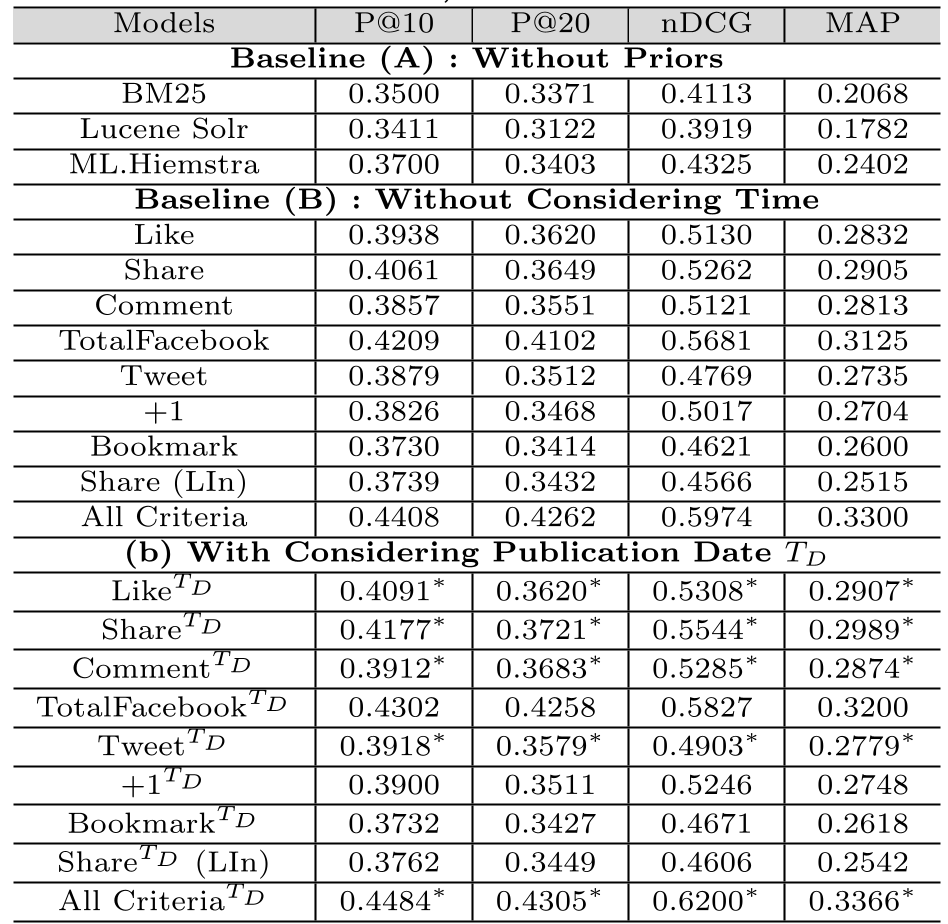 Experimental results showing the impact of publication date (TD) on precision and nDCG.
Critical Analysis & Takeaways
The brilliance of this work lies in its unsupervised nature. It doesn't require a complex "learning to rank" (LTR) setup with massive labeled datasets; instead, it provides a mathematically sound way to inject social "wisdom of the crowd" into standard probabilistic IR models.
Limitations: The authors noted that many APIs (like Facebook) do not provide the exact timestamp for every individual "like" action, only the "last share" or "total count." This forces the use of proxies for freshness.
Future Outlook: The next frontier is Social Polarity. Currently, the model treats a "Comment" as a positive signal. Integrating Sentiment Analysis into these priors—distinguishing between a "hated" viral post and a "loved" one—will likely be the final piece of the puzzle for truly intelligent social search.
Summary Checklist for Researchers:
- Mechanism: Document Priors in Language Models.
- Key Math: Gaussian Decays & Shannon Entropy.
- Impact: Significant SOTA improvement in Social Book Search (INEX).