
The Freshman Handbook: Leveraging Competitor Data for Intelligent Server Placement
The Freshman Handbook: A Hint for Server Placement in Online Social Network Services
The paper introduces "The Freshman Handbook," a framework designed for new online social network (OSN) providers to optimize server placement. By leveraging publicly available data from established OSNs like Twitter and Flickr, the authors propose hybrid clustering algorithms (OSN-MULTI) to minimize both user latency and inter-server traffic.
TL;DR
Deploying servers for a brand-new social network is usually a "chicken and egg" problem: you need user history to place servers, but you need servers to handle users. The Freshman Handbook breaks this cycle by proving that social networks share a consistent "social geography." By analyzing public data from giants like Twitter and Flickr, new providers can predict where their future users will be and how they will interact.
Background Positioning
In the landscape of distributed systems, this work sits at the intersection of Social Graph Analysis and Facility Location Problems. While most SOTA works focus on optimizing established systems (like Facebook’s data center logic), this paper provides a strategic "cheat sheet" for new entrants (Freshmen) using cross-platform data synthesis.
Problem & Motivation: The Cold Start of Infrastructure
Selecting server locations is a high-stakes trade-off between Quality of Service (QoS)—keeping servers close to users—and Operational Cost—minimizing bandwidth usage caused by data sharing between distant servers.
Prior works often viewed this as a static optimization problem based on historical logs. For a startup, these logs don't exist. Furthermore, traditional Integer Programming (IP) solutions don't scale well when the search space includes every possible user location. The authors' insight is simple but profound: Human relationships are consistent. A person’s social personality and locality don't change just because they moved from MySpace to Facebook; therefore, existing OSNs are "ghost maps" of future ones.
Methodology: Balancing Latency and Traffic
The paper proposes a three-tier algorithmic approach to tackle the problem across different dimensions:
- OSN-KMEANS: An enhanced K-means algorithm weighted by user density to minimize the physical distance (latency) between users and servers.
- OSN-MINCUT: A graph-partitioning approach aimed at keeping "friends" within the same server cluster to minimize expensive inter-site traffic.
- OSN-MULTI (The Hybrid): This is the core contribution. It starts with K-means clusters and then performs a "node swap" process influenced by friendship weights, provided the swap doesn't violate a maximum latency constraint ().
System Architecture & Logic
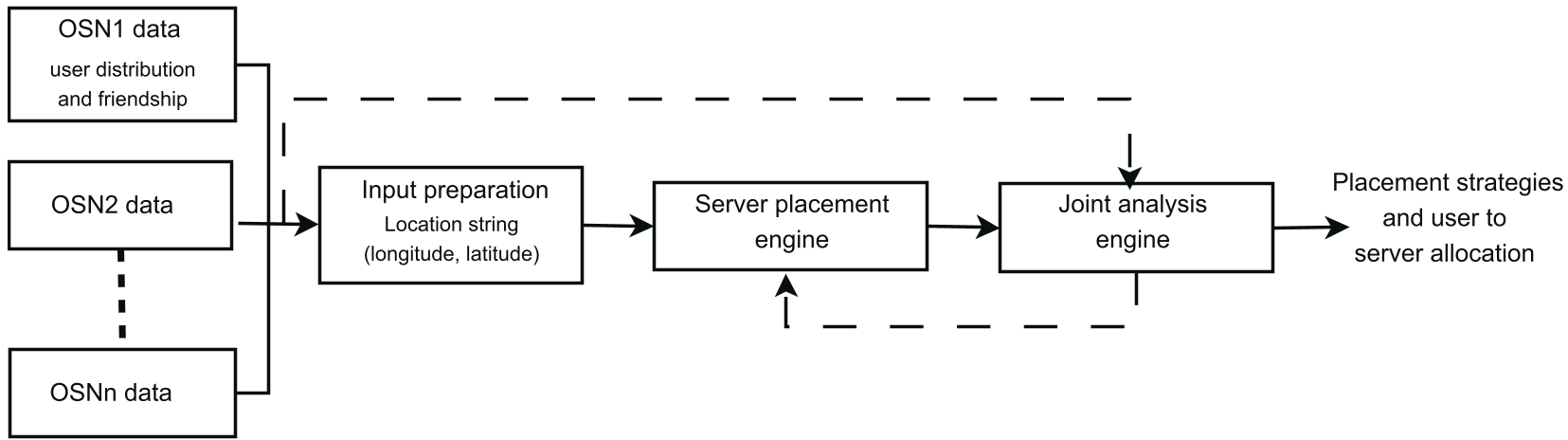
The framework uses Joint Analysis (Joint-Before or Joint-After) to create a "Super Graph" that aggregates geographic and social data from multiple OSNs. This ensures the resulting placement isn't biased toward a single application type (e.g., the professional focus of LinkedIn vs. the interest-based focus of Flickr).
Experiments & Results: The "Social Geography" is Real
The researchers analyzed data from Buzz, Twitter, Flickr, and Amazon.
Key Findings:
- High Overlap: With 50 servers, there was a 70% overlap in optimal locations between Twitter and Buzz, confirming that different social networks attract similar geographic distributions.
- Efficiency: OSN-MULTI outperformed traditional Integer Programming. As seen in the comparison charts, it achieved significantly lower latency and fewer cuts even as the number of servers () increased.
- The Flickr Outlier: Flickr showed more spread-out friendship links compared to Twitter. This makes sense—photography interests are global, whereas "following" in Buzz/Twitter often mirrors local/national social circles.
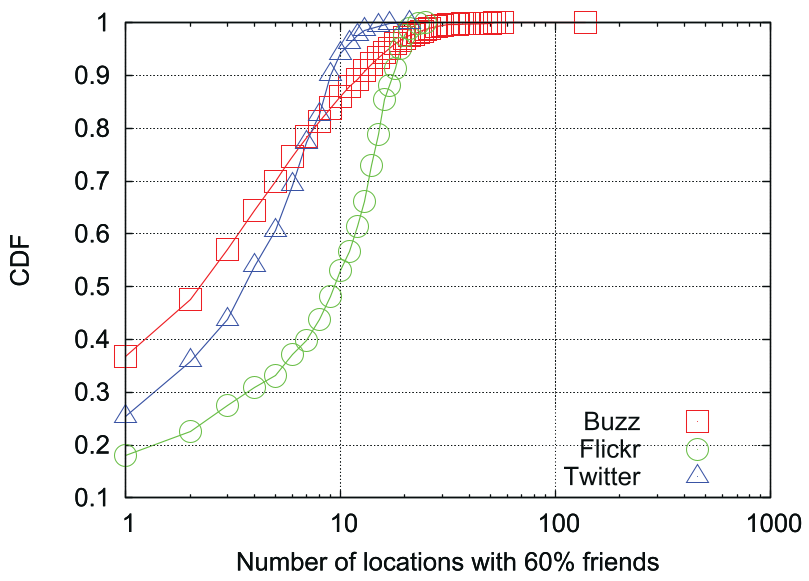 Figure: The 10-server placement logic across different OSNs shows striking similarities in metropolitan clusters.
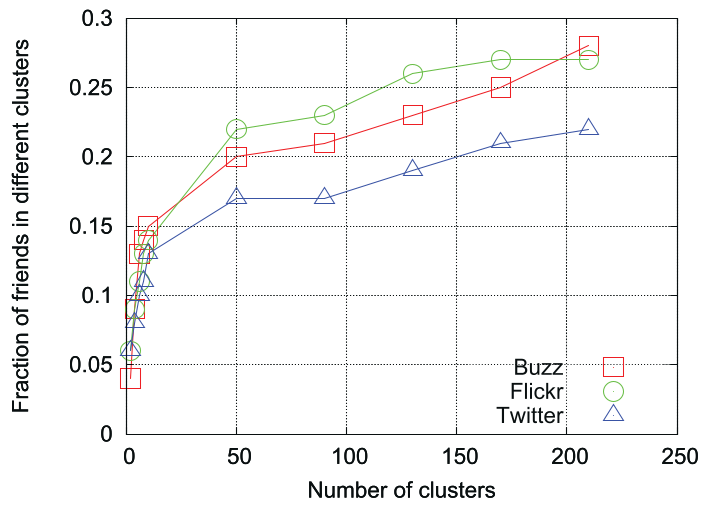 Figure: Performance comparison against Integer Programming (IP) benchmarks.
Critical Analysis & Conclusion
Takeaway
The paper successfully demonstrates that "Freshman" OSNs don't have to fly blind. By using the proposed OSN-MULTI algorithm and public datasets, they can achieve a placement strategy that is nearly as good as if they had years of historical data.
Limitations
- Latency Approximation: The study uses "speed of light in fiber" as a proxy for latency. In the real world, BGP routing, congestion, and ISP peering policies can create significant deviations from geographic distance.
- Privacy/Data Access: Crawling profiles is increasingly difficult due to modern privacy regulations (GDPR/CCPA) and anti-scraping measures implemented by platforms like X (formerly Twitter) and Meta.
Future Outlook
This methodology could be extended to Edge Computing and Content Delivery Networks (CDNs). As we move toward decentralized social protocols (like BlueSky or Mastodon), the ability to predict server/node placement based on "social consistency" will be vital for maintaining a performant, decentralized web.