
Fribo: Turning "Living Noise" into Social Gold for Single Households
Fribo: A Social Networking Robot for Increasing Social Connectedness through Sharing Daily Home Activities from Living Noise Data
This paper introduces Fribo, a social networking robot designed to reduce social isolation in young adults living alone. Fribo recognizes daily home activities via anonymized living noise and shares this information among a small circle of close friends to create a "virtual cohabitation" experience.
TL;DR
Living alone shouldn't mean being lonely. Researchers have developed Fribo, a social networking robot that listens to the "white noise" of your home—like the sound of a vacuum or a fridge opening—and shares it with your friends. By creating a virtual sense of "co-presence" without using invasive cameras, Fribo acts as a bridge that triggers real-world conversations and reduces social isolation.
The Problem: The "Lonely Robot" Paradox
In an era where one-person households are the fastest-growing demographic, social isolation is a rising epidemic. Most current "social robots" try to solve this by being a friend to the user (one-to-one interaction). However, this often fails because:
- Isolation remains: It doesn't actually connect the user to other humans.
- The Privacy Tradeoff: Robots with cameras (telepresence) feel like "Big Brother" in a private home.
The authors of the Fribo paper argue that the solution isn't a smarter AI companion, but a better social middleman.
Methodology: The Power of Living Noise
The team at Yonsei University and KAIST recognized a unique insight: Living Noise. These are the mundane sounds of daily life (not voices) that we usually ignore but would miss if we were truly alone.
1. The Architecture
Fribo uses a Raspberry Pi 3 equipped with an ultrasonic sensor, illuminance sensor, and most importantly, an omni-directional microphone array.
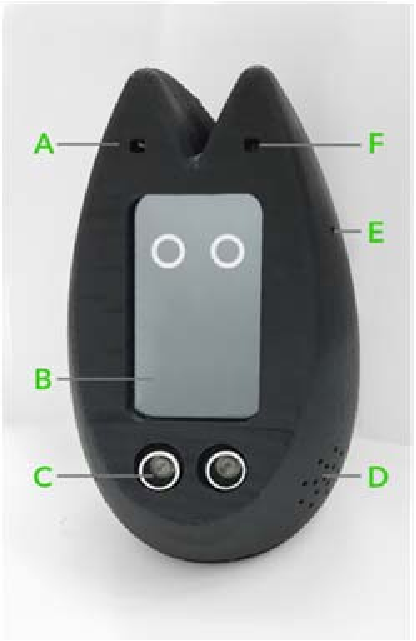 Figure 1: The localized sensor setup of the Fribo prototype.
2. Privacy-Preserving Awareness
To solve the privacy dilemma, Fribo avoids cameras entirely. It filters out human speech frequencies and only shares the activity itself. Instead of saying "John is eating," it tells the group, "Oh, someone just opened the refrigerator. I wonder what they are having?" This anonymity creates a "guessing game" that researchers found increased engagement while decreasing the feeling of being monitored.
Field Study: "I can hear you, so I'm not alone"
The researchers conducted a four-week study with teams of three close friends. The results were striking.
Key Findings:
- Virtual Cohabitation: Participants reported feeling like they lived in the same house but in different rooms. Hearing a friend's "morning routine" through the robot encouraged users to start their own day earlier.
- The "Trigger" Effect: Fribo didn't replace human contact; it started it. Seeing a friend active via the robot made participants more likely to send a text or make a phone call.
- Attachment to the Middleman: Interestingly, users began to view Fribo as a "flatmate" or a "messenger" rather than just a speaker.
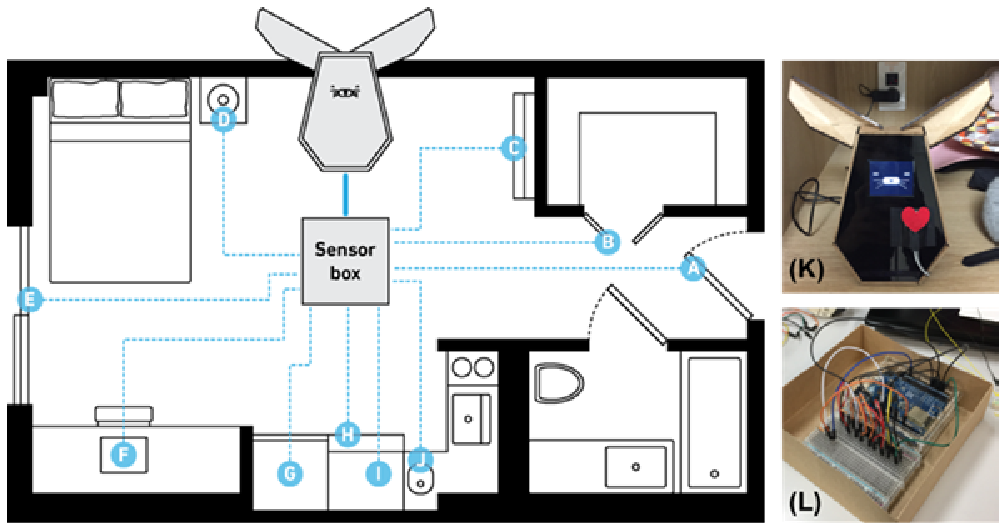 Figure 2: Placement of Fribo and the associated sensors in a typical studio apartment.
Critical Analysis & Conclusion
Takeaway
Fribo represents a shift in HRI (Human-Robot Interaction) from Affective Computing (trying to understand emotions) to Social Mediation (facilitating human relationships). By focusing on "low-fidelity" data like sound, it avoids the "Uncanny Valley" and the privacy paranoia associated with modern smart devices.
Limitations & Future Work
The study was conducted within Korean culture, which may have specific views on social intimacy. Additionally, distinguishing between "actual" living noise and "TV noise" remains a technical hurdle. Future versions of Fribo will likely need to refine their acoustic activity recognition models to handle more complex, noisy environments.
In conclusion, Fribo proves that sometimes, the best way to help someone feel connected is simply to let them know that, somewhere out there, a friend is also making a cup of coffee.