
Friend in the Middle (FiM): Breaking the Social Graph Fingerprint
Friend in the Middle (FiM): Tackling de-anonymization in social networks
This paper introduces Friend in the Middle (FiM), a novel graph-based privacy mechanism designed to counter de-anonymization attacks in Online Social Networks (OSNs). By replacing direct edges between users with intermediary proxy nodes called FiMs, the method obscures the true social graph topology, achieving near-total immunity against state-of-the-art structural re-identification.
TL;DR
Even if you encrypt your messages and hide your name, the "shape" of your friend group can betray your identity. This paper introduces Friend in the Middle (FiM), a structural defense that replaces direct social connections with "mediator" nodes. By breaking direct edges, FiM reduces the success rate of state-of-the-art de-anonymization attacks from a devastating 98% to a virtually invisible 0.01%.
Background: Contextual Privacy vs. Content Privacy
In the world of Online Social Networks (OSNs), we have become relatively good at Content Privacy—using tools like Scramble! or VPSN to encrypt messages. However, we remain dangerously exposed regarding Contextual Privacy.
Contextual privacy refers to the "who-is-talking-to-whom" metadata. Modern de-anonymization attacks don't need your name; they compare an anonymous graph (like a leaked dataset) with a public auxiliary graph (like LinkedIn). If your connection pattern is unique, the algorithm "matches" the nodes, stripping away your anonymity.
The Core Innovation: The Mediated Edge
The authors argue that the root of the problem is the direct edge . Their solution, Friend in the Middle (FiM), transforms the topology:
- Direct Connection: (Vulnerable to structural mapping)
- FiM Connection: (The OSN sees two connections to , but no direct link between and )
Types of FiM Architectures
- Single FiM: A single proxy node sits between and . This acts as a structural mixer.
- Multi-hop FiM (n-hop): Similar to the Tor network, the connection passes through multiple nodes. This ensures that even the entry FiM doesn't know the ultimate destination, providing high-degree anonymity against an "honest-but-curious" OSN provider.
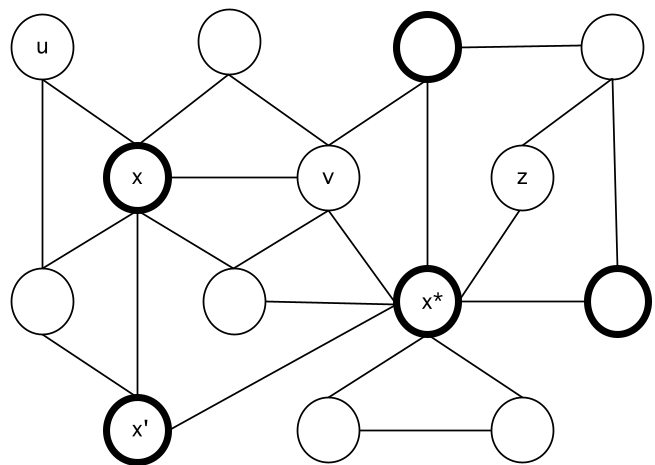 Fig 1: A network topology where non-FiM users (thin) connect via FiM nodes (thick), effectively masking the underlying social structure.
Methodology & Implementation
To make this viable in the real world, the authors propose implementing FiM as an OSN Application (e.g., a Facebook App) or a Browser Extension. The "bridge" information—knowing that is actually a mediator for and —is stored on an external server outside the OSN's domain. This prevents the OSN provider from reconstructing the original graph.
Experimental Results: Turning 98% into 0.01%
The authors tested FiM using the Slashdot dataset (77k+ nodes) and applied the famous Narayanan-Shmatikov de-anonymization attack.
Key Findings:
- Baseline Attack: Re-identified 98% of the users.
- With FiM Applied: The re-identification accuracy dropped to 0.01%.
- The Power of Hops: As the number of hops () increases, the distance between users grows, making it nearly impossible for matching algorithms to find a structural match.
- High-Degree Robustness: Even "super-nodes" (users with many friends), which are usually the easiest to de-anonymize, gain significant protection when they shift even 10% of their connections to FiM nodes.
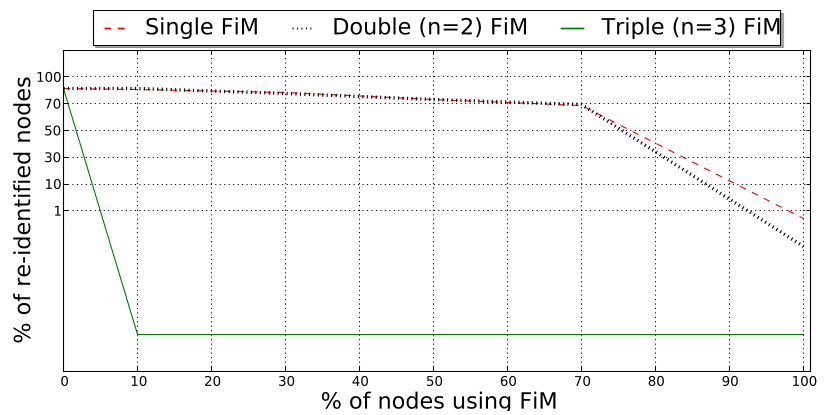 Fig 2: The dramatic decrease in re-identified nodes as the percentage of FiM-mediated connections increases.
Critical Insights: Why it works
The effectiveness of FiM lies in its ability to disturb the classifier. De-anonymization relies on "seed" nodes and structural similarity. By inserting FiMs, the "average degree" of nodes changes, and the "path distance" between friends expands. This creates a massive amount of "False Positives" for the attacker—the algorithm thinks it found a match, but it's actually mapping a user to a randomly similar-looking node.
Conclusion & Future Outlook
The FiM approach proves that we don't need to rebuild the internet to protect privacy. By using existing nodes as "friends in the middle," we can hide the social fabric from the very platforms we use.
Limitations: Currently, the model does not fully protect against advanced Traffic Analysis (e.g., timing attacks). Future work aims to integrate Tor-like features such as dummy traffic and message timing to make the "mediator" nodes even more invisible.
Final Takeaway: In the age of big-data social mapping, your "connections" are your identity. FiM offers a path to talk to your friends without the platform ever knowing you're actually friends.