
Twitter Cultures: Does Your Nationality Predict Your Newsfeed Influence?
Exploring friend's influence in cultures in Twier
The paper investigates cultural variations in social influence on Twitter, proposing a classification model to predict keyword usage (hashtags/named entities). Using L1-regularized logistic regression, it evaluates user behavior across the US, India, and Egypt, achieving a peak AUC of 0.825 for datasets from India.
Executive Summary
TL;DR: This study challenges the long-standing sociological assumption that people from "collectivist" cultures (like Egypt and India) are more influenced by their peers than those from "individualist" ones (like the US). By building a predictive model for Twitter hashtag and named-entity usage, CMU researchers found that US users often grant more weight to their friends' tweets than their Egyptian counterparts.
Background: Published in the proceedings of ASONAM '13, this work sits at the intersection of Social Computing and Computational Linguistics. It moves beyond "who is influential" to "who is influenced," providing a local-first analysis of social networks.
Problem & Motivation: The Gap Between Theory and Data
Sociology (Hofstede, Triandis) suggests that collectivist cultures value interdependence, while individualist cultures value autonomy. Naturally, one might assume an American tweeter is a "lone wolf" while an Indian or Egyptian tweeter follows the pack.
However, the authors noticed a gap: most studies look at the entire network (Global Analysis), missing the subtle, local nuances of a user's immediate circle. They set out to answer: Does our online behavior actually reflect our cultural upbringing?
Methodology: Modeling the Local Sphere
The researchers treated prediction as a classification task: Will User A use Keyword K in the next 20% of their tweets?
The Secret Sauce: Semantic Relatedness
Instead of just looking for exact word matches (which are rare), they used a Relatedness Matrix based on Latent Dirichlet Allocation (LDA). This allows the model to understand that a friend tweeting about "#Tahrir" is semantically related to the user later tweeting about "Cairo."
Feature Engineering
The model evaluates influence through four dimensions:
- Global/Local Trend: Is the topic trending worldwide or just in the user’s immediate circle?
- User History: Does this match the user’s long-term latent interests?
- Friend Inversion: Separate weights are learned for each friend to identify who truly moves the needle.
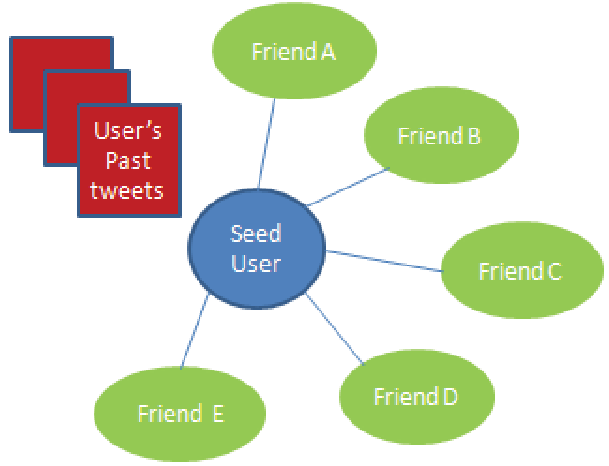
Experiments & Results: A Cultural Plot Twist
The researchers trained over 2,700 individual models. Model #4—which combined user history with semantic friend influence—performed the best (AUC 0.80).
The Unexpected Findings
When comparing the US, India, and Egypt, the data revealed a "Cultural Paradox":
- US Users: Contrary to the "individualist" label, they gave higher weight to their friends' influence in predicting future tweets.
- Egypt Users: Showed the least social influence, staying more consistent with their own latent topics.
- India Users: Balanced both worlds, placing the highest importance on their own history while still valuing friends.
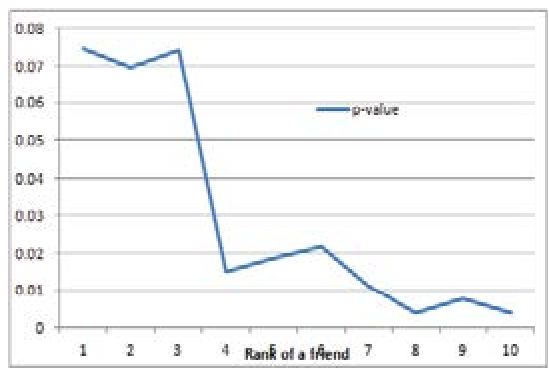 The graph above clearly shows that US and Indian users assign higher absolute weights to their top-ranked friends compared to Egyptian users.
Critical Analysis & Conclusion
Why were the results "backwards"?
The authors suggest two compelling reasons:
- Selection Bias: Twitter users in developing nations in 2013 were often highly "tech-savvy" elites whose behavior might align more with global digital norms than local traditional ones.
- The Nature of Digital Ties: A "friend" on Twitter may not be a real-world confidant. In individualistic cultures, digital platforms might serve as primary social "anchors," whereas in collectivist cultures, real-world ties are so strong that online "friends" carry less weight.
Takeaway
This paper serves as a warning to researchers: Offline cultural identity does not map 1:1 to digital footprints. As we build AI and recommendation systems, assuming "one-size-fits-all" cultural behavior is a recipe for inaccuracy.
Limitations: The study used a small snapshot (Feb–March 2012) and focused on users with 60-150 friends, potentially excluding "power users" or "lurkers" who might exhibit different social dynamics.