
"Friend is Treasure": Revolutionizing Task Offloading via Mobile Social Contacts
“Friend is Treasure”: Exploring and Exploiting Mobile Social Contacts for Efficient Task Offloading
The paper introduces "iTop-K," a social-relationship-aware task offloading algorithm for Mobile Social Networks (MSNs). It shifts from random selection backends to a structured "Top-K" friend selection mechanism, significantly improving load balancing and execution efficiency in edge computing scenarios.
TL;DR
Researchers have moved beyond pure random models for mobile task offloading, proposing iTop-K. By leveraging the intuition that "your friends are more powerful and reliable than strangers," this algorithm uses social contact frequency to achieve up to 15x better load balancing than standard random walk models in real-world mobile social networks (MSNs).
The "Ball and Bin" Problem in the Real World
In distributed computing, the "power of two choices" (d-choice) is a classic way to balance load: effectively, you look at two random bins and pick the emptier one. However, this paper identifies a fatal flaw: Human mobility is not random.
In real-world traces (like MobiClique), social relationships dominate contact duration. Some users meet constantly, while others are effectively invisible to each other. Applying a random "ball and bin" approach to these non-uniform "weighted bins" results in massive queues for some users and idle time for others.
Methodology: The iTop-K Insight
The core philosophy is simple: Stable social contacts are the most efficient conduits for task execution.
1. Social Ranking (Top-K)
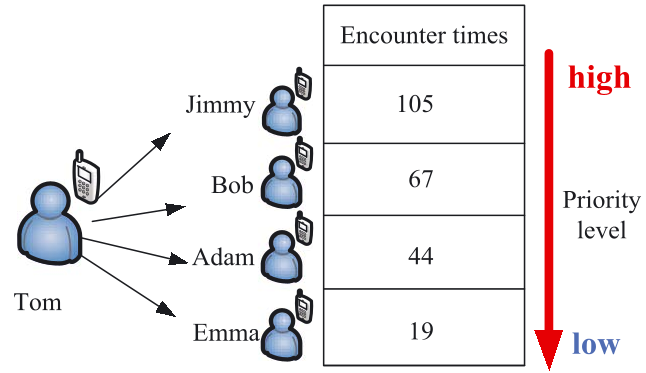
Instead of selecting any random neighbor, the system maintains a "Friend List" based on meeting frequency. Tasks are preferentially offloaded to "Top-K" ranked friends. This ensures that the task is given to someone with whom the user has a stable, high-bandwidth connection potential.
2. Scalable "K" Factor
What happens if your best friends aren't around? iTop-K uses a scaling law:
- If no "Top-K" friend is in the current contact window, the selection scope doubles (e.g., from 2 to 4, then 8).
- This ensures that the system doesn't wait indefinitely for a "best" friend, maintaining a balance between social intimacy and task latency.
3. Task Priority with Social Psychology
The authors incorporate a fascinating empirical model: Social Priority. Tasks assigned to intimate friends are processed with higher priority than tasks from strangers. Mathematically, the execution time for a user ranked in the -th place is modeled as: Where represents the social dampening factor. This reflects the reality that social trust accelerates cooperation in distributed systems.
Experimental Results: Proving the Advantage
The authors tested iTop-K against three major real-world datasets: Sigcomm-2009, Infocom-2005, and Stanford-2010.
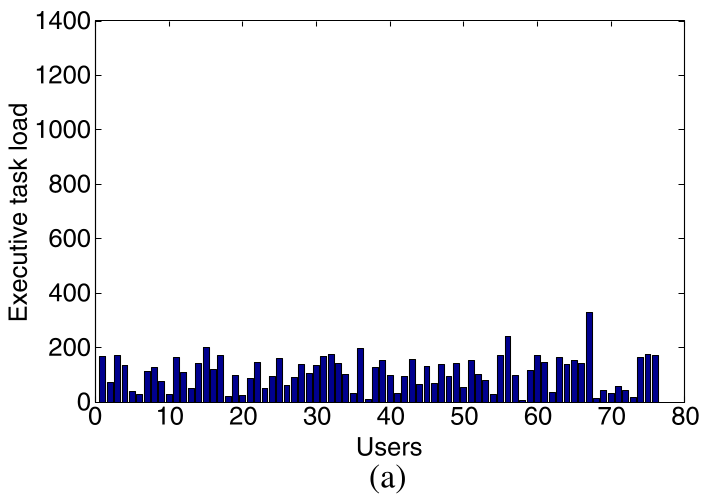
- Load Balancing Performance: Without priority, the load remains imbalanced regardless of the value. However, once social priority is enabled, the task load distribution becomes remarkably smooth across the network.
- Superior Efficiency: iTop-K showed a 9x improvement over basic social assignment and a massive 15x improvement over pure random choice.
Critical Insight: Why This Matters
The fundamental takeaway is that distributed systems cannot afford to ignore the underlying social graph. Most current edge computing frameworks treat every node as an anonymous resource provider. This paper proves that by acknowledging the "Inductive Bias" of human social structures—high-frequency contacts and social-driven priorities—we can build much more efficient and balanced distributed ecosystems.
Limitations & Future Work
The current model assumes a direct one-hop contact for offloading (Direct Contacts). The authors rightfully note that incorporating multi-hop social routing could further enhance the system, though it might introduce higher latency. Future developments in "Social IoT" will likely build upon these "Top-K" principles to manage the increasing complexity of urban crowdsourcing.
Editor's Note: This work stands as a cornerstone for researchers looking to bridge the gap between social network analysis and mobile opportunistic computing.