
My Friend Leaks My Privacy: The Social Circle Model and why OSNs Fail to Protect You
My Friend Leaks My Privacy: Modeling and Analyzing Privacy in Social Networks
This paper introduces the "Social Circle Model," a formalized framework for modeling privacy in Online Social Networks (OSNs) based on the Restricted Access and Limited Control (RALC) theory. The authors evaluate the privacy enforcement mechanisms of six prominent platforms—Facebook, Google+, VK, Sina Weibo, QZone, and WeChat—identifying systemic vulnerabilities in information dissemination and deletion.
TL;DR
Even if you set your post to "Friends Only," your privacy is often an illusion. This research formalizes the Social Circle Model to evaluate how information "leaks" through the cracks of online social networks (OSNs). By auditing six major platforms, the authors expose how re-sharing, tagging, and poor deletion mechanisms allow your private data to escape your intended boundaries.
The "Illusion of Control" in Social Media
We often operate under an Optimistic Bias: because we clicked "Post to Friends," we believe we control the information. However, privacy in OSNs is a multifaceted beast. The authors argue that modern networks fail because they ignore the Restricted Access and Limited Control (RALC) theory.
The core issue isn't just who sees your post, but what happens when a friend interacts with it. Does a "Like" broadcast your private post to your friend's strangers? If a friend re-shares your photo, is your original privacy setting inherited or ignored?
The Social Circle Model: A Theoretical Blueprint
To audit these systems, the paper establishes five "Gold Standard" properties for any privacy-preserving social network:
- Control: Only the owner should define the boundary.
- Consistency: What you think is happening must match what the system does ().
- Usability: Settings shouldn't be so complex that they are ignored.
- Clean Deletion: Deleting a post should remove all "phantom" traces and notifications.
- Non-leaky: People outside the circle should have a zero probability of guessing the content.
Note: The social circle defines the mapping between information belongings (I) and Social Network Identities (SNIDs).
Testing the Giants: Who Fails the Privacy Audit?
The authors conducted a deep dive into six platforms. Here are the most striking technical findings:
1. The Forwarding Leakage (Google+ & VK)
In Google+, if Alice shares a photo with a private circle, Mallory (a friend) can ignore a warning and re-share it to her own circles. Suddenly, Chuck—who Alice doesn't even know—can see the photo on Mallory’s wall. The system warns, but it doesn't enforce.
2. The Reprinting Nightmare (QZone)
QZone allows "Reprinting," which essentially creates a brand new copy of a user’s blog or photo on a friend’s wall. Once reprinted, the original owner has zero control. Even if the original is deleted, the copy lives on, violating the principle of Clean Deletion.
3. The Phantom Post (WeChat)
The most technical "bug" was found in WeChat's notification system. When a post is deleted, the notifications of "Likes" often remain. In specific versions (V6.5.18 on iOS), clicking these "dangling" notifications could actually reload a phantom copy of the deleted message and full-size images.
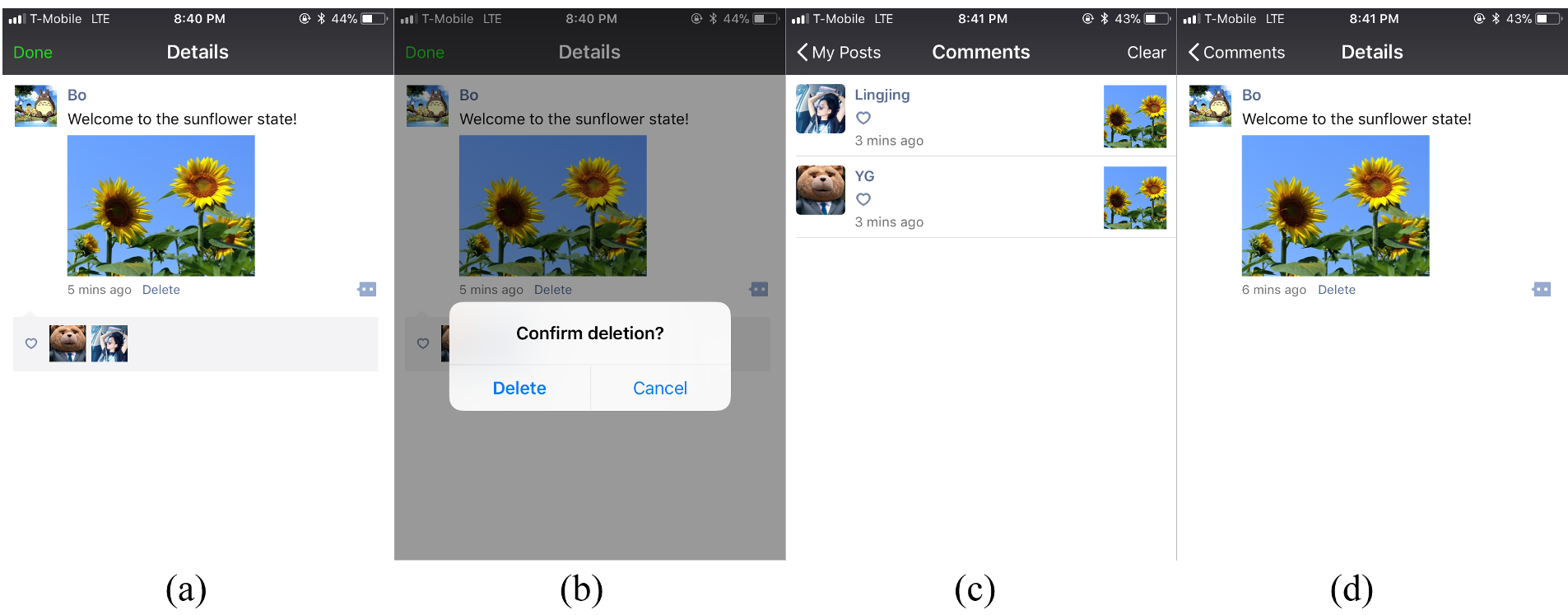 Figure: Non-clean deletion in WeChat allows access to "deleted" content via dangling notifications.
Comparative Performance: A Summary of OSN Privacy
| Feature | Google+ | |||
|---|---|---|---|---|
| Circle Definition | Lists/Smart Lists | Tags/Group Chats | Friend Circle | Circles/Communities |
| Forwarding | Restricted (Private) | Disabled (Type-b) | Restricted | Leaky (Warnings only) |
| Deletion | Clean | Leaky (Notifications) | Semi-clean | Non-clean |
| Replies | Inherited (Open) | Intersection (Tight) | Intersection | Inherited |
Critical Insight: Why WeChat's Reply Model Wins
Surprisingly, the authors find that WeChat has one of the most robust privacy models for "Type-e" information (replies and likes). In Facebook, if Bob replies to Alice, all of Alice's friends see it. In WeChat, Bob’s reply is only visible to people who are friends with both Alice and Bob (the intersection). This prevents "reply leakage" to strangers.
Future Outlook: Co-ownership
The paper concludes that the next frontier is Co-ownership. When a photo contains three people, who should control its privacy? Current systems default to the uploader, but a true Social Circle Model requires multi-party negotiation—a complex technical challenge that OSNs have yet to solve.
Conclusion
Your social network privacy is only as strong as your "gossipiest" friend and the platform's weakest code. The transition from "Identity Privacy" to "Dissemination Control" is the most urgent shift needed in modern software engineering for social media.