
SybilEdge: Turning Sparsed Friend Requests into High-Precision Fake Account Detectors
Friend or Faux: Graph-Based Early Detection of Fake Accounts on Social Networks
SybilEdge is a graph-based algorithm designed for the early detection of fake (Sybil) accounts on social networks. It focuses on new users with sparse connectivity by aggregating the information from their friend request targets and the responses (accept/reject) of those targets, achieving an AUC > 0.9 on the Facebook network for accounts only a few days old.
TL;DR
Detecting "Sybil" or fake accounts immediately after they are created is a massive challenge for social networks because these accounts haven't built enough of a "neighborhood" for traditional algorithms to analyze. SybilEdge breaks this barrier. Instead of looking at where a user fits in the global graph, it looks at who they target and how those targets react. Tested on Facebook's massive scale, it detects fakes with 90%+ accuracy after only a handful of friend requests.
Context: Why Traditional Graph Defense Fails New Users
Most graph-based security tools rely on Homophily: the idea that "birds of a feather flock together." If you are real, you friend real people; if you are a fake, you are mostly stuck friending other fakes.
However, this creates two massive blind spots:
- The Stabilization Period: New accounts (real or fake) have very few edges. There isn't enough structural "homophily" to measure.
- Sampling Attacks: Smart fake accounts intentionally target "indiscriminate accepters"—real people who click 'Accept' on every request. This makes the fake account look perfectly integrated into the real-user community.
The Insight: All Edges are Not Created Equal
SybilEdge, proposed by researchers from Harvard and Meta, moves beyond structural topology. Use the data Facebook already has: high-confidence labels for billions of old users. By looking at how these veteran users interact with known fakes, SybilEdge identifies two powerful signals:
- Target Selection (Preference): Fakes don't pick targets randomly. They target specific profiles (e.g., influencers, public accounts).
- Target Response (Discrimination): Some real users are "expert classifiers." They might accept 90% of requests from real people but only 5% from fakes. A rejection from such a user is a massive red flag.
 Key observation: Over 1/3 of users are significantly more likely to accept a real user than a fake (middle), and fakes target different users than reals do (bottom).
Methodology: The SybilEdge Equation
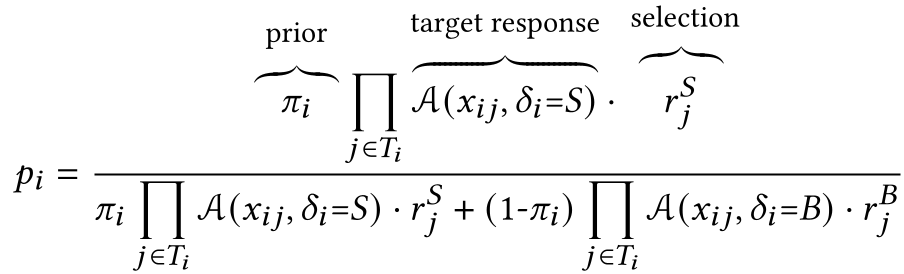
The algorithm uses a Bayesian framework to update the probability of a user being fake () based on every friend request sent.
1. Bayesian Aggregation
For every target that user requests:
- It looks at vs : How likely is a Sybil vs. a Benign user to target this person?
- It looks at : If the target accepted/rejected, how does that align with their historical behavior toward fakes?
2. Confidence Weighting
Not all data points are trusted equally. SybilEdge introduces "Confidence Priors" ( and ). If a target has only received two requests in their life, their "accept rate" is statistically noisy. SybilEdge shrinks these uncertain rates toward the global average, effectively "muting" noisy targets until more data is collected.
Performance: Smashing the SOTA
In head-to-head tests against industry standards like SybilRank and SybilSCAR, SybilEdge wins by a landslide on new users.
- Detection Speed: It hits an AUC of 0.91 within the first week of an account's life.
- Resilience to Smart Fakes: Even when fakes tried to friend "easy" real users, the algorithm wasn't fooled because it recognized those targets as non-discriminating.
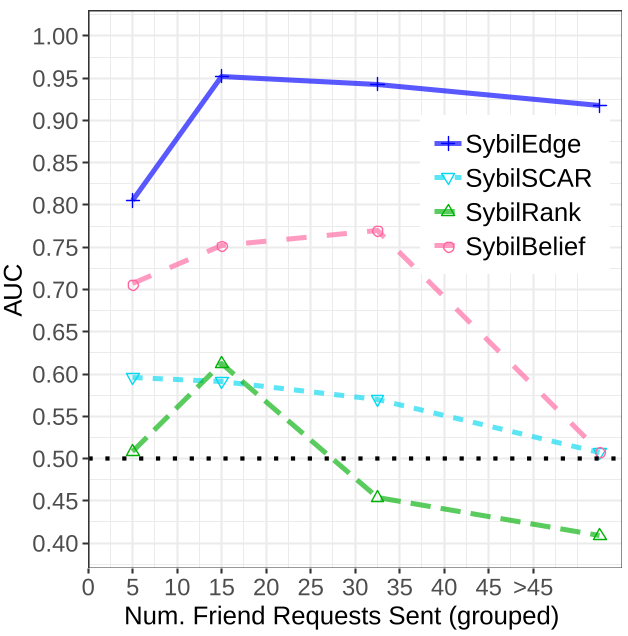 Figure: Performance of SybilEdge vs. benchmarks. Notice how traditional algorithms like SybilBelief actually drop in performance as fakes send more requests (to the right), while SybilEdge remains dominant.
Critical Insight: The "Real-but-Spammy" User
An interesting finding during the Facebook deployment was the "False Positive" category. Many users flagged as fakes by SybilEdge were actually real humans, but they were behaving in "spammy" ways—sending mass requests to people who didn't know them. While technically a false positive, detecting these "spammy" real users is often a desirable outcome for maintainers of platform integrity.
Conclusion
SybilEdge proves that early detection is possible without waiting for a graph to "mature." By harvesting the collective intelligence of how existing users respond to requests, we can build a highly sensitive "immune system" for social networks that identifies malicious actors before they have a chance to inflict harm.
Future Outlook: The logic of SybilEdge could likely be extended to other domains, such as detecting fraudulent sellers on marketplaces by analyzing the "selection" of items they list and the "response" (reviews/returns) from specific classes of buyers.