
Friend or Flood? Defending Opportunistic Networks via Social Trust
Friend or Flood? Social Prevention of Flooding Attacks in Mobile Opportunistic Networks
This paper introduces a social-network-based mitigation strategy for "flooding attacks" in mobile opportunistic networks. By integrating cryptographic signatures and social trust (friendship) into the Simple Social Network Routing (SSNR) protocol, the authors achieve significant drops in node downtime, for instance, reducing median offline time from 42.7% to 6.3% in dense datasets.
TL;DR
Mobile opportunistic networks rely on the kindness of strangers to "store-carry-and-forward" messages. However, this kindness is easily exploited by flooding attacks that drain device batteries. This paper presents a lightweight defense: only relay messages for your friends. By combining cryptographic signatures with social network topology, the authors demonstrate that they can reclaim network availability, reducing node "energy-death" time from 42% down to 6%.
The "Hypernova" Problem: Why Opportunistic Networks are Fragile
In an opportunistic network (like those used in disaster recovery or censorship-resistant communication), there is no fixed infrastructure. Your phone talks directly to another phone via Bluetooth. This creates a massive security hole:
- Lack of Accountability: It’s hard to verify who actually sent a message.
- Amplification: A single malicious node can inject a spoofed message that "tricks" every other node into copying and relaying it, exponentially wasting the collective battery life of the entire community.
Existing MANET (Mobile Ad-hoc Network) defenses often require constant connectivity or centralized authorities—luxuries that opportunistic networks simply don't have.
The Insight: Social Relations as a Firewall
The authors suggest that we shouldn't trust everyone. Instead, we should leverage the Social Graph. Most people use mobile devices to communicate within their social circles (Facebook friends, contact lists).
The Mechanism:
- Identity: Every node has a public/private key pair.
- Verification: When you encounter a node and receive a message, you check: Is the original sender in my local friends list?
- Signature: If yes, you verify the digital signature. If the signature is valid, you relay it; otherwise, you drop it.
This prevents a "stranger" (the attacker) from using your battery to amplify their flood. Even if an attacker "tricks" someone into being a friend, the system includes an Active Defense (ResistantBlocks): nodes track traffic per friend and blacklist anyone sending "3 standard deviations" above the average volume.
Methodology & Architecture
The authors evaluated their defense using three real-world mobility traces: SASSY (sensor-based), LocShare, and the famous Reality Mining dataset from MIT.
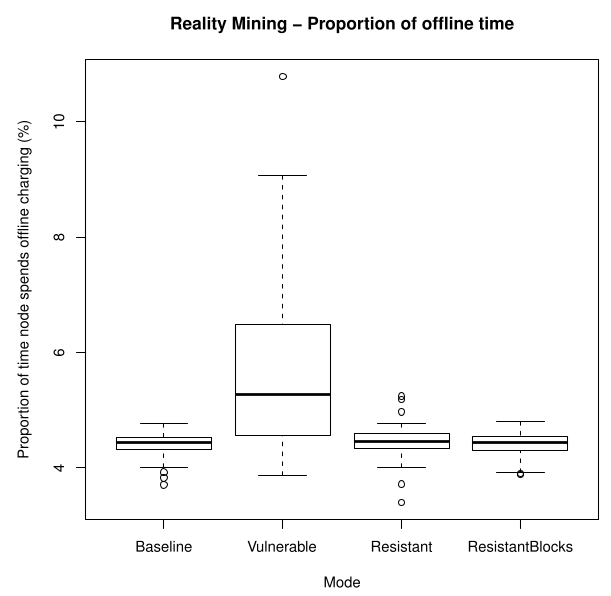 Fig 1: Impact of the attack and defense on the SASSY dataset. Note how "ResistantBlocks" brings the offline time nearly back to the baseline.
The Attack Model
The attacker is assumed to be capable of:
- Spoofing MAC addresses to bypass simple blacklists.
- Forging headers to make messages appear deliverable to anyone.
- Setting undeliverable destinations to ensure the message stays in the network indefinitely.
Experimental Results: Turning the Tide
The results confirm that flooding is a "battery killer." In the SASSY trace, nodes were forced to spend nearly half their time (42.7%) offline just to recharge because they were busy processing junk mail.
- Delivery Ratio: The attack crashed the delivery ratio from 98% to 82%.
- The Cure: Implementing the "ResistantBlocks" strategy restored the delivery ratio to 97.6%.
- Latency: The "Vulnerable" network doubled the delivery delay (from 3.3 to 6.5 hours). The social defense brought this back down to 3.5 hours.
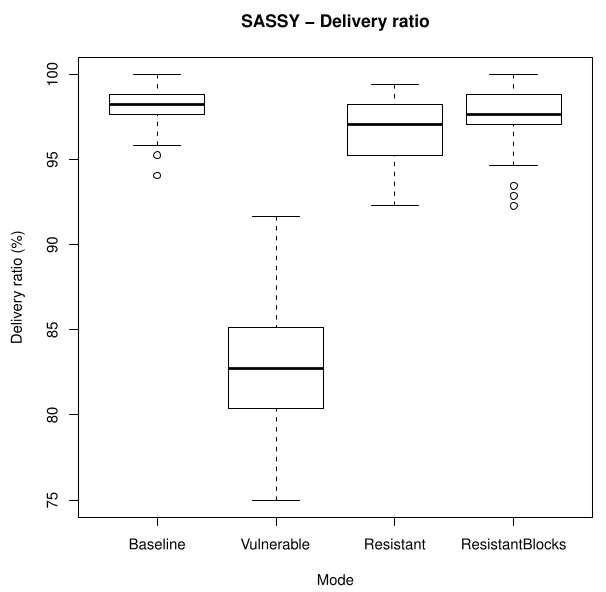 Fig 2: Comparison of Delivery Ratios. The defense (Resistant/ResistantBlocks) effectively negates the performance degradation caused by the flooding attack.
Critical Insight: The Cost of Security
While effective, this social defense isn't a "silver bullet." The authors honestly point out a major trade-off: The death of "Epidemic" communication. By requiring a friendship link to relay a message, the network can no longer support "emergency broadcasts" or "open content distribution" where you want messages to spread to everyone, regardless of social ties.
If we allow "stranger relaying," we open the door to flooding. If we don't, we limit the network's reach.
Conclusion
This work provides a pragmatic, decentralized solution to a "tragedy of the commons" problem in mobile networks. By using local knowledge and social trust, we can protect the finite resources of mobile users without needing a "Big Brother" server to police the network. Future research into "friends-of-friends" trust might eventually bridge the gap between strict social routing and open epidemic spreading.
Takeaway: In decentralized systems, your social graph isn't just for networking—it's your most robust security layer.