
IKA: Strategic Friend Recommendation to Maximize Influence on a Target User
Friend recommendation with a target user in social networking services
This paper introduces a target-oriented friend recommendation task and proposes the Incremental Katz Approximation (IKA) algorithm. Unlike traditional methods that focus on global similarity, IKA specifically suggests connections to maximize a source user's influence over a specific target user in a social network.
TL;DR
Standard social network suggestions tell you who you might know. This paper asks: what if you want to know someone specific? By proposing the Incremental Katz Approximation (IKA), the authors provide a way to recommend friends who act as strategic bridges, maximizing your visibility and influence over a specific target user while maintaining computational efficiency.
Problem & Motivation: Beyond "People You May Know"
Most recommendation engines in platforms like Facebook or LinkedIn are built on the "homophily" principle—suggesting users similar to you or within your immediate circle. However, these systems are passive. They do not help a user who has a specific goal, such as a job seeker wanting to be noticed by a recruiter or a creator wanting to reach a specific influencer.
The authors identify two main hurdles in solving this "Target-User Friend Recommendation":
- Metric Definition: How do we measure "Influence" in a way that reflects information flow?
- Scalability: Calculating influence (specifically Katz Centrality) usually requires matrix inversions, which are —impossible for modern social networks.
Methodology: The Core Mechanics
The paper models information propagation where posts flow from nodes to their neighbors. They define Influence as the ratio of articles a target receives from a source versus all other nodes.
To make this practical, the authors introduce the IKA Algorithm:
- Candidate Reduction: Instead of looking at every node in the graph, IKA limits the search to the source's two-hop neighbors, satisfying a "reluctance" threshold (ensuring you have at least one mutual friend).
- Monte-Carlo Approximation: Rather than solving heavy linear algebra, the system simulates "random walks" of information. It tracks how many "articles" reach the target.
- Incremental Updates: This is the "secret sauce." When a new connection is tested, IKA doesn't restart the simulation. It only calculates the additional diffusion paths created by that specific new edge.
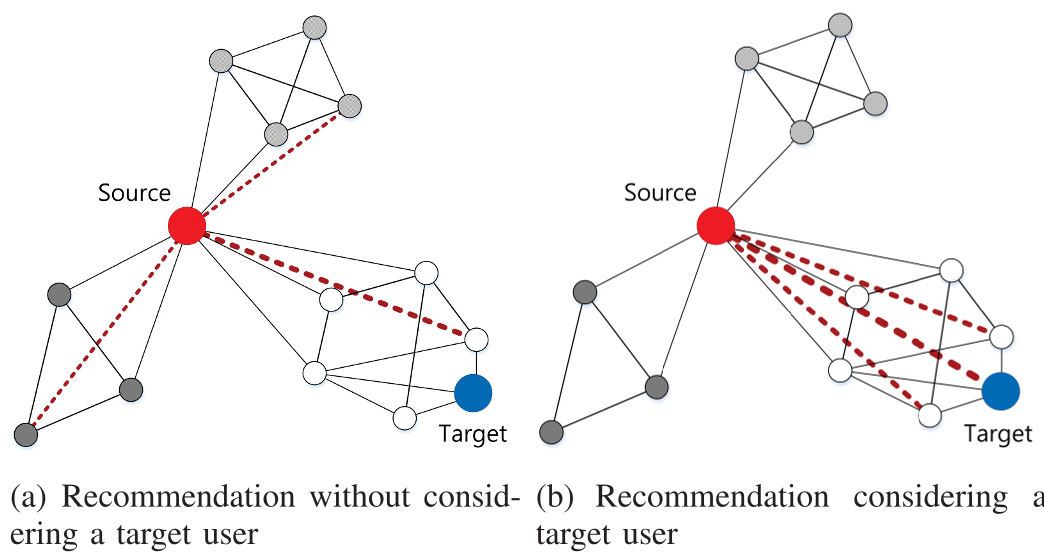 Fig 1: Traditional vs. Target-oriented recommendation concepts.
Experiments & Results
The authors tested IKA against standard topology-based algorithms (Jaccard, SimRank, etc.) on synthetic Scale-Free graphs.
Performance Breakthrough
IKA consistently found the "Bridge" nodes. In scenarios where the source was a leaf node and the target was a hub, IKA identified intermediate nodes that caused a "large leap" in influence. Basic similarity measures often failed to see these strategic connections because they look at shared history rather than future potential.
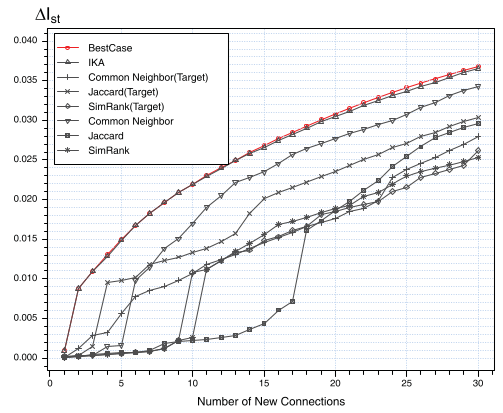 Fig 2: IKA (purple line) achieves significantly higher influence gain compared to topology-based baselines.
Efficiency and Scalability
By using the incremental Update, IKA maintained a near-flat running time growth compared to the exponential growth of exact greedy algorithms. This makes it a candidate for real-world deployment on larger graphs.
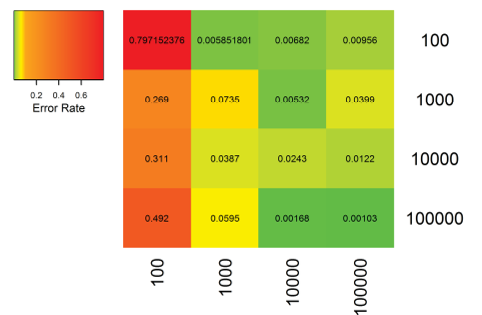 Fig 3: Running time comparison showing the efficiency of the IKA approach.
Critical Analysis & Conclusion
Takeaway
The IKA algorithm effectively bridges the gap between Information Diffusion theory and Recommender Systems. It proves that "strategic friending" can be calculated mathematically and efficiently.
Limitations
- User Acceptance: The model assumes that if the system recommends a friend, the user will add them and the information will flow. It doesn't fully account for the "human factor"—would the intermediate node actually share the source's content?
- Static Probability: The sharing probability () is treated as a constant, whereas in reality, it varies by content quality and relationship strength.
Future Outlook
The authors suggest extending this to Multiple Target Users, which would be a game-changer for digital marketing "micro-targeting" strategies. By identifying a handful of "bridge" friends, a brand could systematically maximize its footprint in a specific community.