
Friendbook: Beyond the Social Graph — Recommending Friends via Life Style Semantics
FRIENDBOOK: A SEMANTIC-BASED FRIEND RECOMMENDATION SYSTEM FOR SOCIAL NETWORKS
Friendbook is a semantic-based friend recommendation system that shifts the paradigm from social-graph-based matching to life-style-based matching. It utilizes smartphone sensors to extract high-level "life styles" from low-level activities using Latent Dirichlet Allocation (LDA) and a unique similarity metric to recommend friends with similar daily routines.
TL;DR
Existing social networks suggest friends based on "who you know" (social graphs), but Friendbook suggests friends based on "how you live" (life styles). By transforming smartphone sensor data into "life documents" and applying text-mining algorithms like LDA, this system finds potential friends who share your daily rhythms—whether you are a busy student or a late-night office worker.
Background: The Sociology of Friendship
Why do we become friends? Sociology identifies several pillars of attraction: shared habits, attitudes, and lifestyles usually rank higher than merely having mutual acquaintances. However, digital platforms have historically ignored the "life style" pillar because it is difficult to capture through clicks and likes. Friendbook bridges this gap by turning the smartphone in your pocket into a reality-sensing platform.
Problem & Motivation: The "Same Location" Blind Spot
The primary challenge in existing routine-based systems is granularity. Previous research relied heavily on GPS. If two people spend all day in a library, a GPS-based system assumes they have identical routines. In reality, one might be "studying" (sitting, typing) while the other is "working" (walking, shelving books).
Friendbook moves beyond location by using motion sensors (accelerometer and gyroscope) to identify fine-grained activities, creating a more robust "semantic" profile of the user.
Methodology: Daily Life as a "Document"
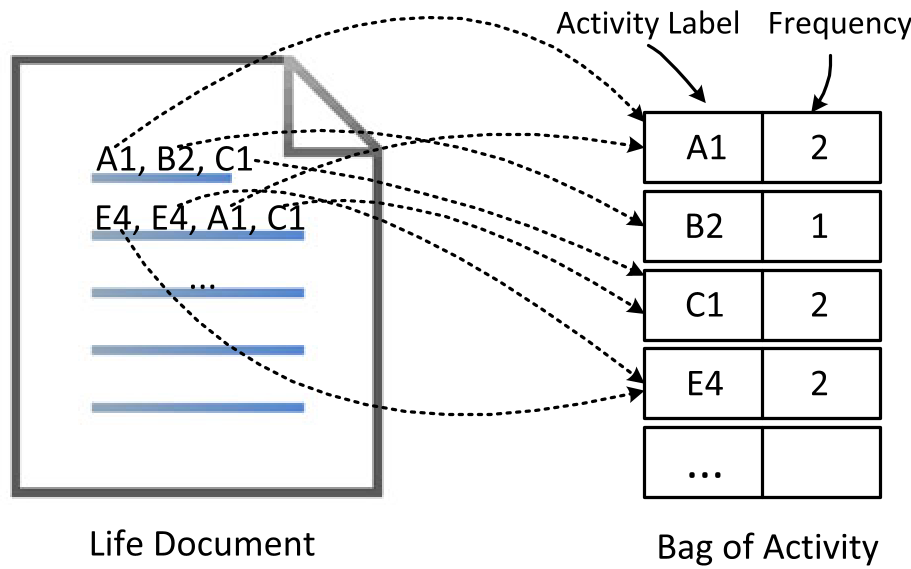
The core genius of Friendbook lies in its analogy to Natural Language Processing (NLP):
- Activities (Words): Low-level actions like walking, sitting, or standing.
- Life Styles (Topics): High-level abstractions like "Shopping" or "Office Work."
- Daily Life (Document): A mixture of various life styles.
The Architecture
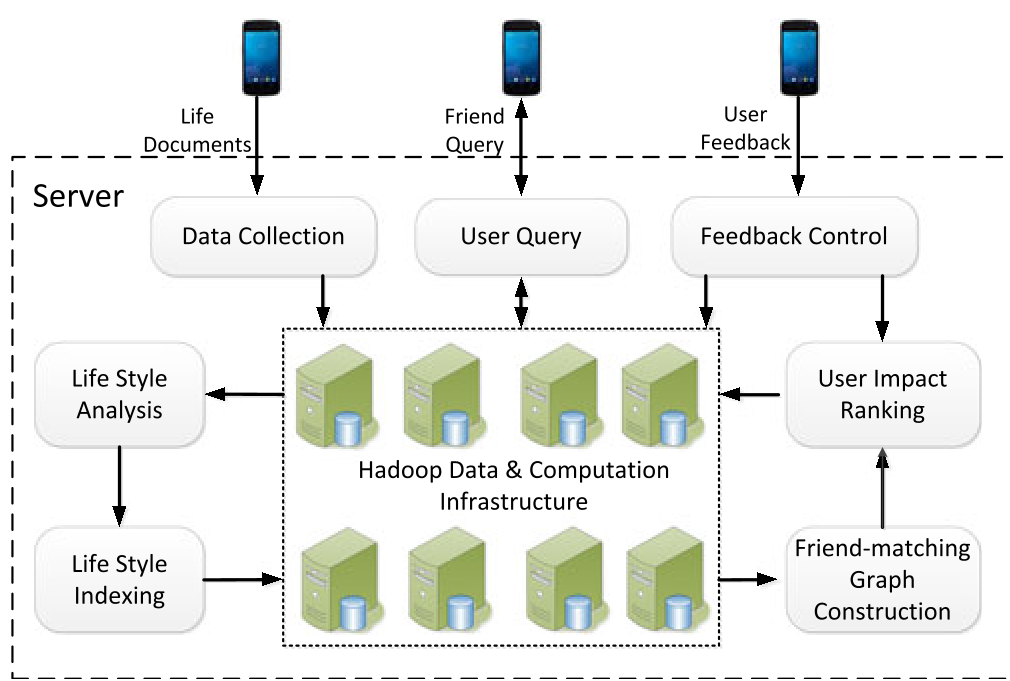
The system follows a client-server model. The smartphone handles real-time activity recognition to preserve privacy, while the server performs the heavy lifting of Life Style Analysis and Friend Matching.
Matching via LDA and Similarity Metrics
By applying Latent Dirichlet Allocation (LDA), the system decomposes the "Bag-of-Activities" into a Life Style Vector. To match users, the authors proposed a two-part similarity metric:
- Cosine Similarity: Measures the overall alignment of lifestyles.
- Dominant Overlap (): Focuses on the 1-2 lifestyles that define most of the user's day, ensuring that "core" habits match.
Experiments & Results: Real-World Validity
The authors validated Friendbook through a 3-month field study and a 1,000-user simulation.
1. Fine-Grained Activity Clusters
Using K-means (), the system successfully clustered noisy sensor data into meaningful activity categories, with standard deviation acting as the most representative feature.
2. SOTA Performance
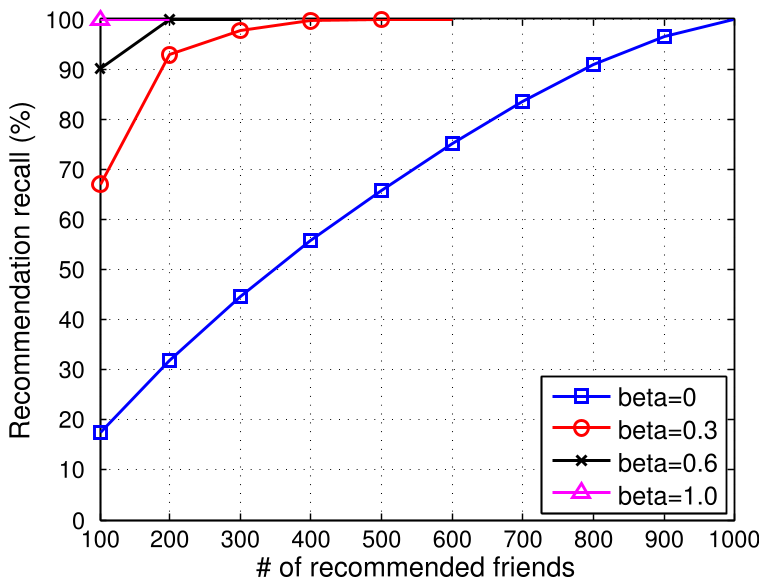
In simulations, the system achieved impressive Recall and Precision scores. A key finding was the balance between Similarity and Impact (Popularity). By adjusting the coefficient , users can choose whether they want to meet their "lifestyle twin" or a "lifestyle influencer" (someone with broad, high-impact connections).
3. Energy Efficiency
Crucial for any mobile app, Friendbook proved it could run for over 13 hours on a single charge while sensors were active—meeting the "full day" requirement for modern users.
Critical Analysis & Conclusion
Takeaway
Friendbook effectively demonstrates that our smartphones can "read" our lives. By abstracting raw sensor data into semantic life styles, it provides a much more intuitive basis for social connection than the current "friends of friends" model.
Limitations & Future Work
While the system is robust, it faces a cold-start problem: users must collect data for at least a day before receiving accurate recommendations. Current research into transfer learning might solve this by using pre-trained activity models. Furthermore, incorporating wearable data (like Fitbit or smartwatches) could provide even richer context, such as heart rate or sleep patterns, to further refine the "Life Document."
In an era where social media often feels disconnected from reality, Friendbook offers a path back to making friends based on who we actually are in our daily lives.