
FriendGroupVR: Can Virtual Reality Solve the Social Media Privacy Paradox?
FriendGroupVR: Design Concepts Using Virtual Reality to Organize Social Network Friends
This paper introduces FriendGroupVR, a system featuring two Virtual Reality (VR) design concepts—Pragmatic (card-sorting metaphor) and Playful (game-based metaphor)—aimed at organizing social network friend lists. The study demonstrates that both VR interfaces significantly outperform the traditional Facebook 2D interface in terms of usability and user experience.
TL;DR
Managing friend lists on social media is a chore that most users avoid, leading to serious privacy leaks. FriendGroupVR moves this tedious task into Virtual Reality. By testing a "Pragmatic" office-style sorter and a "Playful" can-knockdown game against the standard Facebook UI, researchers found that VR significantly boosts usability and motivation, though making the task too much of a game might lead to more mistakes.
Background: The Fatigue of Privacy
We only perceive about 27% of our actual audience when we post online. While "Friend Lists" allow for fine-grained privacy, the mental effort to group hundreds of people is so high that most users simply give up. This is a classic usability failure: the tools exist, but the friction is too high. FriendGroupVR asks: can spatial metaphors and immersion turn a boring administrative task into something users actually want to do?
Methodology: Two Paths to Organization
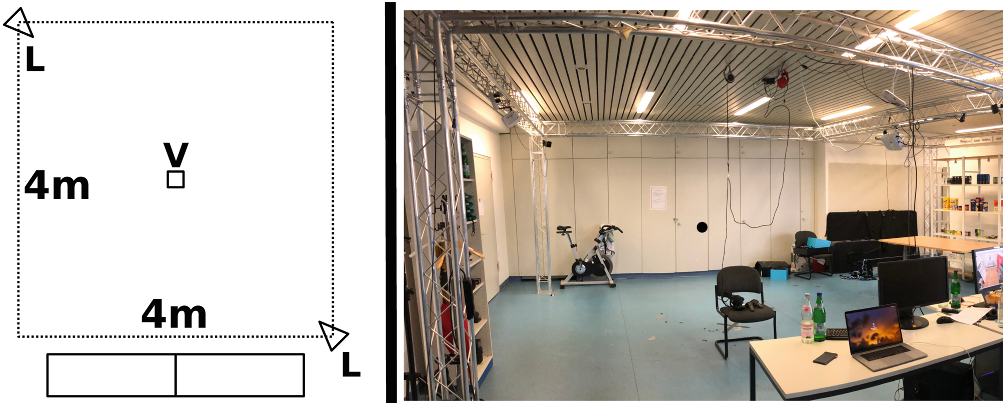
The researchers developed two distinct VR environments using the HTC Vive and Unity:
1. The Pragmatic Design (The Digital Office)
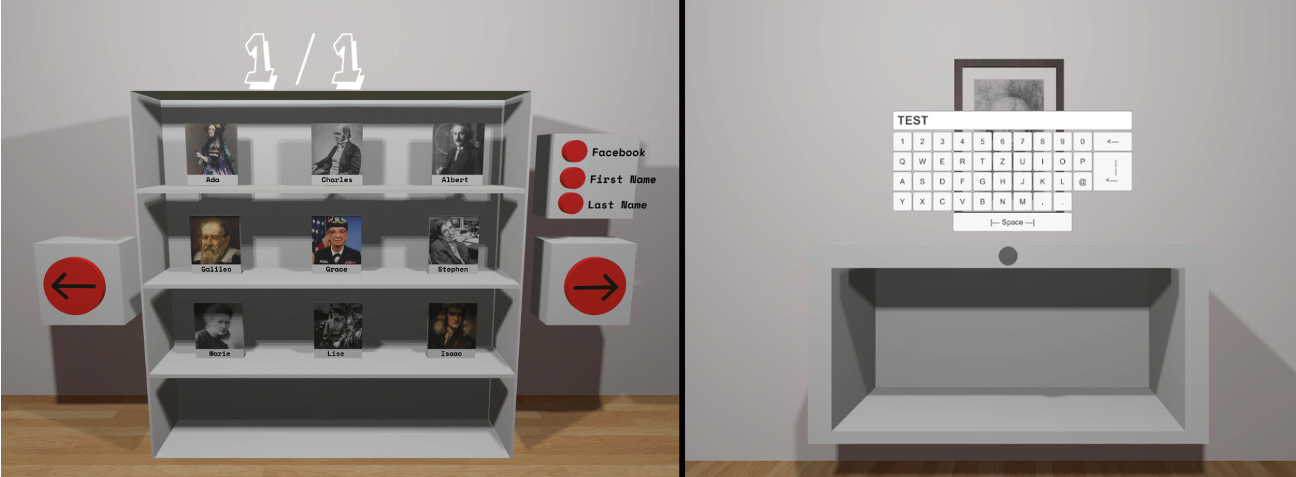
This interface adopts the Card Sorting metaphor. Friends are represented as 3D frames in a bookshelf. Users physically grab a "friend frame" and drop it into "list boxes" (e.g., Family, Work). It’s clean, intuitive, and leverages spatial memory—you remember where you put the "Work" box.
2. The Playful Design (The Can-Knockdown Game)
This design gamifies the process. Friend lists are stacks of cans. Each friend is a ball dispatched toward the user. The user must use a bat to hit the ball into the correct stack. It includes high scores, "bonus balls," and different bat difficulties to keep the user engaged.
Experiments & Results: Play vs. Productivity
The study compared these two VR worlds against the standard Facebook desktop UI.
- Usability Winner: The Pragmatic VR design was the clear winner, scoring nearly perfect on the System Usability Scale. Interestingly, users found it even more usable than the Facebook UI they have used for years.
- Engagement Winner: The Playful design was rated as the most "stimulating" and "fun." However, it had a catch: the error rate (missing friends or putting them in the wrong group) jumped significantly.
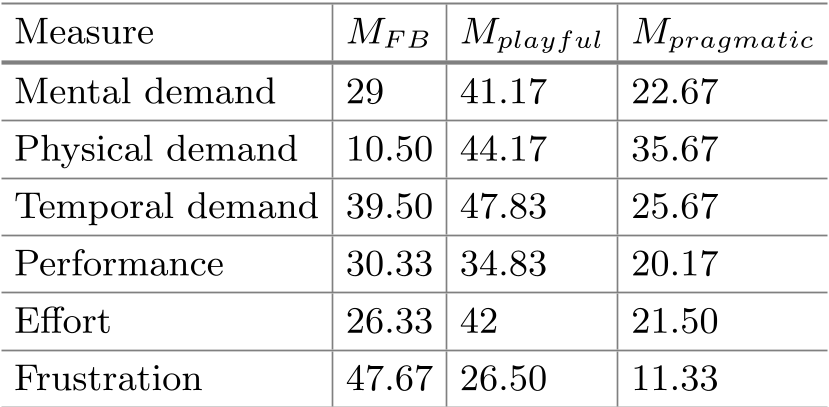
- The Frustration Gap: Frustration was highest on the Facebook UI (47.67) and lowest in Pragmatic VR (11.33). This highlights that while 2D interfaces are "fast," they are emotionally draining for organizational tasks.
Performance Comparison Data
| Measure | Playful VR | Pragmatic VR | |
|---|---|---|---|
| Usability (PQ) | -0.15 | 0.61 | 1.99 |
| Fun Score | 1.57 | 4.77 | 4.57 |
| Error Rate | 8.50 | 11.93 | 7.60 |
Critical Insight: The "Goldilocks" of Gamification
The study reveals a critical lesson for VR developers: Over-gamification can be counter-productive. While the can-knockdown game was fun, the "temporal demand" (pressure to hit the ball) and the "physical demand" led users to make more mistakes.
The Pragmatic VR design succeeded because it reduced the "cognitive friction" of 2D clicking without adding the "distraction friction" of a complex game. It made the task feel more like physical organization—something humans are evolutionarily better at than navigating nested menus.
Conclusion & Future Outlook
FriendGroupVR proves that spatial computing can transform mundane data management into an enjoyable experience. As VR headsets become more common, moving "admin tasks" from social media into 3D environments could be the key to fixing our broken privacy habits. The future isn't necessarily a game; it's a well-designed, immersive workspace that respects the user's focus.
Limitations: The study was conducted in a lab with the HTC Vive. Real-world adoption depends on the friction of putting on a headset versus just clicking a mouse, a gap that "Mixed Reality" (MR) might eventually bridge.